Before I begin this week's report, I must very sadly convey news of the passing of Jon Delf. Originally from Kent, Jon lived more recently in Cheshire where his skills as an entomologist were employed by Liverpool Hope University. Well known to the Shropshire entomological community, for several years he appeared regularly at Shropshire Invertebrate Group meetings and Shropshire & Worcestershire Entomology Days. I last saw him in October 2025 at the AES Exhibition at Kempton Park Racecourse, where he was in good spirits despite his medical issues. A very sad loss.
This week’s trip was a return visit to Longden Road Cemetery, specifically the ‘old’ part of it, which is maintained rather magnificently as a space for wildlife.
 |
| photo: Keith Fowler |
Continuing a theme which began in Clun a few weeks ago, it contains the grave of a notable Shropshire author, this time Mary Webb.
 |
| photo: Keith Fowler |
The predominant habitat within the cemetery must be the flower-rich grassland, which was looking splendid in the June sunshine.
So it was not surprising that grassland species featured heavily in our finds. Here is the first, a Common Green Grasshopper, something which we observed as 3rd instar nymphs a fortnight ago at White Grit Meadows and 4th (final) instar nymphs last week in the Ceri Forest. Now, right on cue, we were surrounded by adults, the males singing en masse when the sun shone.
Several grassland shieldbugs were found. Here is the first, a Small Grass Shieldbug, which is always a noteworthy find.
But it was upstaged almost immediately by this rather tiny nymph, which is that of a Turtle Bug, a species which has moved into the county in only the last few years and is still only otherwise known from a handful of sites in the southeast of it.
From turtles to tortoises – a boldly marked Tortoise Bug. This is another grassland shieldbug, which was unknown in Shropshire until a decade or so ago. It then went through a phase of being very commonly found but it feels like we have seen considerably fewer of them in recent times, so it was pleasing to find them as perhaps the commonest shieldbug species here.
And yet another recent incomer – this is a Crucifer Shieldbug nymph.
Now a species which has always been very common, but no less lovely for that: Hairy (or Sloe) Shieldbug.
Staying with the Hemiptera, this tiny hopper is
Delphacinus mesomelas, a species of dry grassland, where it feeds on fescues.
The grassland itself was, unsurprisingly, full of interest to our botanist. Here are a couple of its components. Firstly Tor Grass,
Brachypodium pinnatum agg.
 |
| photo: John Martin |
And this is Grey Sedge,
Carex divulsa (I admit that it’s a sedge, not a grass!).
 |
| photo: John Martin |
Returning to invertebrates sitting in daisies, this is a male
Bombus vestalis, the Vestal Cuckoo Bee, who’s name gives a clue as to the species’ habits. Cuckoo bees invade the nests of ‘true’ bumblebees, ejecting the queen and appropriating her workers to raise their own offspring.
A smart ground beetle,
Pterostichus madidus, attracted the attention of a photographer.
 |
| photo: Nigel Cane-Honeysett |
As did another beetle, this one not a grassland species. It is
Ochina ptinoides, the Ivy Boring Beetle.
 |
| photo: Nigel Cane-Honeysett |
“The Boy” (a nickname who's origins are lost in the mists of time, and which may be female) was vacuumed from the grass. More correctly it is
Callitula pyrrhogaster, a tiny, parasitic wasp.
Here, continuing an unexpected series, are two species of mite which have admitted to identifications. The first
Erythraeus phalangoides,
 |
| photo: Nigel Cane-Honeysett |
While the second is
Leptus trimaculatus.
 |
| photo: Nigel Cane-Honeysett |
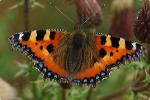
More familiar species were observed as the day continued. A Small Tortoiseshell, a species seen in smaller numbers these days that in times past, stopped to have its portrait captured.
 |
| photo: John Martin |
The first Ringlet of the Summer appeared.
 |
| photo: John Martin |
Yellow Shells were often to be seen escaping from Ivy and shrubs when they attracted the attention of the beating stick and tray.
 |
| photo: Keith Fowler |
A sparkling green weevil,
Polydrusus Formosus, demanded to be photographed.
 |
| photo: Nigel Cane-Honeysett |
Late in the day, another weevil, the Alfalfa Weevil,
Hypera postica, was vacuumed from long grass.
Two spiders were photographed:
Harpactea hombergi |
| photo: Nigel Cane-Honeysett |
And a female
Neottiura bimaculata, carrying her improbably large egg-sac.
 |
| photo: Nigel Cane-Honeysett |
Sawflies are often seen but less often identified. Obsidentify claims this one is
Tenthredopsis scutellaris.
 |
| photo: Nigel Cane-Honeysett |
Near the end the day,
Dioctria baumhaueri, a species of robberfly, was captured and identified.
Another late find was the micro moth (really very micro indeed!)
Bucculatrix thoracella. Its common name is variously Lime Tuft or Lime Bent-wing and it was indeed beaten from a large lime tree.
Blastobasis lacticolella, the Large Pale Masoner, was another micro moth identified on the day.
 |
| photo: Nigel Cane-Honeysett |
Two more plants drew the attention of our botanist. The rather delicate
Campanula persicifolia |
| photo: John Martin |
And the rather less delicate
Bergenia x schmidtii.
 |
| photo: John Martin |
And finally…. The day produced another snakefly! We have been more than usually blessed with them this year. It is a different species, too, than either of those which appeared at The Isle on 20th May, being a female
Atlantoraphidia maculicollis.
An excellent day. We are always grateful to be allowed to visit this brilliantly managed burial ground.


 Posts
Posts











No comments:
Post a Comment
Please feel free to comment on this post...