Wednesday 10th August 2022, Pollardine Farm
It was pretty hot when we met at the car park for this exploration of Pollardine Farm.
And it got hotter and hotter throughout the day.
I’ll try not to mention the heat again …
But it did dampen our enthusiasm for searching a little as the desire to find shade took over.
 |
| Photograph: David Williams |
Pollardine Farm is large, far too large to expect to be able to do it justice in a single survey.
In view of the heat I decided that we should target a few areas of varied habitat that were not too distant from the car park and did not involve much climbing.
Oops! I just realised I have mentioned the heat again.
Sorry!
It is not just us that have been struggling over the past few days.
Having gathered in the car park the inevitable question was asked, “Which way shall we go?”
Bravely, I pointed out a gate through which I wanted to proceed.
Needless to say I was ignored as everyone wandered off in almost the opposite direction to investigate some grassland that fell away to a stream.
After taking the above photograph I turned around to take a photograph that would show how far we had progressed.
As you can see, not very far.
But everyone seemed to be content in that area looking for whatever they could find, which included this inconspicuous ladybird, Nephus redtenbacheri.
 |
| Photograph: David Williams |
For a while a Red kite kept us company.
 |
| Photograph: John Martin |
Until it was chased away by a pair of Ravens.
 |
| Photograph: John Martin |
Ravens dominated the skies for most of the day. We heard their raucous calls frequently and watched as they frolicked in the skies above the woodland at the base of the hill to the left in the first photograph. At one time 27 were observed.
Keeping with the aerial theme. Our man with the very long tripod gained permission from the owners to use it over the farm. He wandered off to make use of this opportunity. Here are a couple of the photographs he took of the farm and surrounding countryside.
 |
| Photograph: Bob Kemp |
 |
| Photograph: Bob Kemp |
You can see from the colour of the grasslands how parched the ground was following the extended period without rain we have just experienced.
By now I had abandoned any thought of taking the route I had indicated when asked that inevitable question at the start of the visit. But I did sugges another area to visit.
This time everyone agreed that it was a good idea.
We made our way towards a pool.
On the way we searched the trees and vegetation at the side of the field through which we were progressing. Among the finds was the larva of a Spectacle moth.
Eventually, but in time for lunch, we arrived at the pool, which is where the photograph at the start of this report was taken.
Lunch was taken at the edge of the pool. We became quite scattered as we sought out any small patches of shade the vegetation provided. Some of these patches were very close to the water’s edge so great care had to be taken not to overbalance and tumble in.
Our aerial adventurer took this photograph of the pool.
 |
| Photograph: Bob Kemp |
Whilst those of us with our feet on the ground had this view.
For a short while we were treated to the sight of a number of swallows and house martins swooping down to the water’s surface to take insects.
A Blue-tailed damselfly was seen resting on the poolside vegetation.
 |
| Photograph: John Lyden |
Time to move on.
Getting up to the pool had involved trampling through long grass, We needed an easier route down. Thankfully, there was a track that led to a gate which appeared, from the pool, to give access onto the road.
We took the track.
Unfortunately the gate did not lead onto the road!
It led into another field.
Thankfully the track continued, and so did we.
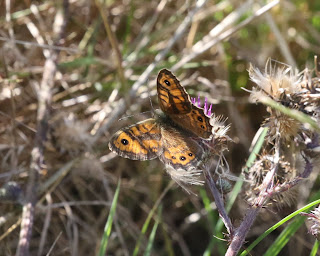
And what a stroke of good fortune this turned out to be as, on reaching a gate that did lead onto the road, we spotted a Wall butterfly patrolling the vegetation.
 |
| Photograph: John Martin |
Crossing the road we made our way across a grassland to a field that bordered a woodland and stream.
The ground in this field proved quite difficult to negotiate but we made it to the shade of a large oak tree under which we set up camp, happy to be sheltered from the sun.
Beating the lower branches of the tree dislodged the nymph of a Bronze shieldbug.
 |
| Photograph: David Williams |
Some of the group stayed put, whilst others set off to and across the stream to investigate what was on the other side. They were rewarded with the sight of a striking hoverfly Chrysotoxum bicinctum;
 |
| Photograph: David Williams |
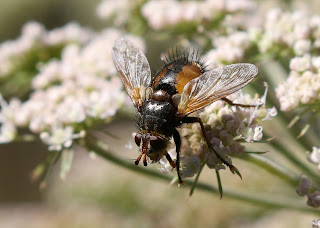
And a large tachinid fly, Tachina fera.
 |
| Photograph: John Martin |
Back at the oak we rested, had some refreshments and took in the view of the ridge of The Stiperstones from the shade of the tree.
Someone had noticed that the edge of the field provided easier walking, so we made our way back, slowly, to the car park via this route.
My thanks to the owners of the farm for allowing us to do what we enjoy doing and to the photographers for providing their excellent images.
Scotch argus
As implied by the name this butterfly's home is Scotland but there are a few colonies south of the border in the Lake District. The opportunity to see one was not to be missed.
Three of us travelled to Smardale Gill in Cumbria on the day following our visit to Pollardine Farm. The journey there was far from smooth as there were several delays on the way. But we got there in the end.
By the time we had walked to the edge of the site, along a disused railway track, it was mid-afternoon. However we were greeted by a few individual butterflies. These were very flighty and it was difficult to get a good enough sighting to satisfy me that they were Scotch argus.
We crossed the viaduct pausing to look at the valley below.
Wandering further along the track we came across numerous butterflies that looked the part but none settled for long enough to get a good view.
Then we spotted one on the ground that was not moving. Unfortunately it was dead, but we were able to get a good look at it.
There was no obvious damage to the butterfly so we do not know what caused its demise.
As the day wore on we saw more and more Scotch argus.
And they became very friendly!
On trousers.
 |
| Photograph: Bob Kemp |
On finger.
On face.
 |
| Photograph: Bob Kemp |
 |
| Photograph: Bob kemp |
What an experience!


 At this point there was a rare appearance by a mammal (other than a
human), who came in, had a look at us, decided they didn’t particularly approve of us and legged it again…


 Posts