Wednesday 15th July 2026, Llynclys Hill
Holidays and rival field trips reduced the
number of participants this week, and the continuing hot weather provoked an
earlier than usual finish for those who did make it to Llynclys.
The first task for the small band of attendees
was to decide which part of this large site should be the focus of our
investigations. |
| photo: Nigel Cane-Honeysett |
We decided upon Ant-hill Meadow, an area in which a lot of
scrub clearance work has recently been undertaken. Reaching it involved a walk
along a wooded path which provided some welcome shade. The most striking
feature of this woodland was the extensive carpet of Dog’s Mercury under the
trees, all of it laid flat and wilted due to the heat and dryness.
Arriving in the meadow, the grass was
predictably dry and parched.
Despite this, butterflies were numerous, the
most numerous of the lot being Gatekeepers
Others present in good numbers included Meadow
Browns and Ringlets, various whites and a couple of Common Blues
For some time it seemed that we might have a
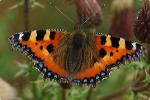
rare, Painted Lady-free day. But no, one materialised on the knapweed.
Among the other, larger and more conspicuous
invertebrates, multiple Common Green Grasshoppers could be heard (this one is a
‘brown form’ male).
Plus similarly abundant Field Grasshoppers.
Common Greens prefer a damper, more humid microclimate
than other common grasshopper species, which makes me wonder how they will fare
in the long term. There is already anecdotal evidence of their decline in
southern England as summers become warmer and drier. On the other hand, Field
Grasshoppers like it dry and hot. They must be loving it!
Our attention turned to the smaller
invertebrates. We start with a parasitised aphid, found on oak. These identifications
are a bit tentative, but the aphid may be
Tuberculatus
querceus and its parasite a Praon species,
possibly flavinode.
 |
| photo: John Lyden |
Two micro moths were found here, both recorded rather
infrequently. First we have the Hypericum Neb,
Oxypteryx
atrella (classified as ‘local’). It feeds on
St John’s Wort, of which there was plenty in the meadow.
 |
| photo: John Lyden |
Whilst this is Hellinsia osteodactylus, the Small Goldenrod
Plume (‘Uncommon’).
 |
| photo: John Lyden |
Still with moths, though somewhat bigger, we were pleased to see a
couple of Six-spot Burnets on the wing.
We move on to bugs. This year has seen an increase in the number of
Tortoise Bugs that we have encountered and today was no exception. Here is an adult,
swept from the vegetation. |
| photo: Nigel Cane-Honeysett |
Several spiders were also photographed. The familiar Garden Spider,
Araneus diadematus |
| photo: Nigel Cane-Honeysett |
The Buzzing Spider,
Anyphaena accentuata |
| photo: Nigel Cane-Honeysett |
Finally a jumping spider,
Evarcha falcata. |
| photo: Nigel Cane-Honeysett |
Time for lunch, taken in the shade of a handily placed tree. While
we ate, we contemplated several hawker dragonflies which circled relentlessly
over us. I attempted photos but was utterly defeated by them, so their
identities will remain mysterious. A Hummingbird Hawkmoth also zipped about in
front of us for a while and proved similarly impossible to photograph. Lunch
over, the keenest member of the group headed off into the quarries. The rest of
us dallied, mostly, I think, due to my ongoing but fruitless photography
efforts. Our minds were eventually returned to the task in hand by a message
from our advanced party – Silver-washed Fritillaries in Upper Butcher’s Quarry!
Off we hurried (well, staggered slowly upwards in the heat). Some minor directional confusion in the trees notwithstanding, the quarries were ultimately achieved.
Good and less good news followed. The good news? The butterflies were putting
on a fine display. The less good news: it seemed to be about 10 degrees hotter
in there, the sun beating directly into the rocky amphitheatre. We soon
flagged, but did get some fine views of the fritillariesAt some point a couple of particularly long-legged harvestman species appeared and were photographed: Leiobunum rotundum...
 |
| photo: Nigel Cane-Honeysett |
...and
Opilio canestrinii.
 |
| photo: Nigel Cane-Honeysett |
The trees produced several Tree Damsel bugs, both female...
 |
| photo: Nigel Cane-Honeysett |
...and male
 |
| photo: Nigel Cane-Honeysett |
Some more vacuuming was done but before long an
unspoken group lethargy became universal and the day drew to a rather premature,
but hot, close. Rather than slog back uphill, we exited downwards through Lower
Butcher’s Quarry. Here, Meadow Grasshoppers were present in numbers, along with
Fragrant Orchids and one of the twayblades.
The day’s
third micro moth of note also appeared here, Nemophora minimella, the Small
Scabious Longhorn (‘Rare’), helpfully sitting on its larval foodplant (Devil's-
bit Scabious). Llynclys Common is the only known Shropshire site for this moth,
with three records, all this century. |
| Small Scabious Longhorn. Photo: John Lyden |
From here, our route took us out onto the road and back to the
parking spot. A shortened, but enjoyable day. Thanks to Shropshire Wildlife
Trust for allowing us to survey this varied nature reserve.
Photographs © the author except as noted.


 Posts
Posts