Showing posts with label "Up. Show all posts

24 Sept 2019

Up, up and away ... again!

Pendeford Mill Nature Reserve, Wednesday 18th September 2019

How can we have been up, up and away again?

Pendeford Mill Nature Reserve whilst not as flat as a pancake is not remotely hilly, so how can we have had to go up?

Read on, all will be revealed.

This was our second out of the county experience of the season as we popped just over the Shropshire - Staffordshire border to visit this reserve a little south west of junction 2 of the M54. The reserve is owned and managed by Wolverhampton City Council. Soon after arriving we met the warden and his assistant who welcomed us to the site.

As always, having met in the car park, we took some time to get ready for the day ahead. One member got fed up of waiting and went off to explore the reserve's huge compost heap.
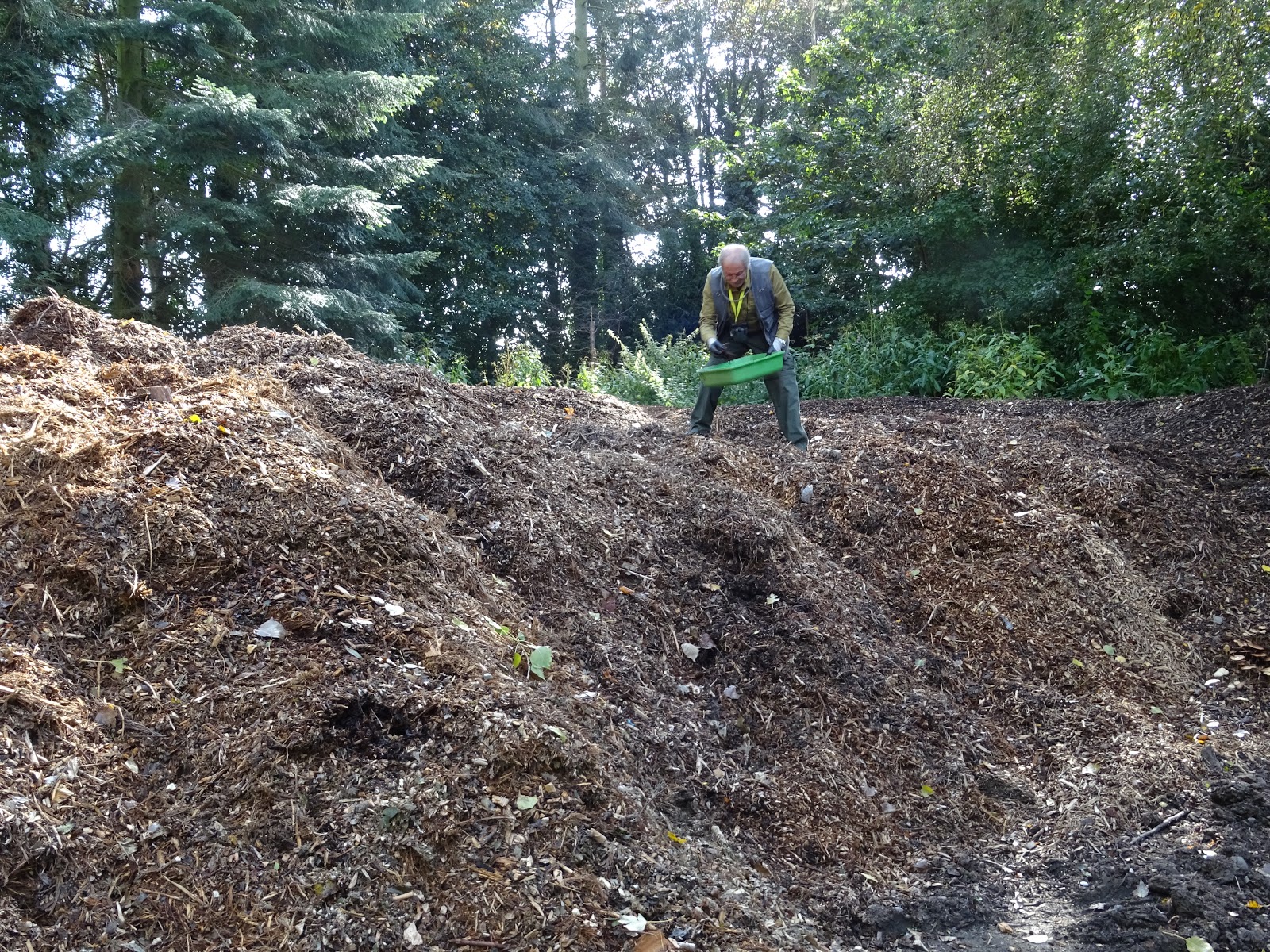

What was he looking for?

Pseudoscorpions. These are tiny arachnids that look a bit like a scorpion but without the tail that contains the sting. Most of the species are less than 3mm long; searching for them is like looking for a needle in a haystack, but needles are much bigger.

Did he find one?

No.

When everyone was ready we moved away from the car park and along the side of a woodland.

Peeping around the edge of an oak leaf was a forest bug.

Photograph: David Williams
And resting on another oak leaf was a hoverfly, Myathropa florea.


On the other side of the track in a small copse by a field hedge we spotted a spindle with its characteristic pink fruits.

Photograph: David Williams
The warden's assistant presented us with two fungi that she had found. The first was a velvet shield, Pluteus umbrosus.

Photograph: Bob Kemp
Turning the fungus over you can see distinctively coloured gill edges.

Photograph: Bob Kemp
The second was an eathstar.

Photograph: Bob Kemp
One of the highlights of the reserve is an ancient yew which, it is claimed, is about 2000 years old. Here it is.


I do not know how they aged the tree but it is an impressive sight which, unfortunately, is not that evident from this photograph. We can only imagine what events it must have witnessed over its lifespan - it certainly puts our short time into perspective.

Accompanying us as we walked alongside the wood was a speckled wood butterfly which had clearly seen better days, but it was soldiering on.


At long last we were coming to the end of this initial track at the side of the wood and we reached the pool.

Photograph: David Williams
At the corner where the track we had been following met the lake there were some bird feeders. A great tit was pleased to receive some free nourishment from this fast food restaurant.


We made our way along the grassy path following the eastern edge of the pool.


A green shield bug and a sepsid fly were spotted on a clump of nettles.

Photograph: David Williams
And a little later the large mirid bug Pantilius tunicatus which is usually found at this time of the year on alder, hazel and birch. On this occasion it was sunbathing on a bramble leaf.

Photograph: David Williams
On the subject of bramble we noticed this peculiar growth on a leaf:


Was it a gall?

I do not think so, it looks like a hazel catkin, or similar, that has just happened to find a hole in the leaf and poked through.

Galls were found, however, on an oak. Here is one of them, a Ramshorn gall, so called because of its shape. The gall is caused by a gall wasp Andricus aries.


Other finds along this stretch of the path were a lily beetle:

Photograph: David Williams
And a female common earwig.

Photograph: David Williams
The shape of the "pincers" at the end of the tip of the abdomen are used to distinguish the sexes. The female's are fairly straight as can be seen from above, but are curved in almost a semicircle in the males.

Time was marching on and we were nowhere near our chosen spot for lunch - the remains of the mill after which the site is named. We needed to get a move on!

We turned off the grassy path into some woodland at the end of the pool. The abundance of yews here caused some to pause to search for a rare spider whose name I cannot remember. It remains rare as we did not find it.

The route again took us past the edge of the pool


Pausing at some poolside vegetation we saw the large hoverfly Volucella inanis. Unfortunately it was too flighty for us to photograph but we did manage to snap a rather more slow moving creature, a weevil, which we believe is Rhinocus pericarpius.

Photograph: John Martin
After this stop we made our way to the lunch spot at top speed (for us).


Refreshed we looked at the remains of the mill.


Clear as day?

Fortunately there was an information board close by to explain what we were looking at.


In case you cannot read what it says, here is a transcription: "This was an overshot mill, meaning water fell onto the wheel in order for it to turn. It is believed that the mill would have served local farms for the grinding of their corn for flour. Some of the water from the mill also fed into the large pool in the wooded area of the reserve."

Nearby were the remains of a well:


Again there was an information board which stated "This well was fed from water overflowing from the Mill pool through a pipe under the ground. When the well became full this would overflow into the small ponds in front of you. Water would have been drawn from the well by means of a hand pump mounted on top. This well could have supplied the stables and pigsties adjacent to the mill."

We continued on the path from the mill site around a small wooded area. At this point one of the group told us that he had got permission from the warden to fly his drone and take some aerial photographs. As he was going to do this in the first area we had visited he took his leave. We would have to wait to see the results.

An alder spittle bug, Aphropohora alni, was found close to the mill remains. It posed nicely for a photograph.

Photograph: David Williams
Nearby a hoverfly, Eristalis pertinax was relaxed enough to be snapped.


The River Penk was crossed using the footbridge rather than the ford.


This brought us to a meadow. Realising how warm it had got we had to stop, for some to enjoy the late summer sunshine and heat, and others to search the area.


A couple of interesting finds were made. The first was a small red beetle that is a member of the ladybird family. Not one of the larger species with which we are generally fairly familiar, but one of the what are known as the "inconspicuous ladybirds". This one is Coccidula rufa.

Photograph: David Williams
The second were a pair of pale tortoise bug, Cassida flaveola.

Photograph: David Williams
Time was pressing on and a return to the cars beckoned. The path on the west side of the pool was taken but this turned out to be rather less interesting as we progressed mainly in shadow from trees. At the end of the pool we paused on the platform to look out over the expanse of water.

Well one or two did, others were more interested in the vegetation that surrounded the platform.


As we passed the yew on our way back several members of the group paid homage to the tree.


Actually when I got closer I noticed that they were measuring its girth. 200 inches I seem to remember was the result of the measurement. I know that girth is important in aging oak trees but I have no idea if this is significant for yew trees.

From here we returned to the car park.

But what of our drone pilot?

Had he managed to get his machine to fly and take photographs?

Yes he had.

First here is a photograph up above the north end of the pool - the platform we were on can be seen at the top of the photograph.

Photograph: Bob Kemp
And a second up above the southern end.

Photograph: Bob Kemp
Having taken the photographs and safely landed his drone he went away to his home.

So did the rest of us.

Another lovely day in an interesting site.

My thanks to Wolverhampton City Council for giving us permission to visit the site and do what we enjoy doing. My thanks also to the photographers David Williams, Bob Kemp and John Martin for the use use of their excellent photographs.

17 Sept 2019

Up, up and away

Linley Estate, Wednesday 11th September 2019

The Linley estate lies to the south (and slightly west) of the Stiperstones extending roughly from Black Rhadley Hill to More. The estate encompasses upland grassland, woodland, farmland, parkland and several pools. The River West Onny runs through the site.

A dozen of us met in the car park on a grey and damp morning. The forecast promised that the rain would move away quickly and be replaced by sunny periods.

So it proved but the wet conditions lingered longer than the forecast implied. Still, after recent very wet Wednesdays a bit a moisture in the air and on the ground was not going to deter us.

As Linley is such a big site where do you start?

The car park was in some woodland close to the main pool so that seemed a good place to begin.


A lane runs alongside the pool and we followed this towards a more open area of grassland that bordered the river.


The local tiger checked us out.


The tiger soon got bored and wandered off to visit other parts of its domain.

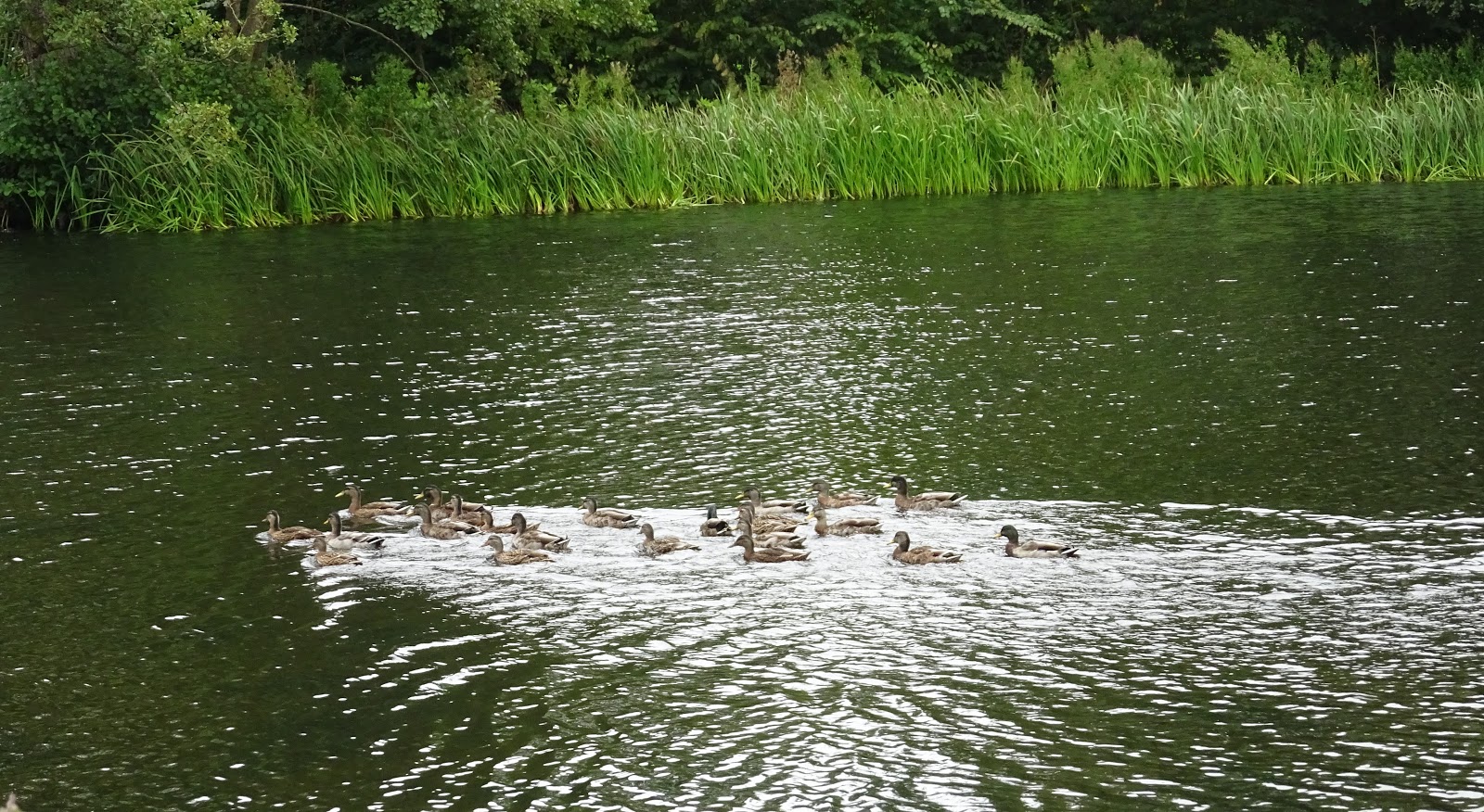
We met a lady who was interested in what we were doing. After a brief chat she told us that one of her jobs was to feed the ducks and swans and she started making duck sounds as she walked along the lane. She was answered by a cacophony of "quacks" as the ducks got very excited and started moving en masse to the feeding station.


The swans remained stoically where they were as though it was below them to be seen accepting free food.

Whilst all this was going on we did have some early successes in our search for invertebrates that we could identify:

A green shieldbug, Palomena prasina:

Photograph: David Williams
And a colourful spider, Diaea dorsata.

Photograph: David Williams
At the end of the pool, on both sides of the lane, was some uncultivated land that boasted all sorts of the types of wild flowers gardeners would regard as weeds. These were a magnet for us as we often find more variety of wildlife in these areas rather than pristine habitat.

In amongst these wildflowers we found a member of the daisy family - shaggy soldier, Galinsoga quadriradiata.

Photograph: John Martin
A patch of willowherb was being inspected by a number of the group who were looking for bees and other insects. All was going well until I blundered in with my net and disturbed the animals.

Oops!

I was severely reprimanded!

With my tail between my legs I wandered away hoping that the insects would return. (I did not check if they did).

A forest bug, Pentatoma rufipes, was spotted and was kind enough to pose for a photograph despite a fly trying to muscle in on the action.

Photograph: David Williams
Our attention switched to the river.


The water was wonderfully clear and not very deep. This was too inviting for some of the group who descended the bank to sample the water and investigate the underside of the stones.

I resisted and stayed on the dry land.

Amongst the finds were a water measurer (sorry, no photograph) and a water cricket (photograph below).

Photograph: Nigel Cane-Honeysett
Also found in the same area, but not in the water, were a couple of painted lady caterpillars.

Photograph: Nigel Cane-Honeysett
The river bank was the perfect location for a picnic so we had lunch.


Before I continue this fly was captured:

Photograph: Nigel Jones
I do not know when or where it was taken on the estate but it is the first time one of these has been recorded for a long time. It is Madiza glabra, a member of the Milichiidae family, the so-called "free-loader" flies.

Lunch over - where to go next?

After a brief discussion we decided to head for Heath Mynd. For us this was an ambitious objective as it was a fair distance away and involved going uphill for most of that distance.

We set off, initially on the level, then we started to go up.

Quite a lot of attention was paid to the wall, the overhanging trees and the ditch to the side of the track as we realised what lay ahead.


That  said, it was an interesting area.

We found a migrant hawker dragonfly, Aeshna mixta.

Photograph: John Martin
Up we went.


Here the path opened out on the left onto an area of damp grassland. Needless to say this area caught our attention as we paused to rest on our relentless ascent.

A thistle seed head provided a refuge for a hairy shieldbug, Dolycoris baccarum.

Photograph David Williams
Up we went.

Photograph: David Williams
As you can see from the above photograph we had gained a considerable height which opened out the view of the countryside around us.

And with a final effort we made our objective - Heath Mynd ...

... the foothills of Heath Mynd ...

the summit required a further ascent of 125 metres.

The foothills were good enough to say we had made it.

We rested by the pool.

Photograph: David Williams
Then set about exploring the area around the pond.

Alder tongue, Taphrina alni, a fungal gall was found on a catkin of alder,


And a painted lady butterfly was photographed on a thistle.

Photograph: David Williams
"It has got to be one of the most attractive pool settings in Shropshire" was the comment that came with this photograph of the pool.

Photograph: Bob Kemp
I agree with the above sentiment and make no apologies for including more than one photograph of the pool. Indeed there is one more to come.

But first our final beast of the day, the walnut orbweb spider, Nuctenea umbratica.

Photograph: John Martin
I assume the small spiderlings to the right of the adult spider are its offspring.

Not content with all the up I had already done, I went up a bit more to and beyond a second, smaller, pool to take this photograph of the two of the most attractive pool settings in Shropshire.


Now for the "away".

But after all the "up" there is the same amount of "down". So down we went which was just as difficult, if not worse, than the "up" for those of us with dodgy knees. However, we managed it.

After exchanging farewells we got "away" to our homes after an exhilarating day on an excellent site.

My thanks to the owners of the Linley Estate for giving us permission to roam about doing what we enjoy doing; to Fiona Gomersall for suggesting we went to the site, and Rob Rowe for guiding us. This report would be very dull without the photographs so my thanks also go to the photographers David Williams, John Martin, Bob Kemp, Nigel Cane-Honeysett and Nigel Jones for allowing me to use their photographs.