Wednesday 24th June 2026, Green
Acres Farm, Kemberton
This, our second visit to Green Acres Farm,
produced a Joy of Wildlife first: an 8:30am start, with the intention of
avoiding the afternoon heat, forecast to be over 30 Celsius. Indeed, it was
touching that number as we left around 1pm.
Green Acres has been organic for 26 years. We
had such a good time last year (despite on that occasion cowering against intermittent
deluges!) that we were always going to ask to be allowed back.
A prominent feature of the fields is the amount
of conservation wildflower planting which has taken place, both around the
edges and also around and between the sapling trees which have been planted in widely
spaced rows over a significant part of the farm. We began in a flower-rich area
near to the farm buildings. Even though it was not yet 9am, the temperature was
already in the region of 24 Celsius and the flowers were buzzing with bees and
flies – a heartening sight. The hovers ranged from the very familiar Marmalade
Fly,
Episyrphus balteatus here on a Corn Marigold
To the large, migrant species
Scaeva
pyrastri (or White-bowed Smoothwing, if you will), on a mayweed species.
 |
| photo: John Martin |
Potato Capsid bugs were also out in numbers, sitting mainly in thistles.
A birch in the boundary of this area produced a
mating pair of Parent Bugs.
There are two ponds near to this area. We spent
some time watching the dragon-and damselflies, including Emperors, Four-spotted
and Broad-bodied Chasers, patrolling and dog-fighting over them. But eventually
we moved on, into the fields proper, where we were met by the rather splendid sight
of the aforementioned rows of saplings trees, almost completely submerged by flowers:
As you can see, their edges were vacuumed. They
were also attacked with nets of various sorts. But there was also a lot of
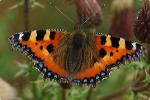
standing and watching. It was good to see a few Small Tortoiseshells about.
 |
| photo: John Martin |
Meanwhile, above us the sounds of Corn Buntings
and Skylarks filled the air. I tried to photograph them both. The larks evaded
me but the buntings, sat on the overhead wires, eventually allowed a close
enough approach for half-decent images
Back on the ground, the flower strips continued
to hold our attention. But at the edge of the field I spotted a Scots Pine on
the boundary.It produced several ladybirds, including Pine,
10-spot
And Larch, albeit this one in larval form.
Plus a Pine Cone Bug
And a Forest Bug.
Finds at ground level included this very smart
rove beetle. Sadly I don’t have an identification for it.
This area also
produced a rather significant fly, as described by Nigel:
“I have one very nice record for a fly that is
strongly associated with veteran trees.
Madiza pachymera is designated
as Nationally Scarce. Shropshire is a bit of a hot spot for it with previous
records from Attingham Park, Millichope Park and Westcott (near Millichope). I
swept the specimen off trees along the roadside edge of the agri-forestry field
near the farm buildings. I noticed a number of very nice large oaks around the
farm, so it is quite plausible the fly came from one of those, if not, most
likely it came from an old tree on nearby land. This is the first time I have
found this very scarce fly other than by flight interception traps put up in
veteran trees.”
We could have spent the rest of the day
inspecting these margins. But the time had come, and some of us made a break
for the other side of the field, ostensibly as a route to an area of acid
grassland farther on, but also because it offered the prospect of some enticing
shade from the already energy-sapping sun and heat. But… the flowery splendour inevitably
caused distractions.
Among the showier blooms there were subtler
delights, including this Heath Groundsel.
 |
| photo: John Martin |
Reaching the shade of the boundary at last, the
trees were examined. Among the finds, a female Oak Bush-cricket nymph was
tapped from the foliage
But a Black and Yellow Longhorn (Rutpela
maculata) needed nothing more than patience while it hovered about indecisively, trying to decide where it wanted to land. It eventually rejected all the
available hogweed and settled on a spent rose instead. I suppose it knew what
it was doing!
The ultimate aim of our trek came into sight:
the acid meadow. This needed to be climbed into, over a gate which had been tied
closed with rope. On sloping ground and with an interesting sandy cliff at the
top end, it was home to Roesel’s Bush-crickets
And Field Grasshoppers.
In Nigel’s words: “The
bare
banks and mini-sand cliff in the acid meadow had quite a lot of solitary bee
and wasp activity. I was only able to capture a few specimens, but these
features will very likely host a good range of nesting solitary bees and
solitary wasps.”
The thistles therein were being carefully inspected by a rather
faded Painted Lady. I think she was ovipositing, but when I managed to capture
a picture of her she was doing nothing more than having a breather atop an unopened
flowerhead.
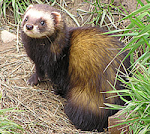
At this point there was a rare appearance by a mammal (other than a
human), who came in, had a look at us, decided they didn’t particularly approve of us and legged it again…
The remainder of our day involved a return to
the main group. Unfortunately, this meant an uphill slog in the full glare of
the sun. We arrived panting, to find them huddled in the shade – the same trees
that during last year’s visit had sheltered us from a ferocious and very
wet storm. They had of course been busy, some of their many finds including both
Small and Essex Skipper butterflies, numerous bugs and, inevitably, “The Boy”. Among
the bugs was a tiny shieldbug nymph: another Turtle Bug, of a similar size to
the one found a fortnight earlier in Shrewsbury.
Those of us who had brought lunch proceeded to eat
it in the shade. The rest had to watch! Either way, this was the last action of the day and we made our way back to our
vehicles, parked fortuitously in the shade of a barn, and departed before the
thermometer rose any higher.
The combination of a day truncated due to the
heat, a rather linear progression and lack of photos has produced a shorter
than average report. But this very much does not reflect on the quality of this
site, which must surely be an exemplar of what can be achieved in farming with
the right attitudes and skills. We are very grateful for the opportunity to
explore what it has to offer. We will be back…again!
Photographs
© the author except as noted.


 At this point there was a rare appearance by a mammal (other than a
human), who came in, had a look at us, decided they didn’t particularly approve of us and legged it again…
At this point there was a rare appearance by a mammal (other than a
human), who came in, had a look at us, decided they didn’t particularly approve of us and legged it again…


 Posts
Posts