25 Sept 2015

Window of Opportunity II

Nipstone Rock and The Bog, Wednesday 2nd September 2015

An early start was needed to reach the Nipstone Rock car park for the designated meet time. It was pouring down as I collected others on the way to the site. It rained almost all the way there, even though, at times, we travelled along sunlit roads. But there was a nice rainbow to admire. 

The rain stopped as we neared the site and, apart from a few spots, it stayed dry and mostly sunny until it was nearly time to call it a day. Once again the weather provided us with a window of opportunity to do our thing.

Nipstone rock is an area of heathland that was planted with conifers in the 1960s. The trees were felled early in the 21st century and the heathland has recovered.


As always we started in the car park where we found a shieldbug nymph in the heather which may have been a Heather shieldbug or a Gorse shieldbug (what was it doing in the heather). The jury is out on this and it has been referred to a higher authority who may be able to determine which it is.

As we made our way up the lane a gorse bush became the centre of attention as the paparazzi gathered around it.


Their and their cameras’ focus was on a number of gorse seed heads that were covered in Gorse shield bugs in various stages of their development from nymph to adult.


The verge of the lane up which we were progressing provided many items of interest for anyone interested in insects, fungi, plants and mosses. One club moss, sorry I do not know its name, was quite common.


And one of the group found a ladybird that we see all too rarely, a Hieroglyphic ladybird.


Unfortunately the Great Spider Hunter was unable to join us on this adventure so, needless to say, spiders and harvestmen were out and about in great numbers. I will not attempt to name definitively the spider in the photograph but it looks suspiciously like a garden spider – I await enlightenment!


An as yet unidentified but distinctive larva attached itself to the sleeve of one of the group. Can you identify it? If so please let me know.

Editor's Note: I think it's a Pebble Prominent moth. Foodplant; Sleeves!


Like last week the window of opportunity came with a stiff breeze. We sought shelter for lunch. As we huddled in the lea of the tree lined bank of the path I knew a decision had to be made. I stood up and addressed the group.

“Who would like to go to The Bog, who would prefer to stay here?”

When the rather childish sniggers had died down it was clear that we were ready to move on.

We returned to the cars and transferred to The Bog car park. The Bog, or Bog Mine as the brown direction sign more decorously calls it. is the site of a former lead and barytes  mine and village which has regenerated into heathland and grassland as well as retaining some relics to remind one of its past.


We explored. Early findings were a couple of lichen that had produced fruiting bodies:


We made our way to a marshy area where we spent a while doing what we do. A few spots of rain were felt; then a few more; then rather a lot more. We decided that discretion was the better part of valour and called it a day and headed to The Bog visitor centre for tea (or coffee) and cake.

Unfortunately as we refreshed in the visitor centre the rain turned into a monsoon. There was no escape, we had to return to the cars at some point. I had just about dried out by the time I got home. But the rain failed to spoil yet another excellent day.

Thank you to the Shropshire Wildlife Trust and Shropshire Council for giving us permission to do what we enjoy doing.

Keith Fowler


21 Sept 2015

Window of opportunity

Devil’s Dingle, Wednesday 26th August

It was raining when I got up, it was drizzling when I set off, it had stopped but the sky was grey when I arrived to meet the rest of the group. The clouds broke up, the sun came out and we had had six hours of almost unbroken sunshine by the time we left the site. It rained again just after I had returned home. The weather provided us with a magical window of opportunity to explore the former ash disposal site at Devil’s Dingle. (It was a bit breezy, but you cannot have everything.)

Eight of us met at the gates of the site and then made our way up to the parking spot at the eastern end of the path that borders the dams. We set out along this path:


Clearly our pace was not to everyone’s satisfaction as two disappeared, off to do their own things. The rest of us scanned the vegetation around the edge of the path and the pool that it borders looking for things of interest and enjoying the excellent view that this site and the weather afforded.

Did I mention the breeze? Well this part is pretty exposed so it was a little windblown(!) causing this moth to hang on to the top of a tube when it was released rather than risk flying:


The moth did open its wings briefly allowing us to identify it as a Shaded broad-bar. Nearby we found a web of a Labyrinth spider.


A common sight at this time of the year are large rugby ball shaped galls on thistles that accommodate the larvae of the “picture-wing” fly Urophora cardui. It is curious that we do not find the adult fly more often.


At the end of the first pool is an area of shingle which has been created to encourage nesting Little ringed plover. To the best of my knowledge these birds have never nested in this area but the shingle is maintained and cleared each year by the Wrekin Forest Volunteers during their sessions at Devil’s Dingle. As you can see a little maintenance will be required this winter:


From here you have a good view of the pool to the east:


the pool to the west:


and The Wrekin to the north:


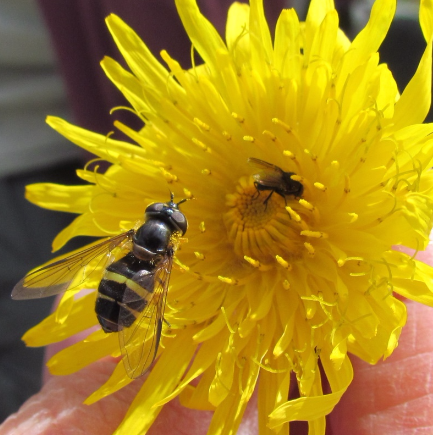
There were some dandelion hawkweed hawkbit .... yellow flowers in the gravel and one had the hoverfly Chrysotoxum bicinctum feeding from it. The fly was so engrossed that it did not fly off when the flower head was picked or when it was photographed. It might still be there.


This area does resemble the beach at some of our popular seaside resorts so we had coffee here which turned a few minutes later into lunch, where we were joined by one of the itinerant members. 

We spent time exploring the grassland between the pools, well, some of us did, two went off in a different direction and one other decided a moment of solitude was needed.


Somehow we all (but one) joined up as we made our way along the edge of the pool towards the western edge of the site. Along the shoreline we found evidence of freshwater mussels:


What had been eating them? Our suspicions fell on ...


At the end of the pool is an area of wet grassland which is part of the overflow system. We arrived mid-afternoon. It was fairly sheltered, it was very warm and several species of butterflies put on a show. Our remaining itinerant joined us as we sat on the bank (avoiding the wasps’ nest) to take in the entertainment that nature was providing.


Re-assembled as a group we made our way back to the cars. On the way I could not resist taking yet another photograph of the cooling towers reminding us of how this haven had come into existence. (I have not been in the area long enough to know what was there before it became an ash disposal site.)


We were not done. We stopped at the entrance to the site for a look at the bank that borders the lane. Here we were treated to some late rarities (for Shropshire). Denticulate Leatherbug and the large hoverfly, Volucella inanis put the icing on the day’s cake.

What lies in store for the site when the power station closes at the end of the year is unknown to us. Let us hope that the powers that be reach a sensible decision that is satisfactory to all parties allowing it to be maintained and remain accessible.

My thanks to E.on for permitting access and allowing us to spend the day doing what we enjoy doing.

Keith Fowler

18 Sept 2015

Thirteen + one

Lea Quarry, Wednesday 19th August

As I drove into the car park at Lea Quarry I found it hard to believe my eyes as a crowd of people were waiting to greet us. I did a quick count as I parked the car, thirteen. Ah! Good job my mother was not there – bad luck was sure to befall us. Just then a further person turned up making us fourteen. “Good job someone else has arrived!” one of the group remarked – so it was not just my mum.

Fourteen was a stretch on our high visibility vest availability. But with a bit of searching and a couple borrowed from Edge Renewables we managed to kit everyone out.


We were aware of the weather forecast – rain later, so the search of the car park was brief before we set off for a couple of target areas close to the quarry face that runs below the Shropshire Way footpath at the north western edge of the site.

With such a large group who have diverse interests we split into a flora group and “others”. The flora group headed off in search of interesting plants whilst the rest of us looked for things that were trying to make a life from the vegetation and each other. (As it happened, we all ended up in the same place.)

The weather was fine at this stage but windy so we headed to a secluded grassland which was the first of our target areas for the day. When we approached we were met by a mound of bark shavings that blocked the way.


Undeterred we found ways around and over the pile to reach our goal.

This was a secluded spot. We were sheltered from the wind and it was pleasantly warm. And we were able to find many things of interest including several butterfly and moth species; a few shieldbugs; several plant hoppers and bugs; spiders; grasshoppers and even a Pill woodlouse.

One find was a Spiked shieldbug which I attempted to photograph. Unfortunately it would not stay still. My words of encouragement telling it that it was destined to be a star fell on deaf ears as I followed it around the net first on the inside, then on the outside before it climbed on my hand and then up my arms. Why did it not just fly away? Eventually it paused on my arm.


In the grass we found an Orb-web spider guarding her egg-sac. This spider did not move even when camera lenses were thrust in her direction. 


The rain started, just a few spots; we donned waterproofs and set off for our second target area. As we emerged around the bark pile we realised that the wind had strengthened and the rain was heavier.

We pressed on but before long, as people, nets and trays became waterlogged, and there was clearly no sign of any let up in the adverse weather, our enthusiasm waned and we decided to call it a day and head home to dry out.

Thank you always to all who turned out for the day and apologies for the shortened visit. Thank you to Edge Renewables for permitting us access.

Keith Fowler