Wednesday 8th June 2022, Venus Pool
The pool at Venus Pool, a bird reserve owned by the Shropshire Ornithological Society, is not the largest part of the site. It is surrounded by large meadows and a large arable field that is used to grow feed for overwintering birds.
We had been invited to visit the reserve to see what we could find, other than birds, making use of the meadows.
For some reason I was late getting to the meeting point in the car park. When I arrived I was told that the keyholder had forgotten the most important piece of equipment, the key to the gate to the meadow off the car park.
Rather than put life and limb at risk by climbing over the gate he offered to return home to retrieve the missing item.
Off he went.
What did the rest off us do?
Some of us were still getting ready following our tardy arrival …
Others milled around the car park …
The rest wandered off into the arable field.
One of these groups located a pair of 22-spot ladybirds enjoying the fine weather.
 |
| Photograph: David Williams |
And another photographed an immature male Common blue damselfly
 |
| Photograph: Jim Almond |
Later the same person found a female of the same species.
 |
| Photograph: Jim Almond |
It was not by design that I was still in the car park when the key arrived, but I was.
The gate was opened to give us access to the meadow.
Now we had to round up those who had escaped from the car park. This achieved, we moved into the meadow to start doing what we enjoy doing – observing, sweeping, beating and vacuum sampling.
An early find was a rather striking moth larva, Helcystogramma rufescens.
.jpg) |
| Photograph: David Williams |
Together with a male and female soldier fly Chloromyia formosa which has been granted the rather unflattering name Broad centurion.
The female;
.jpg) |
| Photograph: Jim Almond |
And the male.
.jpg) |
| Photograph: Jim Almond |
Various trees and bushes grew along the edge of the meadow including Sweet briar.

Buttercups were very common in this meadow and many held at least one insect in their flower. This one was occupied by a Swollen-thighed beetle, Oedemera nobilis.
 |
| Photograph: Jim Almond |
A couple more dragon and damselflies were photographed:
An immature male Black-tailed skimmer;
 |
| Photograph: Jim Almond |
And a Blue-tailed damselfly.
 |
| Photograph: Jim Almond |
We drifted into the second meadow.

And immediately settled down for lunch.
This gathering of people attracted the attention of a cleg, probably Haematopota pluvialis, which is another candidate for the title of the “best eyes” contest.
 |
| Photograph: David Williams |
Mind you, you tend not to notice the eyes when it starts to burrow into you to feed on your blood!
There was plenty of Salix in this area and inspection of these revealed the shiny beetle Crepidodera aurata, known as the Willow flea beetle.
 |
| Photograph: David Williams |
In the taller vegetation close to the Salix we found plenty of Ragged robin in flower.

And this group of very sturdy orchids, the variety is unknown to me.

The weevil, Thryogenes nereis, was found (but not photographed) amongst some rushes.
.JPG) |
| Photograph: Emm Cane-Honeysett |
On the other side of the meadow, away from this taller vegetation area, in the hedgerow that separated the meadow from the lane that leads to the car park, there was a large Ash. Resting within its foliage was a Clouded silver moth.

Now seems a good time to include photographs of four other moths that put in an appearance during the day:
A Burnet companion;
 |
| Photograph: Jim Almond |
A Silver Y;
 |
| Photograph: Jim Almond |
A Clouded border;
 |
| Photograph: Jim Almond |
And a longhorn moth, Nemophora degeerella.
 |
| Photograph: Jim Almond |
Wandering along the hedgerow we intercepted an animal that is definitely an unwelcome guest on a reserve for birds:
A CAT!
Thankfully it was not a big cat whose possible presence is periodically reported in the press.
 |
| Photograph: Neil Nash |
This one looks as though it would not hurt a fly but it may grow up with a taste for the local fare.
A diversion for one of the group took him off to search some oaks elsewhere on the site to look for a particular ladybird. Some time later he returned flushed with success.
 |
| Photograph: David Williams |
This is Scymnus auritus, one of the group of ladybirds known as “inconspicuous” ladybirds. Many of us are familiar with the large boldly patterned members of the ladybird family, such as 7-spot and, as in the first photograph, 22-spot, but there are quite a number of generally smaller and less noticeable members of which the above is one.
Another member of the “inconsipuous” group was found later in a Scot’s pine, Scymnus suturalis.
 |
| Photograph: David Williams |
By mid-afternoon we progressed into the third and by far the largest meadow.

By now, unfortunately, we were tending to find the same beasts that we had earlier in the day. A desire to sit down, relax and enjoy the ambiance of the site spread amongst us.
However, we were able to find a couple of beetles to add to our species list for the day.
Sphaeroderma testaceum;
.jpg) |
| Photograph: David Williams |
And, from oak, this beetle with the most amazing antennae, Ptilinus pectinicornis.
.jpg) |
| Photograph: David Williams |
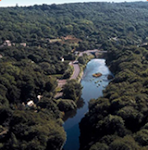
Walking to the highest point of the meadow we were presented with an excellent view over the pool (but far too distant to determine what birds may be on it).

Weary after an excellent day we made our way back to the cars and to our homes.
This week's Wednesday Weevil of the Week is Sitona waterhousei, whose bulgy eyes are such a striking feature that it makes it easy to distinguish from similar species.
.JPG) |
| Photograph: Emm Cane-Honeysett |
My thanks to the Shropshire Ornithological Society for giving us permission to do what we enjoy doing and access to parts of the reserve not generally open to the public. My gratitude to the photographers for providing their wonderful images.


.JPG)
.JPG)
.jpg)
.jpg)


.JPG)
.JPG)


.JPG)


 Posts
Posts