16 May 2022

I was not going to mention it, but ...

Wednesday 11th May 2022, Dolgoch Quarry

Dolgoch Quarry is a disused limestone quarry that is now mainly woodland  but the main quarries are relatively clear allowing wild flowers to flourish. The quarries contain a couple of pools which provide a home for aquatic wildlife.

After my many moans about the weather that has greeted us on our outings this year I was resolved not to mention it again…

But!

Heavy rain greeted us as we assembled in the lay-by close to the site.

Undeterred we set off.

To be fair the main path up to the quarries is not very inspiring but some relief is provided when you chance upon a clearing which, considering the conditions, we tried to make the most of.


A couple of beetles were found in this area:

A soldier beetle, Rhagonycha lignosa;

Photograph; John Martin

And a rather nicely patterned leaf beetle, Cryptocephalus bipunctatus.

Photograph: David Williams

(This photograph was not taken when it was first found but later in the day when the pair were discovered.)

To alleviate us of the despair of treading the main path we had a couple of site experts who took us a different way to the main quarries. It was still through the woods but far more interesting and undulating.

On the way we passed carpets of Ramsons, most of which was in flower.


As we emerged from the woods we found ourselves on top of the hill between the two quarries.

And the rain had eased considerably to what the forecasters might refer to as a light shower.

There were two ways to get down to the quarry floor - tthe quick way, down some steps, or the slow way down a more gently sloping path.

As the steps were muddy and quite steep we deferred from taking the quick way, which may have led to an even quicker descent, and made our way sedately down the slope and into the largest of the main quarries.

The rain had now reduced to the occasional drip.

We had lunch.

And then …

A break in the clouds was spotted …


Quickly followed by the clouds vanishing altogether,


The sun brought about a flurry of activity…

From the gathered throng as they stripped off their outer layers and spread them out to dry …

And from the creatures that inhabited the quarry as they emerged from their shelters to make the most of the warm sunshine.

As the light was now excellent the opportunity was taken to take some aerial photographs:

Of the quarries;

Photograph: Bob Kemp

And a selfie.

Photograph: Bob Kemp

We were now kept busy as all sorts of interesting insects were found.

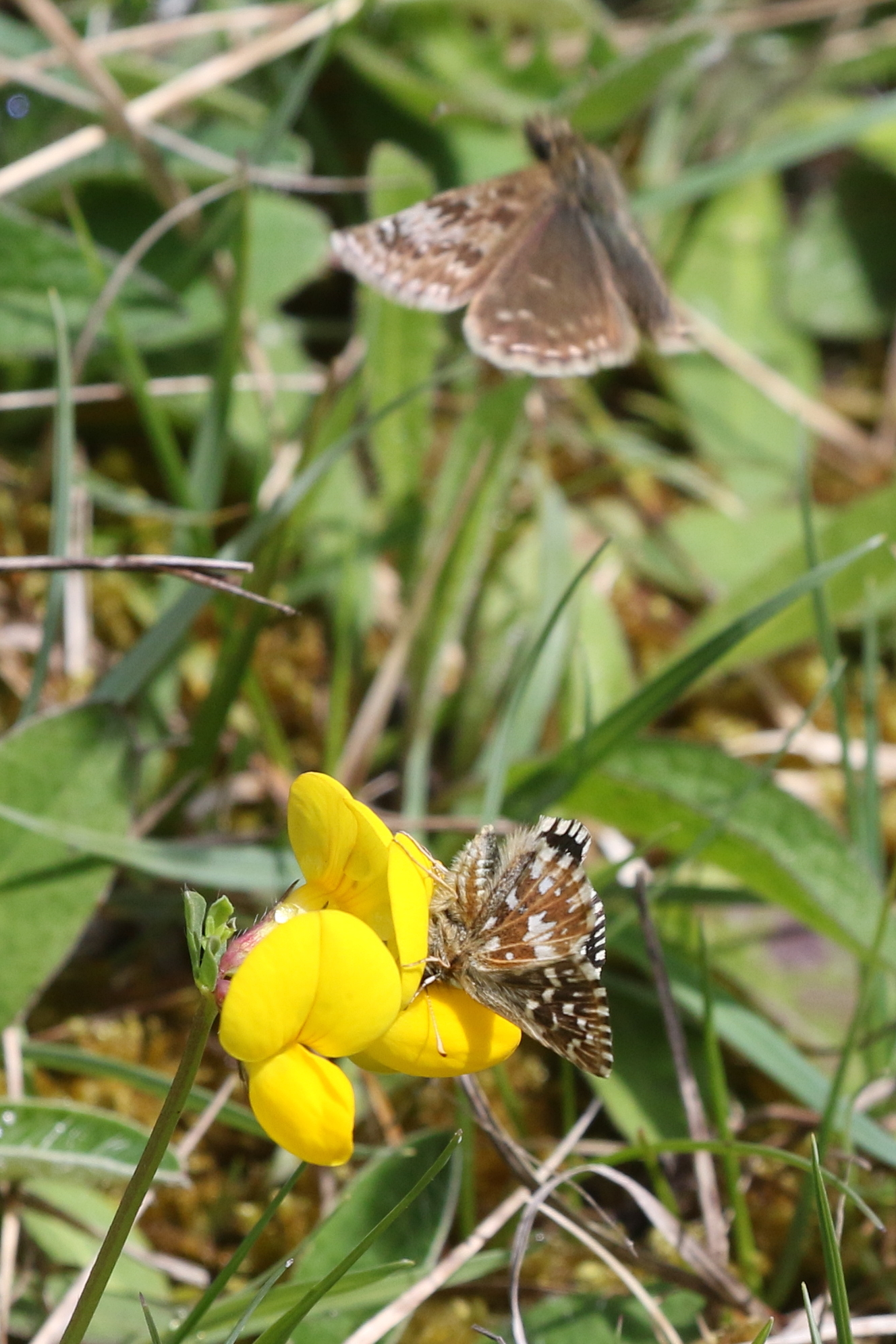
Among the first to be spotted were Grizzled skippers.

Photograph: Bob Kemp

These were joined by Dingy skippers (in the background at the top of this photograph).
Photograph: John Martin

A tiny moth was spotted resting on a rock, Elachista gleichenella.

Photograph: Bob Kemp

A soldier fly Odontomyia tigrina, known to some as the Black Colonel, goodness knows why.

Photograph: John Martin

And this elongate beetle, Oedemera femoralis, which is a close relative of the far more well-known and common Swollen-thighed beetle.

Photograph: David Williams

A pool stands in the corner of this quarry.


A Large red damsel fly and a 4-spotted chaser were observed flying and resting, having emerged recently, presumably, from this pool. On a sapling along its edge we found two male Odynerus spinipes, one of which was photographed.

Photograph: David Williams

This has acquired the common name Spiny mason wasp. The mason wasp part refers to its nesting. It excavates its nest in vertical banks of hard earth and uses the waste material to build a chimney over the entrance. 

Climbing up some steps to a plateau and then making your way to the to the top of the quarry you get a good view of the area we were in.

Photograph: David Williams

Was this an alternative way out to a path that may lead back to where we started?

Sadly, no. It led to a field.

The cloud was building up and the rain threatening to return. We decided to make our way back. But before we left these spiny sawfly larvae were spotted grazing on an oak leaf. They have been identifies as Periclista lineolata.

Photograph: David Williams

The rain did return!

We departed along the main track. This involved doing a limbo dance under a tree trunk that had fallen across the path at about chest height and then weaving our way across the upper branches of another fallen tree.

By the time we reached the clearing the rain had stopped and the sun was shining again.

Remember that I said there were carpets of Ramsons. And where there is this plant and the sun, you may chance upon the distinctive hoverfly Portevinia maculata, that is never found far away from the plant. 

Photograph: John Martin

Keep an eye out for it when you come across Ramsons in the sun.

Another beetle was observed, Malachius bipustulatus.

Photograph: John Martin

After the rather wet start. when we were the about the only things to be out in the rain, it had turned into a really good day with some interesting invertebrates to observe.

To round off this account we have the Wednesday Weevil of the Week which is Hypera plantaginis. The one we found was not photographed but here is one that was last year.

Photograph: Emm Cane-Honeysett

My thanks to Shropshire Wildlife Trust for permission to do what we enjoy doing and, as always, to the photographers for allowing me to include their images.


10 May 2022

More of the same

Wednesday 4th May 2022, Shropshire Hills Discovery Centre

The weather for our outings so far this season has settled into a bit of a rut, following the same pattern each Wednesday - rain at the start which gives way to drier, sometimes sunnier, conditions later in the day, with glorious sunshine by the time we go home! 

What will it bring for our next outing? 

We’ll have to wait and see.

The Discovery Centre has a large car park so it was a huge surprise to find it almost full when we arrived. However there were just enough spaces left to accommodate the group.

This large site has a mixture of grasslands, woodlands and pools. 

From the car park we marched past the centre’s building, formal gardens and play area to an area of grassland dotted with a few blossom trees. Some early finds here included

A 2-spot ladybird;

Photograph: Jim Almond

A Red-headed cardinal beetle;

Photograph: Jim Almond

And a couple of weevils. The first was Phyllobius pomaceus;

Photograph: Jim Almond

The second was a Phyllobius pyri.

Photograph: Jim Almond

Within the grasses there were quite a few cuckoo flowers in bloom. Orang-tip butterflies patrolled the area - males – looking for females; females looking for suitable spots to lay their eggs.

We chanced upon a female feeding on one of the plants.

Photograph: Jim Almond

Another was close by with its wings open.

Photograph: Jim Almond

Searching the grassland edge where it yielded to a bed of nettles produced a sighting of a 24-spot ladybird.

Photograph: David Williams

The group seemed set to stay in this area for the rest of the day but a few of us ventured further to a few large logs that were being allowed to rot. 

Diligent searching of the logs and surrounding vegetation resulted not only in the discovery of a splendid Lesser stag-beetle:

Photograph: David Williams

But also a Lesser stag beetle larva.

Photograph: Nigel Cane-Honeysett

We must thank those members of the group who do not mind getting their hands dirty for these finds.

(I did not find them!!)

On the subject of larvae the beetle larva was quickly followed by finding two more, but this time they were moth caterpillars.

The first was the larva of a Scarlet tiger;

Photograph: Jim Almond

And the second was of a Timothy Tortrix.

Photograph: Nigel Cane-Honeysett

Lunchtime was fast approaching and there was still little sign of movement from the first grassland and the logs. 

Even fewer of us formed an advanced party and reached the large pool where the path divided.

“Which way should we go?”

I spotted a picnic table through the trees to the left.

“Left”  I responded.

Only two of us made it to the picnic table!

The rest went straight on.

Undaunted we staked our places at the table and tucked in, expecting others to quickly join us once rumours of lunch had spread through the group.

I had long finished my food by the time the last stragglers came into sight having circumnavigated the pool in the opposite direction.

The lunch spot was in a meadow sandwiched between the pool and the River Onny.


This area together with the edges of the pool and river became our focus of attention.

Among the finds were a bee, Andrena haemorrhoa;

Photograph: David Williams

A hoverfly, Dasysyrphus venustus;

Photograph: Jim Almond

A bee fly, Bombylius major, with the dark front to its wings;


And a cranefly, Ptychoptera contaminata.

Photograph: John Martin

I wandered over to the river and saw a Kingfisher as it flew rapidly along the course of the river a few feet above the surface.

It was far too quick to photograph but if I had it would have been of the river with a bluish streak drawn across it.

More sedate and easier to photograph was the ornate gall of the mite, Cecidophyes rouhollahi. I am not sure what plant it was found on but the gall affects members of the genus Galium and possibly others.

Photograph: John Lyden

Beating the trees on the river bank dislodged a Cream-spot ladybird;

Photograph: Nigel Cane-Honeysett

And within the grass some Meadow saxifrage was spotted.

Photograph: John Martin

Moving on from the meadow we came to a small pool. Searching the vegetation around this pool entertained some while others moved on to an area of grassland at the far end of the site.

Somewhere between the meadow and the far grassland this muscid fly, Phaonia fuscata, was spotted.

Photograph: John Martin

Meanwhile in the far grassland, above us a Red kite was effortlessly gliding about, changing direction with a twitch of its tail, and riding the air currents without any need to flap its wings.


Back to ground level! The grassland contained a small hillock that contained most of the floral interest of this area and was, as a result, thoroughly surveyed.

On here, a bee fly with spotted wings, Bombylius discolor, was observed and quickly photographed.

Photograph: John Martin

The find was announced, others scrambled (carefully) up the hill only for it to …

Disappear!

There followed a frantic search of the area by a group of adults behaving just like small children chasing the ball in a game of football.

Photograph: Jim Almond

“It’s over here!”

Rush to the finder …

“Sorry, it has gone again”

Spread out …

“Now it’s on that Forget-me not over there”

“Where?”

“Over there”

Rush over there …

“Ah, yes”

“Sorry, I disturbed it!”

Spread out ...

And so on for the next quarter of an hour or so.

Eventually it got fed up of being pursued, paused just long enough to be observed by all and photographed again.

Photograph: David Williams

We made our way back to the car park.

But, the fun was not over.

A casual beat of some Broom revealed a small ladybird Rhyzobius chrysomeloides.

Photograph: David Williams

It looks very similar to Rhyzobius litura but has more heavily darkened wings, a more rounded front corner to its pronotum and if you are able to flip it over and look at the keel between it front legs you will notice it is narrow and fairly pointed.

Photograph: David Williams

Another clue is where it is found; chrysomeloides is generally found in trees and litura in grassland.

This was an excellent way to bring a good day to a close.

This week’s Wednesday Weevil of the Week is the large (about 1cm) weevil, Liophloeus tessulatus.

Photograph: Emm Cane-Honeysett

Photograph: Emm Cane-Honeysett

My thanks to Grow Cook Learn, the organisation that manages the centre, for permission to do what we enjoy doing and to the photographers for allowing me to include their images.

Other News

What is this?

Photograph: Mary Steer

No, this is not a quiz as I am going to reveal the answer, but that was the question posed when this was photographed during a stay in Scotland. 

It is the flightless female of the Belted beauty moth.

A recent find in Shropshire is the Ornate shieldbug, Eurydema ornata, discovered close to the Wyre Forest. This is only the second time this bug has been found in the county.

Photograph: John Bingham

And to finish, I can confirm that Callicera rufa is alive and well on Little Hill and still using the same tree to keep an eye out for females and ward off rivals.


1 May 2022

More in Hope than Expectation

Wednesday 27th April 2022, Hope Valley Shropshire Wildlife Trust Reserve

The Hope Valley reserve lies just to the north of the village of Hope in the steeply sided valley (at least on the woodland side) through which a stream, which may be called Minsterley Brook, flows.

Getting there was a problem. 

There were roadworks that had closed the road between Minsterley and Hope, the way we normally go to get to this reserve. However it was not as simple as that, at least for the car in which I was travelling.

At the roundabout where we turned onto the A488 from the A5 by Shrewsbury we noticed, too late, a diversion sign. We ploughed on in the hope that everything would be fine.

No sign of any roadworks but …

Passing through Pontesbury we noticed the sign of doom – “ROAD AHEAD CLOSED”. 

Unfortunately it was not clear to us where the road was closed. At this point we took the decision to take an alternative route to Minsterley.

That turned out to be a total waste of time!

We got to Minsterley and turned back onto the A488 towards our goal believing that we had avoided the roadworks …

All went well until we got to Ploxgreen where we met the road closure.

Fortunately we were able to divert onto a minor road a little west of the A488 and get to Hope. There we could turn back towards our goal. 

As we turned back onto the A488 at Hope we saw another “Road closed sign”. 

We ignored this and managed to get to the site about 20 minutes late.

Expecting that others would also be held up, we were surprised to find everyone else on site and hard at work!

How at they got there so easily? 

“We followed the Diversion.” 

After the glorious weather of the previous days we were very disappointed to be greeted by cloudy, cool, breezy conditions.

The area by the car park is a damp grassland and this was scoured for lifeforms.


An early find was a Hawthorn shieldbug that was inhabiting a holly bush.

Photograph: David Williams

The weather conditions were rather inhibiting anything from flying but one hoverfly did venture out, Epistrophe eligans.

Photograph: John Martin

Our late arrival threw out any timetable that I may have had for the day so, as it was approaching lunchtime …

Yes, so soon! …

I decided to get the ascent to the top of the hill over and done with as quickly as possible.

By the time I got to the view point overlooking the Stiperstones at the top I was very alone.


Undeterred I tucked into my lunch and waited.

Others started to arrive, find perches and have their picnics.

It was not very long before everyone had made it to the top.

Various weevils were collected during the day. Here are two. I do not know when or where they were found, but now is as good a time as any to include photographs of a couple.

Curculio glandium;

Photograph: Emm Cane-Honeysett

And the very similar Curculio venosus.

Photograph: Emm Cane-Honeysett

Here is a striking “head-on” photograph of the same weevil.

Photograph: Emm Cane-Honeysett

Lunch over we spent quite a long time exploring the area around the view point.

One discovery was this rugged looking beetle aptly named Carabus granulatus.

Photograph: David Williams

Other finds were a spider that had been fungified. (I do not know if “fungified” is an accepted term - spellchecker does not think so - but it does describe the spider’s state.)

Photograph: David Williams

And the bizarre looking Hazel leaf-roller weevil.

Photograph: David Williams

In this high exposed area of the site the cold wind was biting through our clothing. It was time to move on and seek warmth and shelter amongst the trees.

We made our way slowly along the path that runs along the top of the hill.

An Eyed ladybird, with pale rings around its black spots, was uncovered.

Photograph: David Williams

The large cranefly Tipula vittata was spotted on the vegetation.

Photograph: John Martin

The sun came out and the temperature rose markedly just as we came to an area of the wood with more of its flora on display.

Photograph: David Williams

We paused to enjoy the sight and check out if the sudden warmth had stirred the fauna into activity.


One group of insects often found swarming around the branches of a tree in the sun at this time of year is the “long-horned” moths. Really they should be called “long-antenned” moths but, I suppose, “long-horned” sounds more dramatic.

This one is Adela reaumurella.

Photograph: John Martin

Time to get going and make our way back to the cars. On the way we spotted a leaf mine and a host of galls.

The leaf mine, on Honeysuckle, is caused by the fly larva of either Aulagromyza cornigera or Aulagromyza hendeliana. In order to determine which you need to examine the larva. In this leaf the larva had already vacated the mine.

Photograph: John Martin

The galls on rowan were caused by a mite, Eriophyes pyri.

Photograph: John Martin

And home we went by whatever circuitous route we could find to avoid the roadworks.

All that remains is to introduce you to the Wednesday Weevil of the Week which is the scarce Lasiorhynchites cavifrons, a very hairy, subtly blue-hued, large weevil.

Photograph: Emm Cane-Honeysett

My thanks to the Shropshire Wildlife Trust for giving us permission to do what we enjoy doing and to the photographers for allowing me to use their images.