4 Aug 2019

Early lunch was taken

Snailbeach Mine and Rigmoreoak, Pennerley, Wednesday 31st July 2019

Let me start by reassuring you that for this trip I remembered my socks. Even though I was given a lift and, therefore, did not have access to my emergency pair my feet were suitably clothed for the outing.

The final day of July did not provide us with glorious weather. It was dull and overcast. At least it was not raining.

A good number turned out for this event including some visitors from Bedfordshire. How does the word get around?

The plan was to spend the morning at Snailbeach mine, lunch about 1am then travel the few miles to the Natural England offices at Rigmoreoak arriving there about 1.30pm.

We entered the Snailbeach site and immediately found a Yarrow plume moth.

Photograph: Graham Wenman
Encouraged we made a few exploratory sweeps and beats of the vegetation at the entrance before managing to move about 10 yards into the site. Our spiderman did a vacuum sample of the grassland and was rewarded with finding a Six-belted clearwing moth.

Finding such a moth is quite rare and it happily sat on a clover leaf as a frenzy of photographers satisfied their desire for a photograph.


And here is one of their efforts:

Photograph: David Williams
A stunning moth.

After such an early excellent find it is easy for rest of the day to be an anti-climax, but we tried our best not to let this happen.

Around the same time we found a tortoise beetle - Cassida rubignosa. Tortoise beetle get their name from their extended wing cases and thorax which hides the head and legs rather like a tortoise's shell.

Photograph: John Martin
Other finds of the vacuum sampler were the nymph of a Small grass shieldbug:

Photograph David Williams
And the nymph of a Bishop's Mitre shieldbug.

Photograph: David Williams
These were not the last bug nymphs we found. Sweeping the vegetation caught this cute individual.

Photograph: David Williams
We believe this is probably an early instar of a Denticulate leatherbug.

Our final photograph from Snailbeach is of a micro-moth Dichrorampha petiverella.

Photograph: Graham Wenman
It started to rain. Not heavily, but enough to send everyone scuttling back to their cars,

As the Ashes cricket series between England and Australia has started I will use a cricketing term in saying "Lunch was taken early".

If rain intervenes in a test match just before the scheduled lunch break often they will bring lunch forward in order to restart the game earlier than planned.

And that is what happened.

We lunched and the rain stopped enabling us to have a further half hour looking around the Snailbeach site before moving on to Rigmoreoak.

Rigmoreoak is the site of the Natural England Office in Pennerley. Opposite the office was a conifer plantation which was clear-felled recently. This was where we spent the afternoon.

Photograph: David Williams
 On entering the site a stone was turned over and underneath we found a Devil's coach-horse.

Photograph: David Williams
The devil's coach-horse is the largest of the thousand or so Rove or Staphylid beetles. When disturbed it often raises and curls its abdomen like a scorpion.

There was a lot of gorse on the site,


And on one of the gorse bushes we found the larva of a Green hairstreak butterfly.

Photograph: David Williams
Our searches took us to the site borders where there were a few hedgerow trees and ditches. Close by there were a lot of dead tree stumps.


The bark of a few of the stumps was peeled back to see what was making its living in that habitat. There were a lot of woodlice and a few spiders plus a couple of large violet tinged ground beetles. This one is Carabus problematicus.

Photograph: David Williams
The day was drawing to a close. We said our good-byes and made our way home.

My thanks to Shropshire County Council and Natural England for giving us permission to do what we enjoy doing and toe the photographers David Williams, Graham Wenman and John Martin for providing photographs for me to use.


30 Jul 2019

Pizza galore

Denso Eco Garden, Telford and St. Peter's Church, Edgmond, Wednesday 24th July 2019

O dear!

What is it about me and socks?

Yet again I could not find a pair as I unloaded the boot of the car.

I had net, stick, tray, vacuum sampler (in two parts), boots and a bag … but no socks.

And then I remembered.

After last week's lapse I put a spare pair of socks in the first aid compartment in the boot (it seemed an appropriate place).

My feet and boots were saved. Now all I need to do is to remember to put another pair in the compartment for when, inevitably it seems, it happens again.

Sock panic over, as everyone I expected had arrived we ventured onto the site.

The Eco Garden is an area of land around two edges of the Denso site in Telford. A group of the firm's employees persuaded the firm to let them develop what was essentially waste ground into what it is now.

The garden consists of plantation around the edge through which a path has been constructed, a large meadow which was originally destined to be an overflow parking area:


A more formal garden area with raised beds:


And other constructions:


"Wilder" areas:


Pools:


And tree ferns.


If you have some tyres to spare you could also create a feature like this:


The garden is for the employees to enjoy but it is also used to entertain and for educational purposes. It is maintained on a voluntary basis but the firm provides support.

We spent a lot of time in the grassland area and its margin investigating what makes its living there. An early find was a digger wasp:

Photographs: David Williams
This has been identified provisionally as Oxybelus uniglumis but we await confirmation that this is correct.

One insect that we are certain of its identity is Lesne's earwig, Forficula lesnei:

Photograph: David Williams
This is a nymph and can be distinguished from the common earwig (as a nymph) by the colour of the abdomen which is plain dark brown in the common earwig and pale brown with two darker longitudinal stripes in Lesne's, as can be seen in the above photograph.

The grassland was a magnet for butterflies. In all we saw eleven species one of which was a Peacock.

David Williams
The trees and "rougher" vegetation around the edge of the grassland provided habitat that supported the aptly named Specked bush cricket.

Photograph: David Williams
On to the pools we went and someone had the foresight to bring pond-dipping equipment allowing us to indulge in this activity. We are very dry land orientated so our ability to identify aquatic species is very limited but here are a couple we could get close to naming.

First a newt - it is either a Smooth newt or Palmate newt. It is not a Great-created newt.

Photograph: David Williams
And a dragon fly larva.

Photograph: David Williams
One of the features of the garden I have not yet mentioned is the woodfired pizza oven.

And what do you use a pizza oven for?

Yes, I'm sure you could answer that question, cooking pizza.

We were offered generous amounts of a variety of pizzas for lunch in return for our morning efforts, and the offer was graciously accepted and everyone (even the non-pizza eaters) tucked in.

Thank you.

The Denso site offered far more than I had anticipated and half a day was not really long enough to do the site justice. We will return.

On we went to Edgmond and the Church of St. Peter's where we had been invited to look for spiders following a talk our spiderman gave to one of the church's groups.

I'll let you into a secret early … we did not look just for spiders.


On arrival we noted that the churchyard was quite spick and span.


But we did find a small area of grassland that had been allowed to grow.


We met one of the people who look after the church and grounds who told us that many people involved with the church wanted the churchyard to be immaculate. However with persuasion they had been allowed to be less rigorous in their grass-cutting and the above patch was the result. In the longer term I think they hope that more of the churchyard will be allowed to grow providing a greater range of habitats for invertebrates to exploit.

Most of our time was spent looking at the margins of the site which was mainly well developed hedge comprised of a variety of species and the trees that dotted the churchyard.

One of the species in the hedge was box and this yielded a box specialist, the psyllid Spanioneura fonscolobii.

Photographer: David Williams
Attention was paid to the Swedish whitebeam and yielded a couple of insects that were photographed.

The first was an oak bush cricket:

Photographer: David Williams
And a hawthorn shieldbug nymph.

Photographer: David Williams
Although it is known as the hawthorn shieldbug and is normally associated with hawthorn where it feeds on the berries it is found on other trees. In this churchyard the whitebeam was a host.

The afternoon then turned into the afternoon of the ladybird as ten different species were found. Here are photographs of some of them:-

Eighteen-spot ladybird:

Photograph: David Williams
This ladybird looks the worse for wear. Unfortunately it was worse for wear as it was dead and had been for some time. Nevertheless it was still identifiable - just.

Pine ladybird:

Photograph: David Williams
Cream-spot ladybird:

Photograph: David Williams
And finally a Kidney-spot ladybird.

Photograph: David Williams
The heat and pizza took its toll and weariness told us that enough was enough and we went home.

My thanks to Denso for allowing us to survey their green space and for providing the much appreciated lunch; to St. Peter's, Edgmond for inviting us to visit their churchyard and to David Williams for allowing me to use his photographs which illuminate this report.


22 Jul 2019

Not quite to plan

Furber's Scrapyard and Moss Lane Flood Fields, Wednesday 17th July 2019

A couple of year's ago Natural England and Shropshire Wildlife Trust were awarded funding to acquire land abutting Whixall Moss to enhance the well-being of the moss. Part of the land acquired was Furber's Scrapyard.

Needless to say on acquisition the scrapyard was full of scrap, mainly from cars. In addition there were the buildings and other objects associated with the business. The first job was to clear it.

Clearance was completed a little while ago and the site now awaits work to make it completely safe to accept all visitors.

We were given permission to visit as long as we were aware that some hazards remain and took care to avoid them.

The other land acquired were areas surrounding the scrap yard and fields opposite on the other side of the Llangollen canal which were going to be the focus of the second part of the day - but more about that later.

The first part of the plan for the day was to park in the Morris' Bridge car park.

But it was full.

Work was being done on the canal and there was a Natural England work party close by. Their vehicles had occupied most of the car park. Other vehicles were on the verge outside the car park.


We managed to get a couple of cars in but the others had to park on the access road to the site. Not ideal, but we were not aware of anyone needing access on the day.

Eventually we were ready to make our way to the scrapyard. This involved passing this sign:


We had been warned … again!

The verge of the access track (designated as a bridleway and public footpath) was lush and encouraged us to take a look at it for things of interest.


We finally made it to our first objective. We were met with a vast expanse of concrete and sparse vegetation where the scrap had been cleared with patches of rough vegetation  surrounded by trees.


Curiously part of the site had been used to dump birch that had, presumably, been cleared from the Moss. I do not know what will happen to this.


Next to the concrete that greeted us was a large patch of rough vegetation and this drew our initial attention.


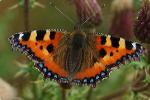
Sitting on top of a thistle was a factory fresh Small tortoiseshell.


A curiosity was a couple of bulrushes that where growing just off the edge of the immense concrete slab possibly as a result of rain water run-off from the concrete creating a small damp habitat.


An early find that took us a little by surprise in view of the "poor" habitat was a blue bug nymph:

Photograph: David Williams
We later found an adult. Or rather it found us as it landed at my feet just as we were leaving the site.

A couple of moth larvae were found which have been identified by the county moth recorder:

Common marbled carpet:

Photograph: David Williams
And Canary-shouldered thorn.


The vacuum sampler was used often in the morning and was by far the easiest way to seach in this habitat. One of its finds was a Denticulate leatherbug.

Photograph: David Williams
A fairly early lunch was taken before we dispersed to explore the further reaches of the site which had, in the main, been covered in scrap until recently. It was quite remarkable that we found a good number of species but its proximity to Whixall Moss probably helped the invertebrate fauna to move in.

The moss-side edge of the site yielded a couple of dragon- and damsel-flies:

A black darter:

Photograph: David Williams
And an Emerald damselfly.

Photograph: David Williams
Next two grasshoppers for the price of one!


The insect at the top of the photograph is a male Meadow grasshopper; the one at the bottom is a male Common green grasshopper.

The site has a few outcrops of denser vegetation including willow presumably where there was less inhibition from the contents of the yard.


And one mound to remind us of its former use.


In addition to the Small tortoiseshell we saw quite a few butterflies including a beautifully bright yellow Brimstone but one that posed for a photograph was a very well travelled and worn Painted lady.


And for our final insect another curiosity. Cinnabar larva - not on Ragwort which is the normal foodplant but on Colt's-foot.


According to the Field Guide to the Moths of Great Britain and Ireland by Waring and Townsend the larvae of Cinnabar are found mainly on Common Ragwort, other ragworts, groundsels and occasionally on Colt's-foot. Well this was one of those occasions.

Time to move on.

But before we left we had time to admire this piece of art at the second entrance to the site:

Photograph: David Williams
No doubt the artist has prepared a huge script detailing his/her every thought in the process of producing this desirable piece.

Or, perhaps, it was just too difficult to remove it.

The plan was to spend some time in the flood fields either side of Moss Lane on the other side of the Llangollen Canal to the scrapyard.

But they were flooded!!


Another part of the plan for the day had gone awry.

As the amount of water present made access difficult we contented ourselves with a bit of bird-watching before returning to the cars and heading home after another satisfactory if slightly disrupted day.

My thanks to Shropshire Wildlife Trust for giving us permission to do what we enjoy doing and to the photographer David Williams for his excellent pictures.