18 Jul 2019

Sockless in Shropshire

Cunnery Road Cemetery, Church Stretton and St. Margaret's, Acton Scott - Wednesday 10th July 2019

This was our third outing with Caring for Gad's Acre. We visited two sites - the cemetery at the bottom of Cunnery Road just south of the centre of Church Stretton in the morning and the churchyard of St. Margaret's in Acton Scott in the afternoon.

In the morning we were accompanied by a film crew who were preparing a series of videos about the importance of churchyards and we were to help make the one about invertebrates. It was a bit like "Springwatch" as the crew flitted bout the cemetery filming bits of action, both invertebrate and human. 

And, of course, the interviews. 

Fortunately we had a volunteer to be interviewed. Somewhat reluctant, but a volunteer.

Whilst all this was going on we were joined by a group from Shropshire Wild Team who came for a morning of surveying.

The day started well. I was ready without stress early, collected the others on time and after a quiet drive to Church Stretton arrived on site early. It was only when I was getting ready that I realised I had forgotten something - my socks.

It was too far to nip home for a pair. The choice was boots without or the open toed sandals I was wearing. 

Wary of bramble creeping up on me and taking advantage of unprotected toes, my decision was easy. Boots without socks. 

It never occurred to me that I may have been able to buy a pair in Church Stretton. Hindsight, what a wonderful (but useless) thing.

All this writing and no pictures … I had better do something about that.

The cemetery has an information board:
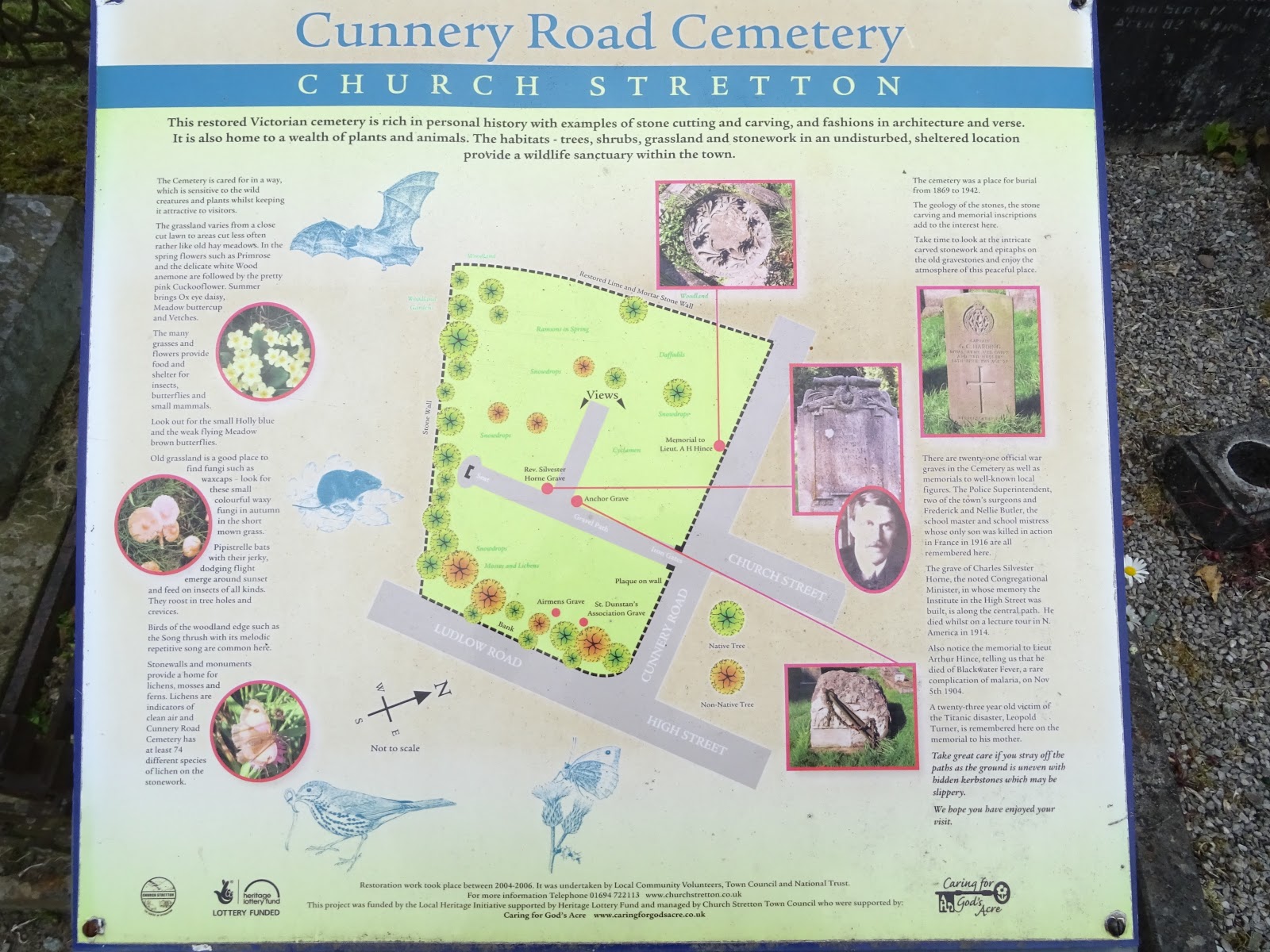

If you click on the image your browser should give you a larger image that you may be able to read

And here is a photograph of a part of the cemetery:


In the main apart from a small patch where the grass had been cut the vegetation had been left to do its own thing. This was good for animals that like tall rough lush vegetation but less attractive to those that prefer sparser vegetation. 

There were plenty of meadow brown butterflies flying about and the film crew spent quite a while trying to film them especially one pair that were full of the joys of spring.

And what did we find?

I am afraid to say that overall it was a bit disappointing. Although there were plenty of invertebrates there was not a great variety of species. However there were some stars - my own interests may have clouded my judgement slightly!

A forget-me-not shieldbug nymph:

Photograph: David Williams
The nymph of a large plathopper, probably Evacanthus acuminatus:

Photograph: David Williams
The star of the day - a Tortoise shieldbug

Photograph: David Williams
This species had a curious distribution with all the early records being found in Wyre Forest. Then, a few years ago, one turned up in Dolgoth Quarry in Llynclys which is in the opposite corner of the county to Wyre. A couple of years ago they were found in Cramer Gutter close to Catherton Common and in Telford. It has now turned up in Church Stretton. Long may this expansion continue.

Look away gardeners, here are sawfly larva on rose doing the sawfly thing of eating whilst holding a picturesque pose.


Finally before we move on one of the "Springwatch" team in interview mode:


We lunched, said goodbye to the Shropshire Wild Team and the film crew and prepared to move on to St. Margaret's in Acton Scott.

As we were all set to go my passenger noticed a large moth on a car parked in front.

"Is that a Scarlet tiger?" he asked.

He got out of the car for a closer look.

It was. What an excellent spot.

Unfortunately it was disturbed and flew off.

Straight into the cemetery … so we recorded it.

On to Acton Scott we went.


This Grade II listed building dates back to the twelfth century with additions in the 14th; parts were rebuilt in the 19th, The porch, in a recent renovation was dated 1722:


The grass in the churchyard had been allowed to grow although it is due to be cut soon. The dominant trees yews, several of great girth.


We set about our "work".


What did we find?

First the same species of butterflies that the film crew had been chasing - Meadow brown:


Photograph: David Williams
And another bordered shieldbug:


Photograph: David Williams
A clump of tiny, recently hatched, Hairy shieldbug nymphs were found on Woundwort:


Photograph: David Williams
A couple of the larger hoverflies were spotted on flowers.

Volucella pellucens:


And with its distinctive pattern on its thorax Myathropa florea.


Photograph: David Williams
The heat and excitement of the day was beginning to take its toll and enthusiasm was flagging and the 1722 porch with its coolness and seats became popular.

But others continued searching and found a Narrow-bordered five spot burnet:


Photograph: David Williams
And a Field Grasshopper


Photograph: David Williams
What a day.

My thanks to Caring for God's Acre for inviting us and making the necessary arrangements. My gratitude also to the photographer, David Williams, for providing me with his excellent images for me to share with you.

8 Jul 2019

It's not a sting in the tail

Underhill Farm, Pant, Wednesday 3rd July 2019

We were a little tardy leaving. And as always happens when you are running late the traffic seemed against us with slow moving this and that getting in the way. But by the time we reached Knockin and mourned the passing of the Olde Knockin Shoppe I thought we were going to make it on time.

How wrong I was as we came to the sign declaring "ROAD CLOSED".

A diversion was provided which we took but we ended up on the outskirts of Oswestry before turning south to Pant. By now we were very late. However we got there eventually.

When we asked one of the others who had come from Telford if he had been held up he replied "What Diversion?".

He had come a different way from Knockin and was oblivious to the road closure. Lucky him!

Underhill Farm as suggested by the name nestles at the foot a hill - in this case Llanymynech Hill, which is the site of Llanymynech Rocks Nature Reserve. From where we parked we had a good view of the quarry face.


The owner of the farm met us and gave us a brief outline of the history and layout of the farm and what he is trying to achieve in the way he manages it. Unfortunately recent events have not helped his cause with Severn Trent driving a new water main through his land causing havoc and devastation across a wide swathe of land.

The photograph below gives a glimpse of how Severn Trent finished the job. Far from ideal leaving the owner with the problem of how best to restore the land.


In addition his tenant had cut the meadow early causing more frustration.

However it gave one of our group the chance to exercise his photographic imagination.

Photograph: Bob Kemp
In addition to a range of old buildings there was a range of facilities available to us: a picnic area; a sheltered area; a kitchen with a refrigerator and kettle and, joy of joys, a toilet. No need to nip behind a tree - Bliss!

We were taken through the entrance to view the facilities:


At the end of the path on the left of the buildings was a 19th century hay wain which will, all being well, be restored.

This again brought out the "artist" in our photographer:

Photograph: Bob Kemp
For those of you not hankering after the days of yore here it is in colour.


Close to the hay wain we found a Ringlet butterfly living up to its name with the row of "rings" along the edge of its wing.


Whilst close by a Harlequin ladybird had buried its head ostrich-like in a thistle.


We meandered to the recently mown meadow and inspected the hedgerow and dense marginal vegetation.


The margin harboured several Pyramidal orchids

Photograph: David Williams
Amongst the insects we found in this area was the larva of a Peacock butterfly:

Photograph: David Williams
A wasp with an extremely long ovipositor (no it is not a sting) which has tentatively been identified as Gasteruption jaculator:

Photograph: David Williams
Despite the wasp looking pretty distinctive there are lots of wasps that look similar! The wasp will inspect nest holes of solitary bees and wasps and if the conditions are right, insert its ovipositor into the nest hole and lay its own egg next to the egg of the host. The larva of the wasp on hatching will devour the larvae of the hosts and any food stored.

A 14-spot ladybird larva:

Photograph: David Williams
A Ruddy darter dragonfly:


And, finally, a Forest bug nymph.

Photograph: David Williams
A leisurely lunch was taken, quite late by my standards, at the picnic tables (although one or two had succumbed already).

Refreshed we moved into the field occupied by about a dozen sheep.

Photograph: David Williams
This field contained a couple of pools which were very quiet except for a Comma butterfly that posed on the leaf of a bur-reed.


The sun was beating down, the temperature was soaring and the energy of one or two or three members of the group was flagging ….


Restored after a brief rest we moved onto a third field.

Here we found a tiny Ant damsel bug nymph.

Photograph: David Williams
In this field a small sheet of metal had been placed on the grass. Reptiles are sometimes found under such a sheet, but more often than not it is ants and occasional amphibians. When this one was lifted there were slow worms underneath.

Photograph: David Williams
What a wonderful end to the day.

My thanks to Steve Evison for allowing us to visit his farm and Gareth Egarr of Shropshire Wildlife Trust for suggesting the site and providing the contact. My thanks also to the photographers David Williams and Bob Kemp for allowing me to use their photographs.

Steve Evision is involved in running two organisations that bring people and nature closer together. If you are interested you can find more information at the following two websites:


2 Jul 2019

In my absence

Hodnet Heath, Wednesday 26th June 2019

Hodnet Heath is a privately owned patch of heathland just outside, do I really need to say, Hodnet. 

It is a Site of Special Scientific Interest as a remaining small segment of the more extensive heathland that was present in North Shropshire. This site is predominantly wet heath with patches of dry heath and pools surrounded by secondary woodland.

I missed this trip as I was away on the Isle of Wight for a week. However I had a very able deputy who was able to keep an eye on things in my absence and ensure that the outing passed without incident.

My deputy is a man of few words and here is what he wrote about the visit:

"Arrived on time (more or less); overcast but dry; plodded down main path; had lunch; headed off towards schwingmoor; found cranefly, grass wave etc; went home."

To be fair he did offer to flesh it out, but why take up more of his time when that sentence encapsulated the day!

I need to expand a little on this summary.

The "schwingmoor" is an area of bog formed over water or mud and it quakes when you walk on it.

The cranefly was the beautifully marked Idioptera pulchella. A species that is rarely seen making this an exceptional find:

Photograph: David Williams
The "grass wave" is a moth which is found on lowland heathland, moorland and bogs.

Photograph: David Williams
Well, that's about it for this week. But before I sign off, I know you like to see the excellent photographs of species observed during the day. Here they are.

Bog bush cricket nymph:

Photograph: David Williams
The eggs of a bronze shieldbug:

Photograph: David Williams
The nest of buff-tailed bumble bees:

Photograph: David Williams
A slime mould, Ceratiomyxa fruticulosa:

Photograph: Bob Kemp
A group of Cinnabar moth caterpillars munching their way through a ragwort:

Photograph: David Williams
A weevil, one with a very long rostrum, Curculio venosus:

Photograph: Bob Kemp
A jumping spider, what big eyes it has:

Photograph: David Williams
A longhorn beetle, Leptura quadrifasciata:

Photograph: David Williams
Next a couple of bagworms. These are the larval stages of moths in the Psychidae family. The larvae of this family encase themselves in detritus to provide them with a disguise that protects them from predators. Often the moth can be identified from the structue of the case.

The first larva has included lichen in its case, this is Luffia ferchaultella:

Photograph: David Williams
The second is Psyche casta which has built its case from blades of grass and rush:

Photograph: David Williams
And finally a grasshopper - a meadow grasshopper.

Photograph: David Williams
My thanks to Pete Boardman for arranging access to this excellent site and permission to survey. My gratitude as always to the photographers David Williams and Bob Kemp for the use of their pictures. And special thanks to David as well for looking after the group in my absence.