Wednesday 15th November 2023, Colemere
We were treated to a glorious autumnal day for this visit. We parked and met in the visitor car park, discussed which direction we should circumnavigate the mere, agreed, then immediately went the other way (should I be surprised) by starting in the large meadow.
Our first sighting was of some black cattle which were grazing the meadow. Three or four stopped what they were doing and stared at us. Then, one of them proved extremely friendly and said hello to our Dipterist.

Perhaps it was hoping that he would get his pooter out and remove the flies that were pestering it.
They followed us for quite a while until someone else arrived on site and wandered off onto the meadow. The cattle seemed to think he was more likely to give them what they wanted and trooped after him, leaving us alone.
Early activity was at the edge of the mere where the plants were being examined closely and photographed extensively.

And this is what had been found under one of the leaves.
 |
| Photograph: David Williams |
Three species of ladybird. From left to right: Coccidula scutellata; Coccidula rufa and Water ladybird.
After the copious amount of rain that had fallen in the previous days the meadow was very wet and parts that were normally dry were flooded.

Within the meadow there is an area that is meant to be wet. On this occasion it was very wet, but it did nor stop one member of the group wading in to see what he could find.

I would like to think he found this:
 |
| Photograph: John Martin |
A curlew. However, this was an opportunistic photograph of a passing bird snapped later in the day.
It may have been in this area where the shore fly Trimerina madizans was found. This is a fairly scarce species of wetlands that eats the eggs of wetland inhabiting spiders in the genus Hypselistes. It’s a handsome little fly sporting shiny black livery and bright orange legs.
 |
| Photograph: Nigel Jones |
Moving on we checked out the rougher vegetation at the edge of the meadow. Here we disturbed a rather groggy Silver Y.

You often come across these moths during the day when walking through grassland. Generally you see something fly away from you and settle at a “safe” distance. As you try to follow it, it will almost inevitably fly away again as soon as you start to get close enough to identify it. As you can see from this photograph, this moth had lost its get up and go.
Continuing our circumnavigation, we entered the wood. A Common darter was spotted resting on a tree. An attempt to photograph it resulted in it flying away. We saw where it went and tried again, with the same result. Fortunately, we were able to follow its flight as several other unsuccessful attempts were made before it finally decided to pose for us.
 |
| Photograph: John Martin |
After this chase things settled down as we were able to concentrate on more sedentary species as we made our way through the wood.
A Speckled wood larva.
 |
| Photograph: David Williams |
A Forest bug nymph on the trunk of a tree.
 |
| Photograph: David Williams |
The larva of a case-bearing moth Taleporia tubulosa.
 |
| Photograph: David Williams |
A Green shieldbug.
 |
| Photograph: David Williams |
And a harvestman Leiobunum blackwalli.
 |
| Photograph: John Martin |
Having exited the woodland, we were now at the far side of the mere in a small open area of grassland. Glancing through the trees, bushes and other poolside vegetation we were able to see the church, on the far side, picked out by the mid-afternoon sun.

As time was marching on, we raced back (more like ambled with a purpose) through the woodland glade bordering the mere. To be fair, apart from a few fungi, there was little to observe.
Back at the grassland by the car park we had a last search before returning home.
Wednesday 22nd November 2023, Benthal Edge
We have visited the woods along Benthal Edge quite frequently, but have always been at the foot of the edge and never the top. This visit changed that as we wandered along the summit footpaths.
Having met in Benthal Hall car park we made our way along a lane to the Edge. There was a little dallying as the hedgerow was tapped and patches of vegetation suction sampled, but, on the whole, we got to the woodland fairly quickly.
Reaching the wood, the path divided with one going left and one going right. There was a third path that went down but temptation to take it was curtailed as this was closed due to a landslip.
Unfortunately, the path did not prove very interesting entomologically and very few species yielded to our efforts to find them.
Here are photographs of a few species that we did find and were able to photograph.
A pseudoscorpion, Neobisium carcinoides, with its meal, a captured springtail.
 |
| Photograph: John Martin |
A beetle that we were only able to identify to genus, not species, Asaphidion.
 |
| Photograph: John Martin |
A harvestman Rilaena triangularis. This species has recently suffered the indignity of having its name changed – it used to be Platybunus triangularis.
 |
| Photograph: David Williams |
A bristletail, again we could not identify the species only the genus, Dilta. Just look at those eyes!
.jpg) |
| Photograph: David Williams |
A spider Cyclosa conica, its name seeming to reflect its conical shape.
 |
| Photograph: John Martin |
Another harvestman, Nemastoma bimaculatum, with its two white patches on a dark body.
 |
| Photograph: David Williams |
And a bit of a curiosity, a larva with what looks like caked mud between its legs.
 |
| Photograph: David Williams |
Are they clumps of mud or are they parasites that have covered themselves in detritus?
I do not know, do you?
Wednesday 29th November 2023, Corbet Wood, Grinshill
You may have noticed that I have yet to mention success in finding Snow fleas recently. Although it is early in their “season” we had hoped to find them in the sites we had visited. With this in mind we visited Corbet Wood where, a few years before, several had been found.
Corbet Wood is a former quarry on the side of a hill that has naturalised with woodland. There are also some patches of conifer.
As usual, after getting ready, we dallied in the car park as a patch of rough grassland with marginal bushes and trees was investigated. Eventually it was suggested that we headed to the spot where Snow fleas had been found before.
We “raced” to that spot, skirting past the upper quarries…

And down a long descending path …

To the path that followed the foot of the site.
We followed the path for a short way to “the spot”.
Search as we might, we could not find any Snow fleas.
Very disappointing.
Down, but not out, we then concentrated on what was there rather than what was not.
An early surprise for us, and for it, was a Tawny owl that our rummaging in the undergrowth disturbed. Unfortunately all that most of us saw was a flash of wing feathers as it disappeared into the woodland.
More sedentary was this Common wasp.
 |
| Photograph: Neil Nash |
And this long-legged harvestman Dicranopalpus ramosus agg.
 |
| Photograph: Nigel Cane-Honeysett |
Why the agg.? Well, there is at least one other species that looks the same and rather than having to kill and dissect it to determine the species we just lump them together with the “agg.” suffix.
A cluster of 7-spot ladybirds.
 |
| Photograph: David Williams |
A tightly rolled up Pill millipede.
 |
| Photograph: Neil Nash |
A ground beetle, Notiophilus biguttatus.
 |
| Photograph: Nigel Cane-Honeysett |
A pair of spiders, Drapetisca socialis, living up to their name.
 |
| Photograph: Nigel Cane-Honeysett |
A fungus, Purple jellydisc.
 |
| Photograph: Neil Nash |
A quarry wall in this lower section of the site attracted a good deal of attention.
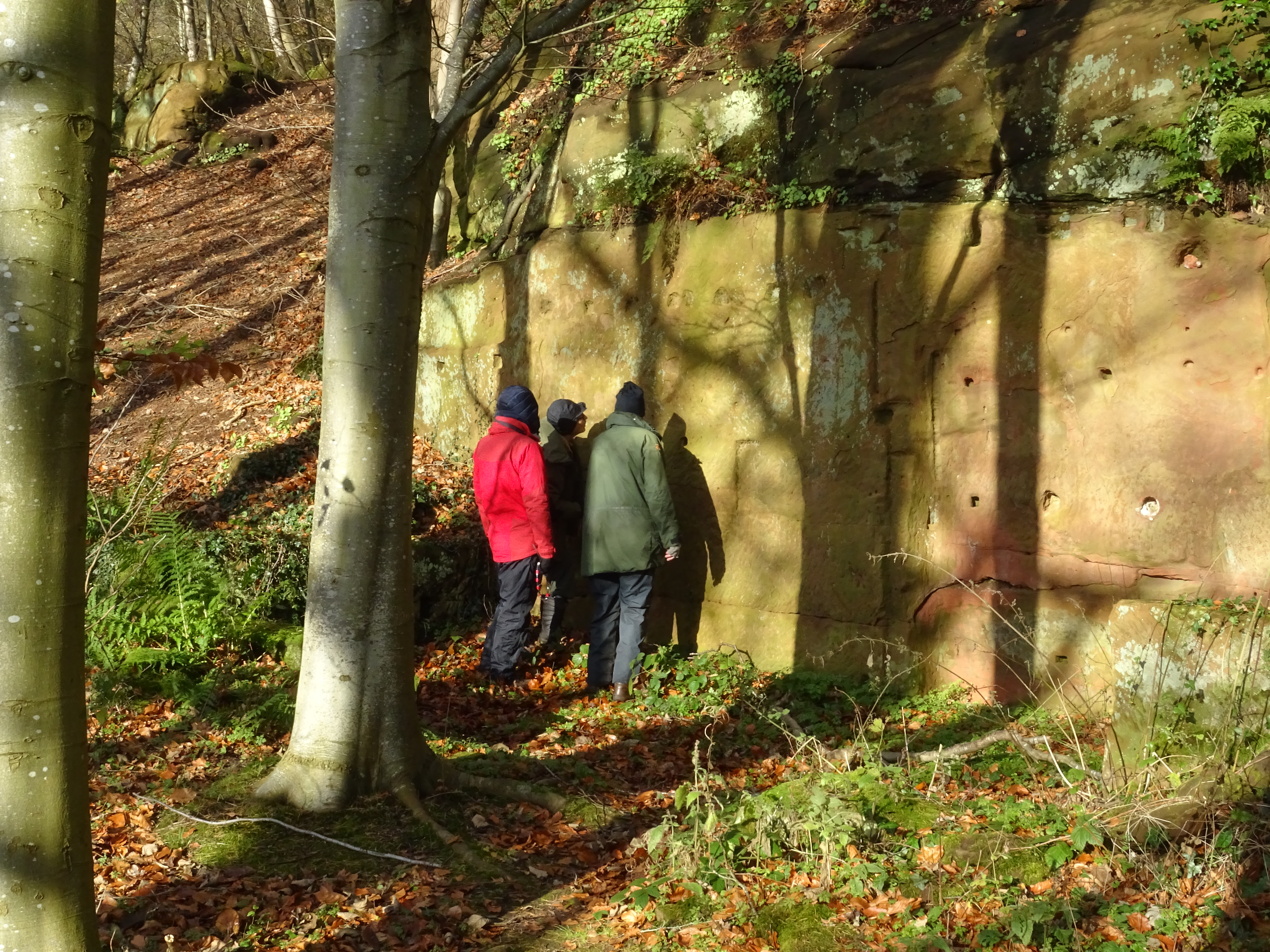
What were they staring at?
A tiny indentation in the stone face in which a Forest bug nymph had stationed itself.
 |
| Photograph: David Williams |
We were making slow progress along the bottom path as species of interest (except Snow fleas) kept turning up.
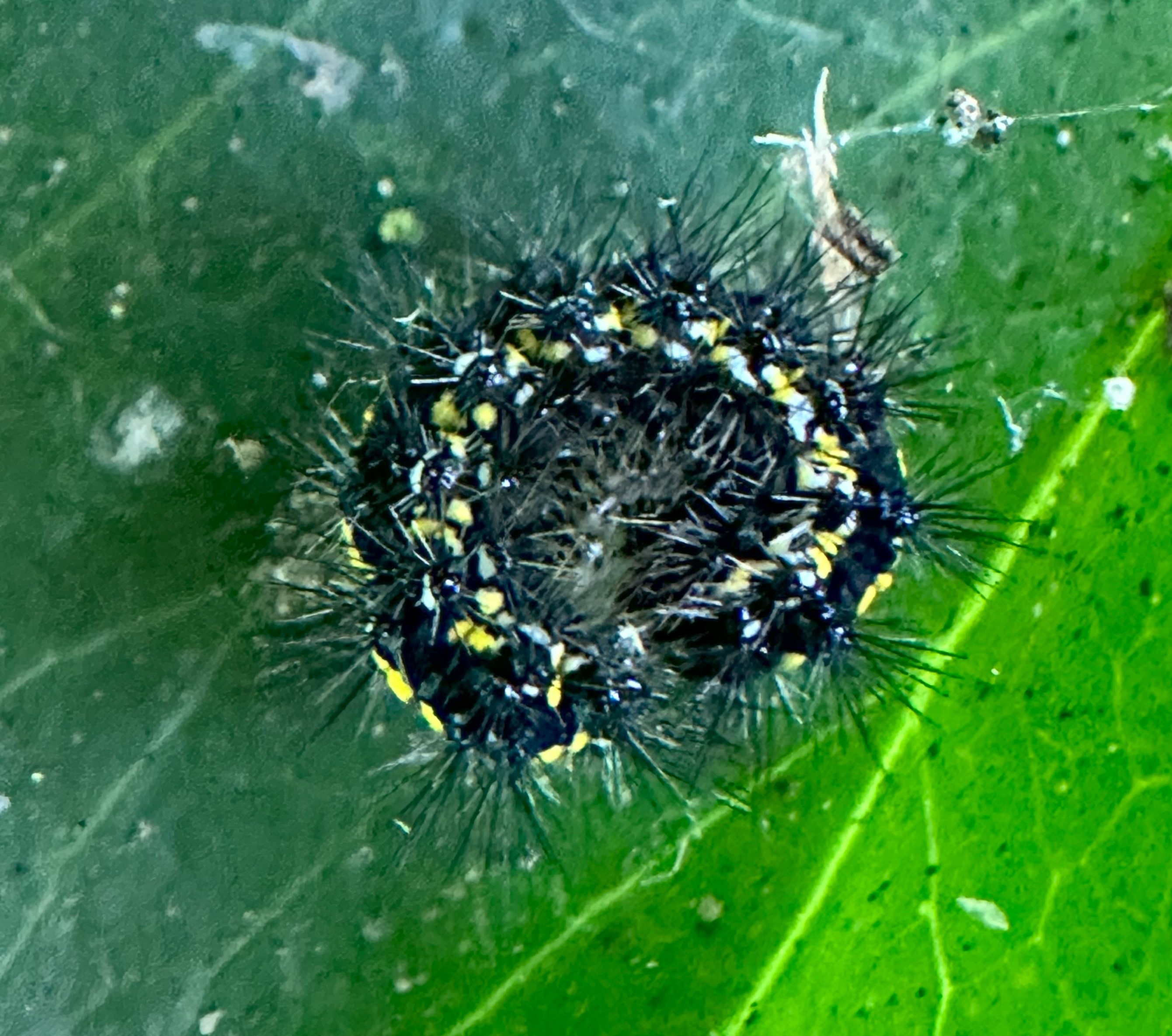
A Scarlet tiger moth larva.
 |
| Photograph: Nigel Cane-Honeysett |
A harvestman Nemastoma bimaculatum whose description I mentioned above when we found it on Benthal Edge.
 |
| Photograph: Nigel Cane-Honeysett |
And a very common and distinctive fly Mesembrina meridiana, known as the Noon-day fly as that is generally about the time of day you find it, on sunny days, resting on the vegetation.
 |
| Photograph: David Williams |
For a change I wandered up the slope a little way and found two enormous fungi. I have no idea what they were but am happy to be enlightened. Here is one of them.
.JPG)
The object at the bottom of the photograph, to give you a sense of its size, is my boot.
Reaching a gently sloping path that seemed to return us to the start we ignored it and carried on along the path at the bottom. This passed some houses then joined a lane. After a few yards the lane veered off to the right and some of the group wandered off along it.
Others were more circumspect and noticed a path over a huge stone stile that seemed to offer a route to the top. This was taken.
Clearly we had split in two. A few telephone calls later we were content that everybody would end up in the same place and we carried on.
Reaching the top one of the group spotted some holes in an oak leaf.
 |
| Photograph: David Williams |
These were feeding signs of the case-bearing moth Coleophora flavipennis. Diligent searching of the tree on which the leaf was found revealed the larva tucked in at the base of a leaf bud in its case.
 |
| Photograph: David Williams |
Passing through an area of conifers we caught a glimpse of The Wrekin.

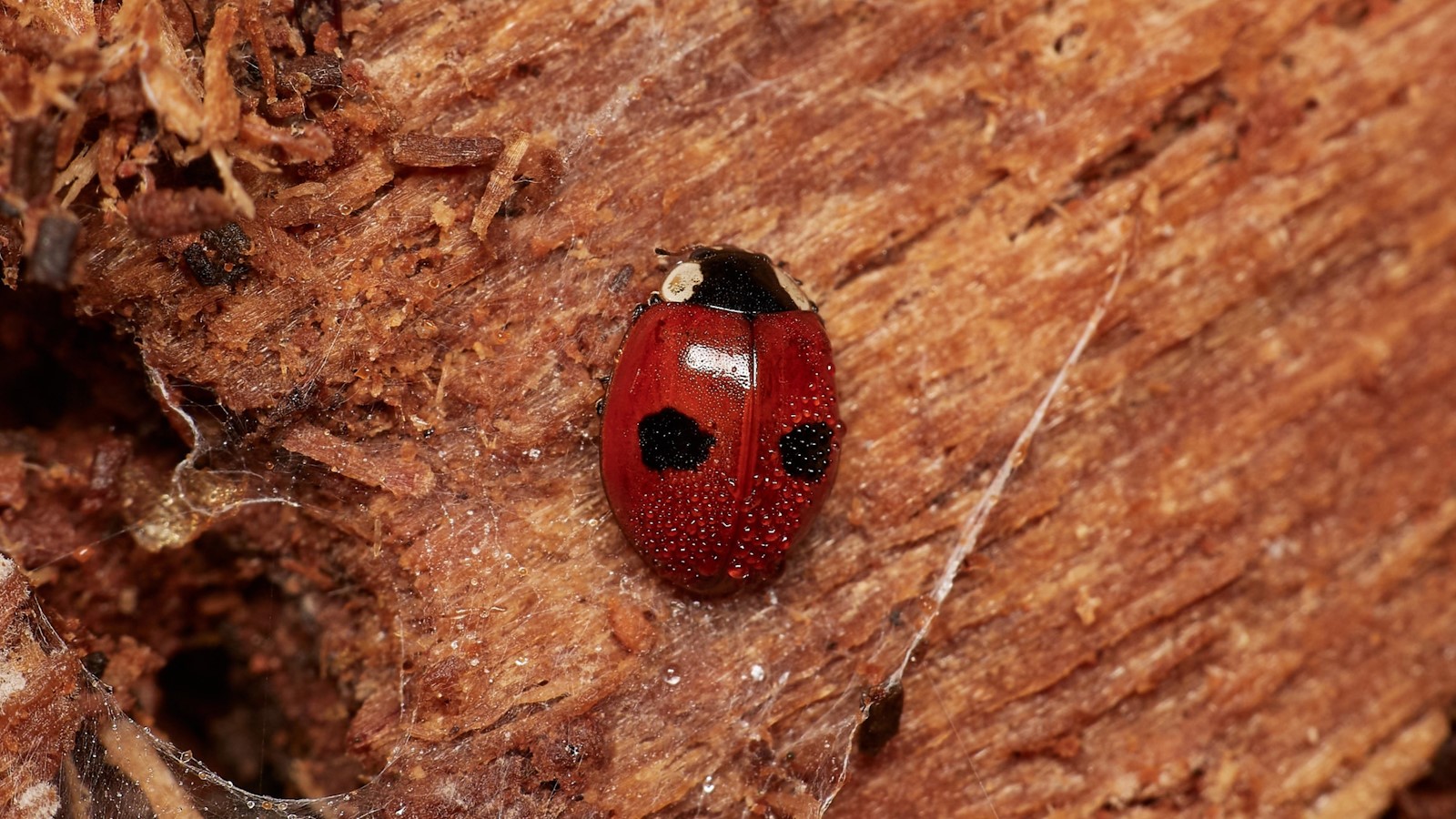
One of the conifers had taken a tumble and the opportunity was taken to examine it and, lurking on its bark, was a 2-spot ladybird with beads of condensation (or melted frost) on its elytra.
 |
| Photograph: David Williams |
Nearby a clump of bramble was beaten and out fell this…
.JPG)
I am no good at identifying a bug from its underside, so it was flipped over to reveal that it was a rhopalid bug, Corizus hyoscyami.
.JPG)
And passing a final seat one of the group found it just right for a little reflection on the day's events.

My thanks to Shropshire County Council and the National Trust for allowing us to do what we enjoy doing. My immense gratitude to the photographers for sending me their images to illuminate the report.


.JPG)
.JPG)


.JPG)

.JPG)
.JPG)

.jpg)
.jpg)


.JPG)

.jpg)
.jpg)


.jpg)
.jpg)

 Posts
Posts