Thursday, 10th June 2021
Just over a week ago the Joy of Wildlife group was hosted by Denso at their facility in Telford. Part of their grounds has been given over to an "Eco Garden" for the benefit of wildlife, their staff and visitors.
The site consists of a large patch of wildflower grassland, woodland, bug hotels, bee hives and a few raised garden beds. There are plenty of paths to follow which weave in and out of the features making it is easy to lose your sense of being on a factory estate surrounded by other industrial units.
As the grassland was nearest to the car park that is where we started.

The boundary between the wildflower rich area to the right of the photograph and the woodland on the left was the focus of our attention for a good part of the morning as we swept, beat and vacuumed our way along it.
An early find was Lesne's earwig.
 |
| Photograph: David Williams |
This is an adult male. It is slightly smaller than a common earwig and the claspers have a longer and broader straight section before the curved section. In addition no wings can be seen sticking out from the wing cases.
Not only did we find this male but also first instar nymphs.
 |
| Photograph: David Williams |
The wonders of photography is that the nymph appears to be the same size as the adult. Rest assured it is not; it is minute.
As someone who is always on the look out for Forget-me-not shieldbugs I was drawn to a large patch of blue flowers.
Unfortunately as I got closer it became clear that they were not Forget-me-nots but Germader speedwell.

No shieldbugs.
More joy for our Othoptera and Allies (which include earwigs) Recorder, a Speckled bush cricket nymph.
 |
| Photograph: David Williams |
More frustrating for this recorder was the large number of early instar grasshopper nymphs that were pinging around the grassland, as it is not possible to reliably identify the nymphs.
As I have said before, where there are yellow flowers there is quite often an insect or two, sometimes many more, in residence feeding or resting. Here we have a pair of Oedemera lurida beetles trying to ensure the survival of their species.

And whilst on the subject of buttercups here is one I did not know existed - Ranunculus parviflorus, Small-flowered buttercup.
 |
| Photograph: John Martin |
Every trip is a voyage of discovery. In amongst the mundane something extraordinary usually crops up.
The weather was treating us well, too well as it had become rather hot in the wide open grassland. We sought shade in the woodland and seats for lunch.
Lunch over we headed, by as direct a route as we could find, to a small pool, where we watched a pair of Azure damselfiles in tandem as the female was ovipositing around the edge of leaves on the surface of the water.
At the edge of the pool we found a Red-headed cardinal beetle
 |
| Photograph: David Williams |
When we looked more closely we found not one ...
Not two ...
Not three ...
But lots, so many that I cannot remember the exact number, but it may have reached double figures and beyond.
Looking up the collective name for cardinals I have found "conclave" and "college" as options. I have gone with the former for the title of this piece.
But the tale of cardinal discoveries is not yet fully told ... read on.
From the pool we ventured further into the woodland and chanced upon a small "exotic" area where tree ferns had been planted and pride of place was a skull.

Nearby a Black-headed cardinal beetle was spotted to complete our Conclave.
 |
| Photograph: David Williams |
We left the jungle and headed for more open countryside.
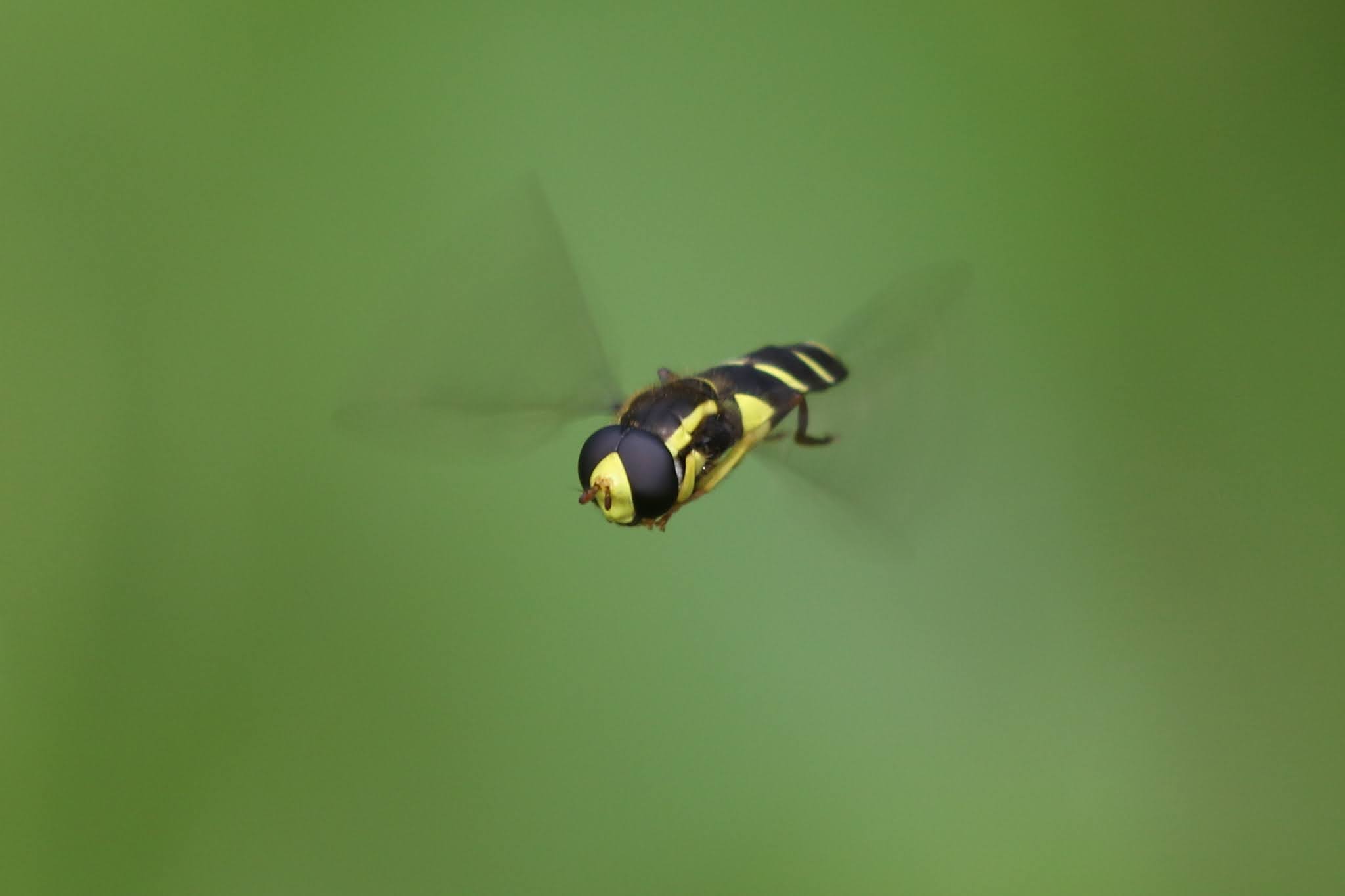
A Xanthogramma pedissequum was photographed in flight.
 |
| Photograph: John Martin |
It is hard enough trying to capture a hoverfly in flight with a net, I cannot imaging the patience and technical wizardry required to photograph one this way.
Back to more sedentary insects, a Woundwort shieldbug was beaten from the general vegetation.
 |
| Photograph: David Williams |
I think this is one of our most attractive shieldbugs and it is always a delight to find one.
But, whilst I was admiring the bug, attention switched to a nearby patch of vegetation where a long horn beetle, Leptura quadrifasciata was resting on a leaf.

Time had flown by - it was time to go home.
So we did.
My thanks to Denso for welcoming us to their creation and allowing us to do what we enjoy doing, to the photographers for allowing me to use their photographs and to all who attended and supplied records.
Bioslog Update
Neil tells me he is now nearing 800 species.
Other goings on
The Tanyptera Trust project, based at Liverpool Museum have restarted their recording days. Their first outing was to a dune system, Red Rocks SSSI, in Hoylake on the Wirral. The site is a home to Natterjack toads.

Opposite. in the mouth of the Dee Estuary is Hilbre Island.

Apparently when the tide is out far enough you can walk to the island.
Not directly but from West Kirby, which is about 2 km further down the estuary from Hoylake. The sands around Hoylake are not to be trusted, but those around West Kirby are.
I was not tempted.
The only insect I photographed on an enjoyable day was a Oak eggar larva which had become stranded on a path. I moved it to the vegetation at the side but did not wait to see if it returned to the middle.

The following day the Shropshire Moth Group held a moth night at Pam's Pools, Underton which is near Bridgnorth.
The group had trapped there before on several occasions but on this evening we moved across the road from the main area of the site to a recently acquired area that has been reclaimed from a disused sand quarry.
Things were going very well with an early find before the traps were fired up.
A Wasp beetle
 |
| Photograph: David Williams |
The traps were started and, although the moths were not exactly flocking to the traps. there was a steady influx.
Then we hit a technical snag. The generator we use to power a couple of the traps decided that it had done enough work for the night and cut out, leaving the traps in darkness.
No amount of kind words, cajoling, restarting etc, would persuade it to produce electricity so we had to call it a day (or night) earlier than we wanted to.
Despite the truncation a few "nice" moths were found and photographed.
Poplar hawkmoth:
 |
| Photograph: David Williams |
This is a head-on view of the same moth.
 |
| Photograph: David Williams |
An Alder kitten:
 |
| Photograph: David Williams |
A Lime hawkmoth:
 |
| Photograph: David Williams |
Earlier this week I visited Rodborough Common, Stroud with a couple of colleagues. Our target species for the day were two butterflies - Adonis blue and Brown argus, and an ice cream from an ice cream shop on the common, much missed during lockdown.
We were successful with the butterflies finding both species within a few yards of each other on limestone grassland in a sheltered valley.
Adonis blue:


Brown argus:

It was still a little early for our third target of the day so we did a little more exploring.
We were delighted to find numerous Small blue butterflies.


As we watched the Small blues we realised that a pair were involved in some form of pre-mating ritual, flitting from flower to flower, spending a few seconds on each flower arching their abdomens as though preparing to couple before moving on.
 |
| Photograph: Bob Kemp |
Eventually they settled on one plant, coupled then proceeded to rotate quite quickly around the plant.

We left them in peace.
Not far away we spotted an unusually marked common blue (at least we think it is a common blue) with black streaks towards the wing tips of the forewing.
 |
| Photograph: Bob Kemp |
It was time to achieve our third target but on the way we were distracted by finding a Marsh fritillary.

At last we made it to the shop to be met by a queue of young children waiting to have their reward for returning to school after the half-term holiday.
We waited patiently, got to the front of the queue, made our choice and retired to a grassy bank close by to enjoy.
Three targets achieved. A satisfactory day.
But it was not yet over. We wandered over to another part of the common and had a good look around and tested the many seats that were scattered across the area.
This final section provided a huge surprise when we innocently photographed a beetle with 10 spots. It was not a 10-spot ladybird but a Cryptocephalus primarius (also known as the Rock-rose pot beetle).

We later found out that this is an endangered nationally scarce beetle.
What a delight on which to end the day.
Take care.


 Posts
Posts