Wednesday 6th May 2026, Brineddin Wood, Chapel Lawn
In my opinion, Chapel Lawn, deep in the Welsh Marches countryside, should have been included by A. E. Housman as one of his "quietest places under the sun". ‘Rural’ hardly covers it. Though I admit that the list would be unpoetically long if he'd included every qualifying place in this part of Shropshire and in any case it neither rhymes nor scans, so he probably knew what he was doing. But it's certainly very quiet! Brineddin Wood stands over the village on the south-facing slope of Hodre Hill. An information board in the woodland gives a comprehensive description and history of the site.
 |
| photo: Nigel Cane-Honeysett |
We had arrived and parked in the village hall car park. From here it was a walk of 10 minutes or so across fields to the wood. Weather forecasts had predicted a grey and rather chilly day. Well, the wind was rather fresh, but the weather which greeted us looked altogether more like this:
And the view to our destination looked like this:
As the group contemplated what threatened to be a rather testing ascent, thoughts turned to something we had passed as we walked out of the car park…
 |
| photo: Keith Fowler |
In due course, we panted our way up to the entrance gate. We were not yet on site! Through the gate we went, where we found ourselves on the perimeter path running along the bottom of the wood. |
| photo: Keith Fowler |
We considered the woodland above us on what seemed to be a 45 degree slope. We considered the perimeter path. We decided that the path was clearly in need of a very thorough and careful investigation. Opposite us, across the River Redlake, was Caer Caradoc. Well, a Caer Caradoc - there are several; Caractacus clearly got about a bit! |
| photo: Keith Fowler |
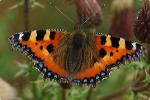
In the above picture the river’s route is marked by the meandering line of flanking trees. Several lines of molehills can be seen, also meandering across the field. The pleasant, sunny aspect took our minds off the words of our host as he let us in through the gate: “There are loads of deer in the area, so you may encounter some ticks”. We continued to be distracted as a Painted Lady flew past us and landed in the adjacent field, where it was photographed with a long lens. |
| photo: John Martin |
At this point the vacuumers got down to business, whereupon the tick situation became all too real. The first sample produced at least four of them.
Over the course of the day it became apparent that this was the norm. Every beat, sweep or vacuum sample produced ticks in numbers. They were everywhere. I have never seen so many ticks in my life. Trousers were tucked into socks. But we carried on and tried to concentrate on the other finds.
Another species which was surprisingly common in the vacuum samples was Bordered Shieldbug.
Not a species we commonly encounter, it is found in Cleavers and other bindweeds, which begs the question why it isn’t seen more often. Here, it turned up in most samples, often in multiples, though not rivalling the ticks in abundance.
Several tiny Oak Bush-cricket nymphs appeared from the undergrowth. An arboreal species, we often find these hatchlings at ground level. I don’t know whether they just fall out of the trees or if they are there by choice (eggs are laid in the bark of tree trunks, so they could go either way). As predators, they should be able to find food in either situation. At this age they are indistinguishable from the closely related Southern Oak Bush-cricket, but the chances of that synanthropic species being in this wood are vanishingly small.
Ladybirds were in surprisingly short supply. The odd 7-spot was seen and late in the day a single Meadow Ladybird was vacuumed. Otherwise all the ladybirds we found were 14-spots.Bluebells lined the path and formed patches under the trees.
Two organisms associated with them were duly found. This is the micro-moth Hysterophora maculosana.
 |
| photo: John Martin |
And this is Blubell Rust, Uromyces hyacinthi.  |
| photo: John Lyden |
On the subject of rusts, this is Pale Bramble Rust, Kuehnola uredinis.
 |
| photo: John Lyden |
It is wiglet season - hurray! Or if you want to be po-faced about it, earwig nymph season. Several appeared over the day, all of them second instar Common Earwigs.
Back to micro-moths. This is Cauchas rufimitrella.
 |
| photo: John Lyden |
Whilst this is Nematopogon swammerdamella.
 |
| photo: John Lyden |
The time had come for some of us at least to face the prospect of an ascent into the woods.
We had been accompanied all day by the sound of Pied Flycatcher song. I slogged uphill in the hope that I could see one. I did. But it remained resolutely above me no matter how high I ascended. In the end, this distant view of it, not exactly showing its best side, was all I could achieve. Several areas in the woodland have been fenced to exclude deer. It was hoped that we could survey these enclosures (or, more accurately ‘exclosures’) so that a comparison could be made with the woodland outside them, at the mercy of the deer. The deer are having a serious impact on the woodland understorey and particularly on the regeneration of the oaks, all the germinating seedlings being eaten by them. Unfortunately, within the exclosures we quickly found the Bramble scrub to be too hard going to make much headway and so rather failed our targets in this respect. To add insult to injury, ticks appeared to be just as prevalent within the exclosures as without them!
The rest of the day continued at the lower level, finds continuing to be made. Rather than attempting a chronological account of the ones that were photographed I will list them taxonomically, starting with the flies. We begin with what must have been the find of the day, the scarce Tachinid, Carcelia bombylans.
 |
| Carcelia bombylans. photo: John Martin |
 |
| Phania funesta. photo: John Martin |
 |
| Myathropa florea. photo: John Martin |
And now a picture of a stick. There were quite a few of these, it being a woodland. But wait, this is not just any stick, it is a section of Hawthorn twig which reveals the signs of the fly Phytobia carbonaria, the larvae of which mine the stems of hawthorns and apples.  |
| photo: John Lyden |
We move on to beetles:
 |
| Woodland Dor Beetle |
 |
| Red-headed Cardinal Beetle |
 |
| Rhagium mordax. photo: John Martin |
 |
| Cantharis obscura. photo: John Lyden |
 |
| Grynobius planus |
 |
| Hazel Leaf-roller. photo: Nigel Cane-Honeysett |
 |
| Silver-green Leaf Weevil. photo: Nigel Cane-Honeysett |
 |
| Hairy Spider Weevil. photo: Nigel Cane-Honeysett |
 |
| Small Nettle Weevil. photo: Nigel Cane-Honeysett |
 |
| Clover Seed Weevil. photo: Nigel Cane-Honeysett |
Now a few other insects. |
| Green Shieldbug. photo: Nigel Cane-Honeysett |
 |
| mayfly, cf. Ecdyonurus torrentis |
 |
| stonefly cf. Isoperla grammatica |
A couple of spiders…  |
| Philodromus dispar. photo: Nigel Cane-Honeysett |
 |
| Pachybgatha degeeri. photo: Nigel Cane-Honeysett |
And finally two more beetles, these found in the local churchyard in which we had a brief diversion as we walked back to our vehicles at the end of the day.  |
| Amara cf. similata |
 |
| Two-spotted Carpet Beetle |
Many thanks to our hosts for granting us access to this lovely site.
Photographs © the author except as noted.


 We had been accompanied all day by the sound of Pied Flycatcher song. I slogged uphill in the hope that I could see one. I did. But it remained resolutely above me no matter how high I ascended. In the end, this distant view of it, not exactly showing its best side, was all I could achieve.


 Posts
Posts











I missed a treat there! Great write up of a fabulous site.
ReplyDelete