13 May 2018

Berrington, Shropshire! Not the Shire of Hereford

Berrington Hall, Wednesday 5th May 2018

First things first. We visited Berrington Hall in Shropshire, not the place with the same name that is a National Trust house in Herefordshire.

Right! Having got that confusion out of the way....

Ten of us turned up at the correct site for a day wandering around the grounds of this former rectory.

Photograph: Bob Kemp
The house was built in 1805 and served as a rectory for many years. The current occupants are the Crabapple Community who were formed in 1975, taking on the house a couple of years later. The house is surrounded by extensive grounds including grassland, woodland and gardens. And it was these that we spent the day exploring.

After parking in front of the house the first thing we noticed were a couple of impressive trees. These were identified as Tulip trees. The following photograph is of the leaves.

Photograph: Bob Kemp
After kitting up we moved into the grassland at the front of the house.


This area and the woodland surrounding it proved very productive and we spent a considerable amount of time here. Some of the things we found were:

The tortoise beetle Cassida vibex:

Photograph: David Williams
A weevil that we found on oak and identified as Curculio venosus

Photograph: Bob Kemp
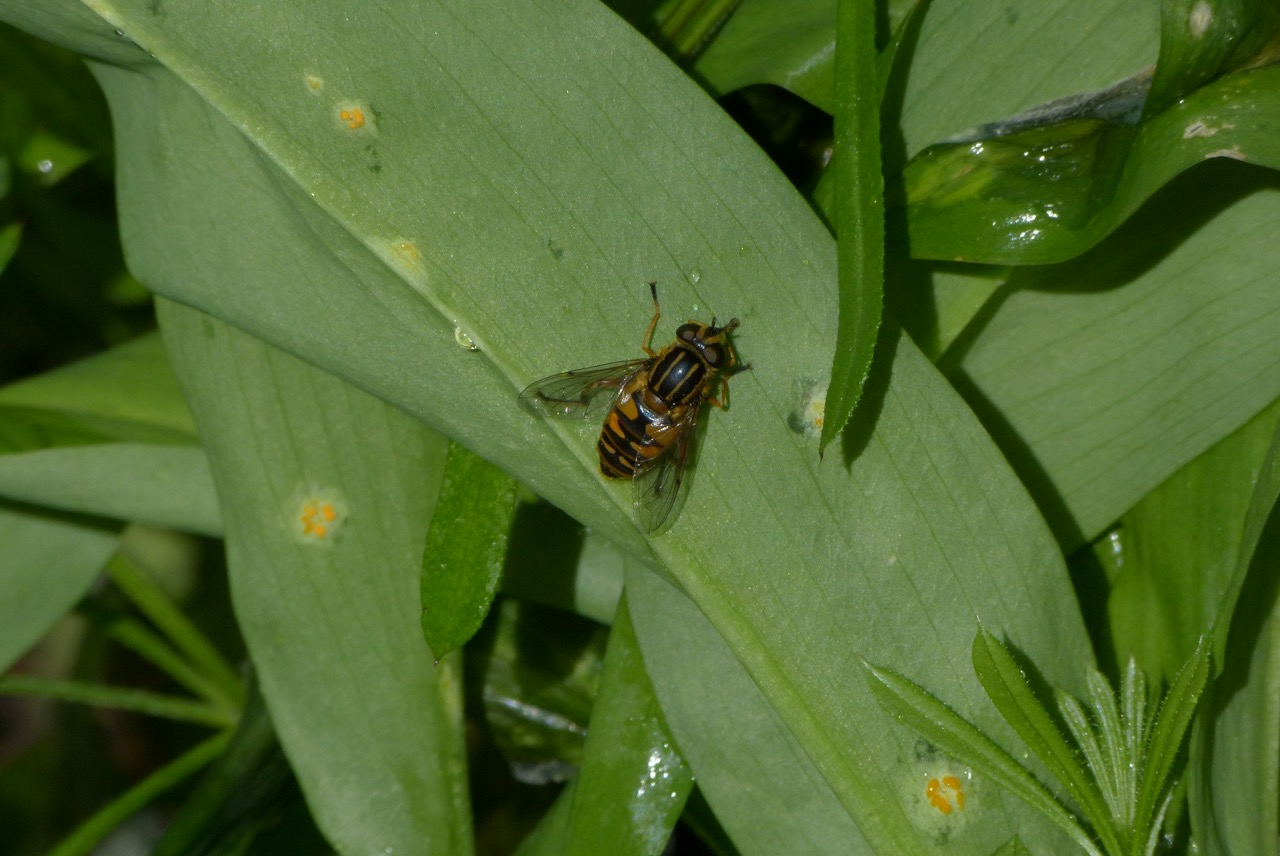
The hoverflies Leucozona lucorum:

Photograph: Bob Kemp
and Eristalis intricarius:

Photograph: Bob Kemp
A bee-fly Bombylius major:

Photograph: Tony Jacques
A noon-day fly Mesembrina meridiana:

Photograph: Tony Jacques
Mating dock bugs:

Photograph: David Williams
A lonely Sloe bug (also known as a Hairy shieldbug):

Photograph: David Williams
A Tawny mining-bee

Photograph: Jim Cresswell
And our first damselfly of the season, a Large red damselfly:

Photograph: David Williams
What a lot of photographs, and nothing about what happened! The best approach. This is about the wildlife we find after all.

Yes, we did move on and yes, it was time for lunch. But as we finally left the grassland looking for a suitable spot to eat we noticed a female Orange-tip just passing the time of day on a nettle leaf.


A path led from the grassland into a strip of woodland. We followed this for a while then settled down for lunch.

Settled down is not quite the right word. There was nowhere to sit apart from the ground, which was very damp. There was a circle of chairs set out in the grounds at the edge of the grassland but we had left those behind when entering the wooded area. It was too far to walk back to them (at least a hundred yards) so most ate their lunch standing.

Eating lunch standing gives you more opportunity to find things as you move around and your eyes wander. And so it proved.

Baccha elongata, a hoverfly with a long thin abdomen that normally skulks around the undergrowth, was resting on a nettle leaf.

Photograph: Bob Kemp
The groundbug Scolopostethus grandis was spotted, not living up to its general name, climbing a tree.

Photograph: Bob Kemp
Lunch over we made our way along the path through the woods until it opened up into the garden. As we reached the end there was great excitement when a pair of mating Pebble hook-tip moths were spotted. Taking photographs did not disturb their activity.

Photograph: Bob Kemp
Nearby a larva was found in a tree. This was later identified as a Mottled umber moth larva.

Photograph: David Williams
We now wandered around the garden and its surrounds. There were several beds either dug out or in use, a number of poly tunnels, a small more formal garden and plenty of areas of rough vegetation. There were also three compost heaps which immediately drew our attention, looking for compost heap specialists such as Lesser earwig and pseudoscorpions. Alas, despite extensive searching, none were found.

There are now a couple of photographs from several taken around the time we were in the garden showing insects busy attempting to preserve their species.

Tipula varipennis:

Photograph: Jim Cresswell
Helophilus pendulus:

Photograph: Jim Cresswell
There was also the unwelcome sight for a gardener of a Large white which, thankfully, for the gardeners, flitted happily away. However a Small white had taken up residence.

Photograph: Jim Cresswell
An ant was photographed carrying a springtail in its jaws.

Photograph: Bob Kemp
Slime moulds rarely get a mention. I think the last one was when we went to Pentre Wood last year. Well, long overdue, here is another, spotted on a log - Lycogala terrestre.

Photograph: Bob Kemp
Time was marching on; I checked the time - we were doing overtime! We left the garden passed through another patch of grassland then found our way to a walled garden.

The first thing to notice (or miss in my case) was a hole in the wall where a colony of Honey bees had made their nest. The wall was also a good host for lichens including lichens that parasitize other lichens.

Photograph: Bob Kemp
Our master lichenologist provided the explanation - Phaeophyscia orbicularis is the grey, lobed, lichen on the middle and left of the photograph. The darker grey circles are the submerged apothecia (fruit bodies) of the parasitic lichen Arthonia phaeophysciae before they break through. 

I could not have expressed it any better!

What was going on over the far side of the garden?


It was another compost heap. Another opportunity to find Lesser earwig, etc.. 

All in vain. 

No earwigs and no pseudoscorpions.

We did go home ... eventually .... 

An excellent day in an excellent and varied site.

My thanks to the Crabapple Community for granting us permission to explore their grounds and the interest shown by members of the community. My thanks also to the photographers, David Williams, Bob Kemp, Jim Cresswell and Tony Jacques who willingly provided most of excellent photographs that make producing this report a pleasure. I apologise to all four for not using all their photographs.

Postscript

On the following Friday evening we re-visited Berrington Hall, this time to hold a moth night. The weather was unkind to humans - very wet - but, I am told, moths do not mind the rain!! 

We did not catch many moths but there was a good variety of species with some species that we do not see very often.

When the rain stopped as we were packing up our intrepid photographer managed to photograph a few of our finds. Unfortunately the weather meant that he had to take the shots with the moths in pots which is not the ideal background.

Small phoenix - Photograph: David Williams

Streamer - Photograph: David Williams

White-pinion spotted - Photograph: David Williams

Least black arches  - Photograph: David Williams


6 May 2018

Sun at last - for a bit of the day at least

Shavington Park, Wednesday 2nd May 2018#

The rain was hammering the window as I received my first email:

"Are we going?"

"Of course" was my reply.

Fortunately I had seen the early morning weather forecast which predicted that the rain would clear from the west and it would be brighter later.

How later?

That was the question!

It was raining hard when I was collected, but I had hope in my heart.

It rained for quite a while on the journey but there were signs of brightening on the horizon.

As we got closer the skies brightened more. And one or two small blue patches made a fleeting appearance. Not enough blue to make a pair of sailor's trousers but an encouraging sign.

By the time we got to the site, parked and kitted up the rain had stopped. It was very overcast for a long time but apart from the odd spot there was no more rain and the sun did eventually come out in the afternoon.

Enough about the weather ... time to get on with the story of the day. (OK the weather will get mentions later on.)

Parking was the early issue. We parked on a track within the site. "No-one will be using this track and if they do they can drive around on the grass." we were told.

Within minutes a van pulled up and the driver asked us to move one of the cars as he could not get around. This was done and the van went merrily on its way.

The grassland close to the parked cars was our first port of call.

Photograph: David Williams
Our first record, more or less, was the spider in the above photograph. It is Cyclosa conica, named after its distended abdomen, which really found us. It wandered into our spiderman's tray!

The tray had been put on the ground whilst a couple of us tried to vacuum sample some growths on a tree.

Photograph: David Williams
Our efforts were not rewarded.

The van returned along the track, this time with a trailer. With its extra length it could not get around the cars so all the drivers had to make their way back and move to a place that was definitely off the beaten track. 

Back to the wildlife.

This area supported a good population of the longhorn moth Adela reaumurella. Normally you see the males of these moths in a display flight whilst the females just sit around on leaves feigning disinterest. On this occasion all the moths were grounded.

Photograph: Jim Cresswell
Having moved away from the grassland we made slow progress down a path towards the woodland and carr that borders the main pool. A female hoverfly, Eristalis pertinax, was spotted on the pathside vegetation.

Photograph: Jim Cresswell
We then entered a field. This was easier written than done. The path was very muddy. Great care and precision in placing one's feet was required to avoid boots getting stuck or the ignominy of ending up on one's posterior.

Safely in the field we investigated the woodland edge.


An orange tip butterfly was spotted on a cuckoo flower.

Photograph: Jim Cresswell
By now the clouds were breaking up and the sun was making short appearances. We meandered our way to the edge of the pool.


This seemed a good spot to break so we spread out our ground sheets and lunched. (Had we gone 10 yards further we would have seen a large log just right for sitting on!)

Photograph: David Williams
Lunch over, back to our quest. Although the sun was shining for longer there was a stiff cool breeze so we decided to head for the shelter of the woods even though this meant retracing our steps and running the gauntlet of the mud bath that called itself a path.

Needless to say we did not go in a straight line. We veered this way then that and the route took us past a hoverfly, Leucozona lucorum.

Photograph: David Williams
Eventually we reached a hedgerow and as the sun was shining we spent a good deal of time looking for insects that may be flying about looking for nectar in the improving conditions.

Orange tip butterflies lay their eggs on cuckoo flower and you can often find an egg by careful inspection of the plant's flower head as this excellent photograph shows.

Photograph: David Williams
The mud was renegotiated without incident and we made our way into the woodland and carr. The willow in the carr was often covered in moss giving them an other-wordly appearance.


Early season woodland plants were evident

Bluebells

Photograph: David Williams
Opposite-leaved golden-saxifrage


A primula hybrid

Photograph: David Williams
And insects also caught our attention

The bee, Andrena haemorrhoa, named possibly after the copious red hairs on its thorax.

Photograph: Jim Cresswell
And a pair of mating flies, probably Scathophaga furcata.

Photograph: David Williams
There was plenty of dead wood lying around. This is often a fertile habitat for many beasts. In this piece we found a juvenile newt. Unfortunately we could not determine which species but it was either a Smooth newt or Palmate newt.

Photograph: David Williams
The sunshine was now unbroken. There was not a cloud in the sky. We had been lulled by this excellent weather into staying much later than we normally do, so it was time to return home. On the walk back to the cars this lovely beetle was spotted.

Photograph: David Williams
There has been some discussion about the species but in the end it was thought to be Ischnomera cyanea. This is a rare species (Nationally Notable B). There are a couple of similar species but these are even rarer. Separation of these species is based on the tarsal claws.

Eventually we went home.

My thanks to the owners of Shavington Park for granting us permission to do what we enjoy doing; to Gerry Thomas for negotiating that permission and to the photographers Jim Cresswell and David Williams for sharing their excellent photographs.

29 Apr 2018

Yet more April showers!!

Donington and Albrighton LNR, Wednesday, 25th April 2018

This nature reserve is split into three areas. To the west of the road that cuts through it is mainly grassland with some scrub, pools and woodland. The other two areas are to the east of the road. The middle area is a pool and easternmost is an area of woodland and carr. 

For our visit we were invited to survey the woodland and carr, an area that is not normally open to the public.

We assembled in the car park, but no sooner had we got out of the cars to exchange greetings the heavens opened driving us back into them again. The heavy shower soon passed and we managed to get a bit further in our preparations before....

Yes, you've guessed it.

The next heavy shower arrived, this time as hail. Shelter was once again sought in the cars.

It would have been easy to throw in the towel but we are made of sterner stuff!

The showers relented long enough for us to meet our host and his two work experience assistants who gave us an introduction to the site then escorted us onto it.

We were due to be joined on this trip by a group from the Shropshire Wild Teams. Unfortunately a traffic snarl up on the A49 meant that the group could not be collected and only their two leaders managed to get to the site. Let us hope we are able to arrange another date for this group to experience the delights of what we do.

When the weather is wet collecting invertebrates is even more challenging. Equipment soon gets wet and is difficult to handle; any invertebrate caught in it can become water-logged and may be damaged when extracted. So in these conditions the vacuum sampler comes into its own and it was soon brought into use and its catch examined.


This part of the site is very wet. Not only because of the rain! A stream flows into it and as it progresses it breaks up creating several little islands. In addition there are many small pools and very wet areas. 


Marsh marigold was in flower in many small clumps.

Photograph: Jim Cresswell
A plant in abundance was wild garlic. A few just about in flower but the vast majority were waiting for that intangible indicator that lets them know its time to display. In the meantime the plants attracted the occasional passing hoverfly.

Helophilus sp. - Photograph: Jime Cresswell
The above photograph shows some rust developing on the leaves. It can be seen more clearly here.

Photograph: Jim Cresswell
I believe this is the Arum rust Puccinia sessilis. Please let me know if you think I am wrong.

Two craneflies proved to be common on the day. The first was Tipula vittata, recognised by its distinctive wing pattern and stripes down the side of its abdomen.


The second one was Limnophila schranki - a smaller insect but also with a striking wing pattern. Here we have a male and female.

Photograph: Jim Cresswell
In past reports I have often featured photographs of photographers usually when they are in discomfort taking that "one perfect shot". For once someone took a photograph of me taking the photograph of the Tipula vittata above. Fortunately I have not adopted an odd position to take the shot but if I am prepared to include photographs of others I must be prepared to include myself.

Photograph: JIm Cresswell
The weather remained changeable all day - heavy rain interspersed with sun - fortunately there was enough sun, and warmth when it came out, to encourage us to stay on site when next shower came along. We took advantage of a longer period of sun to have lunch.

A couple of shieldbug species were found. I did not find any but those that were pointed out to me were taking no chances with the weather they were on leaves of plants with higher leaves acting as umbrellas. What good eyes some people have.

Green shieldbug - Photograph: David Williams
Hawthorn shieldbug - Photograph: Jim Cresswell
An alder fly was photographed. There are only three species of alder fly in Britain but they all look the same! Identification is based on their reproductive organs so this alder fly cannot be identified to species. That said, the only species I have ever found is Sialis lutaria. Of course this one may have been different. We shall never know.

Photograph: David Williams
My thanks to Shropshire County Council for giving us permission to survey in this closed site. My thanks to the photographers for allowing me to share their excellent photographs with you.