Wednesday 1st July 2026, Middle Spoad,
Newcastle on Clun
Our visit this week took us to a former farm, through which the River Clun flows. This floods the meadows in winter and has a
defining influence on the character of the land. The mature hedgerows and trees
include willows and alders, plus several Black Poplars.
We began our investigations in a particularly scenic
meadow, though we had crossed a bridge over the River Clun to get there, noting
the extensive areas of exposed river shingle as we did so.
The meadow was made all the more attractive in
the July sunshine by good numbers of butterflies.
 |
| Small Skipper |
(both Small and Essex Skippers were present,
but only the former was photographed)
 |
| Ringlet |
 |
| Meadow Brown. Photo: John Martin |
 |
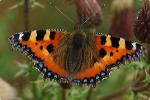
| Small Tortoiseshell |
 |
| Painted Lady |
Aside from the several adult Painted Ladies, a
nearly full-grown larva was spotted on knapweed.
 |
| Painted Lady larva |
This provoked closer scrutiny of thistles
(their usual first choice foodplant), where several others were subsequently found.
The many other finds from the grassland areas
included this Tachinid fly,
Phasia pusilla
 |
| photo: Nigel Jones |
And a number of hoverflies including Eristalis
intricaria.
 |
| photo: John Martin |
Meanwhile, the grasses themselves were being
scrutinised, and two parasitic fungi noted. This is
Epichloe typhina (‘Choke’)
on False Oat Grass
 |
| photo: John Lyden |
And this is Ustilago filiformis (a
cereal smut) on Glyceria maxima.
 |
| photo: John Lyden |
While investigations of the grassland continued,
others moved to the margins and sampled the hedges. This revealed a
couple of bug species in particular abundance:
Heterotoma planicornisAnd nymphs of the Tree Damselbug,
Himacerus
apterus
The attractive nymph of
Deraeocoris ruber
was too smart not to be photographed.
Among the many insects extracted from the oaks
were a Forest Bug
And the micro moth
Carcina quercana.
At this point we reach the first of several
county firsts recorded on the day. The Black Poplars, notable organisms in
themselves, were hosting a ‘pouch gall’
Pemphigus
populinigrae, not previously recorded in
Shropshire.
 |
| photos: John Lyden |
A Kidney-spot Ladybird larva was beaten from
one of the many willows
Continuing the river-influenced theme,
various sizes of yellow sally stonefly were absolutely ubiquitous in everything
we beat or swept.
Moving closer to the river, Alder Tongue Gall
was recorded.
 |
| photo: John Lyden |
The Alders were not having an easy time of it –
these galls are caused by
Taphrina sadebeckii. This has been recorded in
Shropshire only once before, last century and at the other end of the county in
Colemere.
 |
| photo: John Lyden |
I stated above that we began our investigations
in the meadows. This is not entirely correct. Our Dipterist was so taken with
the river shingle that he made straight for it and then spent much of his day in
it.
 |
| photo: Keith Fowler |
Others joined him later. To me, river shingle
means 5-spot Ladybirds, a scarce species in Britain. In Shropshire it has been
recorded a couple of times, in river shingle at the Welsh edges of the county,
often frustratingly on the wrong (ie Welsh) side of the river! Well, there weren’t
any, at which point my interest waned, beyond snapping a male Beautiful
Demoiselle.
It is fortunate that the rest of the group was
more diligent, because this habitat turned out to be a goldmine of super finds.
To begin with, here is a Giant Lacewing,
Osmylus fulvicephalus, a most
splendid creature. Most of the relatively small number of Shropshire records of
this species are from the Wyre Forest and this seems to be the first one from
anywhere in the southwest of the county.
A Figwort Sawfly was taken from the figwort
growing on the shingle.
 |
| photo: Nigel Jones |
More strongly associated with shingle or river
sediment were
the spider hunting wasp Anoplius
concinnus, with dozens of males seen running around over a raised bed of
gravel, a very local shore fly
species,
Athyroglossa glabra and an equally local horsefly species,
Tabanus cordiger.
 |
| Tabanus cordiger. Photo: John Martin |
Next,
Alliopsis
pilitarsis, another county second record, but of a
very scarce fly with very few records nationally.
 |
| photo: Nigel Jones |
And finally (for the exposed river shingle) three notable beetles. The
first two are both county first records: the little click beetle Zorochros
minimus
 |
| photo: Caroline Uff |
And
the rove
beetle Philonthus rubripennis.
 |
| photo: Caroline Uff |
Also found was
the
ground beetle Bembidion decorum, a third county record, but the first in recent times. What a day!
But we
were not done yet. Dragging ourselves from the shingle and the meadows, we
headed off to a pond. Sadly, but predictably given the weather, it was almost
completely dry. It did admit to a couple of noteworthy finds though, including
this
Iris Sawfly larva, Rhadinoceraea micans.
 |
| photo: John Martin |
In the herbage next to the irises was a Poplar Hawkmoth, doing its
best dead-leaves impression.A short distance from this, another hawkmoth
was spotted – an Elephant Hawkmoth.
And finally... to round the day off, a bug which was only
recorded in Shropshire for the first time a couple of Wednesdays ago at
Wildegoose Nursery made a second appearance:
Liorhyssus hyalinus.
An exceptional day. Many thanks to our hosts for
allowing us to indulge ourselves so richly.
Photographs
© the author except as noted.


 Posts
Posts











No comments:
Post a Comment
Please feel free to comment on this post...