2 Apr 2018

Valley of the Pseudoscorpions

Lake Vyrnwy RSPB Reserve - Wednesday, 28th March 2018

Sue, a regular member of our group last year, has now taken up a position at Lake Vyrnwy RSPB Reserve and she invited us to visit her at the reserve. We were very happy to accept. 

We met in the car park close to the dam head and RSPB's Visitor Centre. After a joyful reunion we started our visit in the bird hide where our host has the early morning task of filling up the feeders. 


A good number of birds were taking advantage of her largesse including a good number of siskins, a bird I had not seen for quite some time. They used to be regular visitors to our garden in the winter but have long since gone elsewhere.

Photograph: David Williams
Competing for the food with the siskins were chaffinches, various tits, nuthatches and probably others that I cannot recall. Underneath the feeders pheasants were picking up the scraps. A great spotted woodpecker was investigating nearby trees and a couple of squirrels were scurrying around but not attempting to get to the feeders.

Photograph: Peter Hodgkinson
We could have stayed there all day but we were also keen to see other areas of the site. Our host had arranged for us to look at a couple of fields that the RSPB planning to turn into wildflower meadows. 

As the fields were a fair way around the western edge of the lake we used cars to get us and our equipment to the sites. 

The first field had been grazed by sheep. These had been removed but their presence was very evident in the short sward and droppings. I believe the plan is to see what happens if the field is left to develop naturally rather than seed it.

A brief pause to take in the view of the lake and its distinctive pump house.

Photograph: Margaret Mitchell
A hawthorn in the field attracted our attention as it was laden with lichens.


Usnea this and Usnea that declared our lichenologist who was very impressed by the variety and abundance on show. The following picture is of some Usnea florida that was found on the ground (not taken from the tree).


At this point our lichenologist turned drone pilot as he bought out his latest gadget (with permission I must add). 

Lift off.

The drone is in the top right hand corner - Photograph: Peter Hodgkinson
The drone has a camera which records a video of the flight and it is possible to capture pictures from this. Here are a couple of views of the lake that you will not see unless up in the air.

Photograph: Bob Kemp

Photograph: Bob Kemp
To bring us down to earth here is a more conventional view from ground level, albeit up the slope at the top of the field.

Photograph: David Williams
And also to bring us down to earth what did we find? Unfortunately the answer is very little - a few spiders, a springtail or two, a couple of woodlice and a millipede. Still, better than nothing. And it is not a good time of the year for finding wee beasties. (Well that's our excuse!)

Lunch beckoned. Rather than picnic in the field we made our way to the top of the lake and the Centenary Hide. This commanded a view over what looked like an isolated pool as it was surrounded by trees with a pleasant backdrop provided by the surrounding hills.

Photograph: David Williams
Whilst we lunched we kept an eye out for birds. There were not many about but we did spot a chiffchaff, robin, long-tailed tits, goldcrest and a little grebe. Every now and then the water would ripple as a fish swam near the surface.

After lunch we made our way to the second site. The grass in this field was longer, not eaten to the ground by sheep, but there was a pony on it. It came to greet us when we arrived but quickly lost interest and was indifferent to our activities.


One of the group picked up a moss covered log from a log pile and exclaimed "PSEUDOSCORPION".

This caused tremendous excitement (had we never seen one before?) and some of us crowded round to look and marvel how the finder had managed to spot a brown 2mm long insect in a forest of moss.

Photgraph: Peter Hodgkinson
A tiny froghopper was also found. This caused no excitement other than to myself. I later identified it as a female Delphacodes venosus.

As the grass and other vegetation were lusher here I was hopeful that we would find more and, employing "moth-vac" we did. Four more pseudoscorpions (never before had we found so many) and a couple more Delphacodes venosus.  To be fair the pseudoscorpions are cute, especially their ability to sprint backwards when threatened. We believed that all four were the same species and one was later identified as Neobisium carcinoides


Both photographs: David Williams
After all this excitement we needed refreshments. We returned to the tea room for a well deserved cup of tea/coffee/chocolate before making for our homes.

On the way home, in the absence of a Welsh speaker, we decided that Vyrnwy must mean "Valley of the Pseudoscorpions"!

My thanks to Sue for arranging the visit and to the RSPB for permission to do what we do. My thanks also to the photographers for supplying so many excellent photographs - sorry that I could not include them all.

And finally! One more shot from the air.

Photograph: Bob Kemp


20 Nov 2017

Two hundred and nine feet tall

Telford Town Park, Wednesday 15 November 2017

Little did I suspect that a visit to Telford's Town Park on a grey day in mid-November would be so appealing. When we had assembled in the car park by Grange Pool at the south end of the park there were a baker's dozen folk within the group, including three newcomers (welcome all) and a couple who were re-appearing after a period of ill-health (welcome back).

I have long understood that my suggestions for where to go on the day are ignored so I plunged straight in ....

"Where do you want to go?"

"Stirchley Chimney" was the immediate response.

So with little further ado we set off and marched to the aforementioned feature of the park.

As we marched along I looked at the vegetation verging the path. Should I pause and do a bit of beating, or should I continue blinkered like the others. 

Sorry, but I could not resist. I beat (halfheartedly) some ivy and out popped a small earwig with no visible wings and distinctive male claspers. I thought I knew what it was but I called our earwig expert for an expert identification. Yes ... I was right ... a Lesne's earwig.

Photograph: David Williams
There are very few records of this earwig in the county so this was a good start to the day.

By now the rest of the group were so far ahead that they sent someone back to find out where we were.

We quickly rejoined the group in the grounds of the Stirchley Chimney.
 

What is a chimney doing in the middle of a park? Fortunately a helpful information board held the answers.


(Remember you can click on the photograph to open it in a new window so that it can be enlarged for reading.)

As you will see we did  not need to measure the height of the chimney, the board informs us that it is approximately 209' high, built in 1873 by the Old Park Iron Co. using Randlay brick.

Then I got a bit of a shock. As I looked around the site I saw a building that I had no idea was there. Not just a small building but a huge construction.


One of the group had worked with the archaeologists involved in investigating the site so he gave an impromptu guided instructional tour.

A major attraction of this area was the presence of three picnic tables around which we established our encampment while we explored the site.

An early find was a Woolly milkcap.


Another find was the springtail yet to be given an official name

Photograph: David Williams


This attractive small beast is known as Katiannidae genus nov. species nov. a in the British list (http://urweb.roehampton.ac.uk/collembola/taxonomy/) but is Katiannidae genus nov.1 species nov.1 in the "world" list (http://www.collembola.org/frset.htm). In the British list it is described rather affectionately as a " spotty alien found in Richmond park.". Well it has spread from Richmond Park and  has turned up in several sites in Shropshire.

The vacuum sampler was put to good use and its catches minutely examined.


The chimney is enclosed by a small semicircular wall with various shrubs planed on top. One was in flower.


I have no idea what it is but for once my attempt to photograph a flower was reasonably successful so I have included it to provide a bit of balance between the flora and fauna.

Lunch was taken (at the picnic tables) then we moved on to an area known a Fletcher's Pool and the meadow that leads down to it. 

A couple of the group were lucky enough to catch a glimpse of a kingfisher as it flew across the pool, the rest of us had to make do with another view of the chimney.


After looking around the meadow and searching the accessible part of the pool edge we made our way back towards the car park but by a circuitous route that took us by the side of Grange Pool.

As we looked across the pool a duck landed amongst the mallards that was clearly not a mallard. Binoculars were employed and it was identified as a Mandarin duck.


The swan families nearby were not impressed and just got on with their lives.


We returned to our cars and home to get on with our lives.

My thanks to Telford and Wrekin Council for allowing us to pursue our interest in the Town Park and to David Williams for the additional photographs.


2 Oct 2017

A fungi filled day

The Cliffe - Wednesday 27 September 2017

For our season's finale we visited The Cliffe an area of heathland overlooking the neighbourhood of Nesscliffe and westwards towards and into Wales. Unfortunately the weather did not enhance the experience by being rather hazy and overcast. Never mind, a good day was had by all with fungi being the stars of the show.

There is no convenient parking spot near The Cliffe so we met in the car park of Hopton Wood. My intention was to ferry the group to the site as I knew that the distractions of Hopton Wood would seriously delay our arrival at and limit our time on the Cliffe.

However, as always the group had other ideas and insisted on walking to the site. 

"Alright, but no stopping." was my grudging response. 

We set off.

To be fair we only stopped once and that was to look at several fungi that adorned the pathside vegetation including a blue one of which I have no photograph nor can I remember its name.

So we reached The Cliffe in record time. Our fist point of interest was the pool. When we visited last year we had our lunch here and were serenaded by frogs. Here is a reminder:


Imagine our surprise when we found no pool.


We did have a look around the area and the lack of water meant we could search where the pool had been. A find that excited our fungi hunters was Dog's stinkhorn, a small version of the Stinkhorn. (Sorry, no photograph - I'm not doing very well.)

A little way from the "pool" is an old quarry and this was our next calling point.


The walls were inspected closely for spiders


Photograph: Stephen Mitchell
And springtails, an insect that does not feature in these reports very often.

Sminthurinus aureus - Photograph: Ed Phillips
Springtails are very small and "spring" at the slightest threat which makes photographing them more an art than a science. Here is a master springtail photographer in action.


Unfortunately that one got away.

Our next fungi find was a pink one. I have done better this time; I have remembered the name it was given Mycena rosae and have a photograph:

Photograph: David Williams
One of the group picked up some wet debris and found a "thing" attached to it.

Photograph: David Williams
What is it? Any offers?

We moved on to the top of the hill and the view of Wales. One of the group is pointing to Wales just in case you cannot see it.


A picnic table and benches had been placed at this vantage point so we took full advantage of its presence and had lunch. 

Every now and then, to keep us entertained as we ate, a sweeper was sent out to check the heather and other vegetation around the picnic spot. On return the contents of the net were placed in a tray for inspection and identification. Two moth larvae were included in the catch.

A Beautiful yellow underwing

Photograph: David Williams
And an Oak eggar

Photograph: David Williams
After being photographed these were returned to the habitat from which they were brought.

Lunch over we moved on to the next viewpoint where, helpfully, there was a toposcope which pointed out all the features in the distant and not too distant landscape that we could not see, including, very optimistically, the "Source of the Severn" 40 miles away. (In case you cannot see it - it is just uder and to the right of the large SW.)


And here is a photograph of the Source of the Severn taken in the direction indicated.


More fungi were found in this area including a blackish one which has been identified, rather tentatively, as Mycena vitilis, possibly.

Photograph: Ed Phillips
A hairy beast was discovered in the vegetation - the larva of a White ermine.

Photograph: David Williams
We moved on through some woodland. Here again there was lots of fungi including a clump of Shaggy scalycap

Photograph: Ed Phillips
The quest for fungi continued as we wandered on. Eventually we came out of the woods and onto a large area of heathland. Unfortunately the misty conditions had not relented and the view was still very restricted.


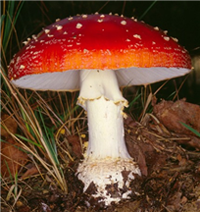
Time was marching on so we started to make our way back. On the way we made a small detour to another clearing where we found several Fly agaric

Photograph: David Williams
Photograph: Ed Phillips


These were providing a feast for one hungry slug.

Photograph: Stephen Mitchell
Just as we were about to leave a nymphal Bronze shieldbug was found - well there had to be at least one shieldbug picture in this report!

Photograph: David Williams
It started raining. We returned, pretty promptly, to the cars and made our way home.

My thanks to Shropshire County Council for giving us permission to enjoy ourselves and to the photographers - Stephen Mitchell, David Williams and Ed Phillips for their wonderful photographs.

This is the last report I will be writing for a while as our programme of weekly walks has come to an end. My thanks to everyone who has attended the events and ensured that the "Joy" in the title of the programme is not just part of a catchy name.

Thank you also to all of you who have read these offerings I hope they have been informative and entertaining.

As for the future, there will be monthly walks over the next six months and then, all being well, it will all start again next April.