skip to main |
skip to sidebar
Wednesday 17th September
The dry and warm late September weather provided an excellent accompaniment to another wonderful day at Devil’s Dingle for our penultimate walk of 2014. To my delight eight of us gathered at the gates to the site at the appointed hour despite the alternative attraction of a walk up the Wrekin with Pete Lambert of the Shropshire Wildlife Trust.
We started our meander by the corner of the eastern dam making our way along the lane that runs alongside its eastern edge. The County Orthoptera recorder had joined us and he was soon using his detector (a bat detector) to identify a Roesel’s bush-cricket. Unfortunately I could neither hear nor see it, but it was there.
I was lent a huge sweep net for the day and with one of my first sweeps of the vegetation edging the lane collected a Bishop’s Mitre. A good omen, if you believe in omens. And the omen proved to be correct as the shieldbug list was quickly bolstered with our first Gorse, Sloe (or Hairy), Dock and Green shieldbugs.
The orthopera list also grew to include a Dark bush-cricket, which I did not hear, but did see; a Meadow grasshopper and a Speckled bush-cricket. It is very unusual for us to take more than a passing interest in Orthoptera as we are not very good at identifying them and when we do it is usually a Common green grasshopper! It was good having an expert with us and his detection gadget to show us the varied delights of this order.
The vegetation bordering the lane along the side of the dam provided rich pickings and it was about coffee time when we reached its northern edge.
Orthoptera kept appearing and by lunch we had also found a Field grasshopper, a Common groundhopper, a slender groundhopper, a Common earwig (yes, earwigs are part of Orthoptera) and the curiously named Long-winged cone-head.
What is a cone-head? Grasshoppers have short antennae, bush-crickets are superficially similar to grasshoppers but have long antennae, groundhoppers are like small grasshoppers, earwigs are ... well ... different, but what makes a cone-head? To me they look like a bush-cricket with a head in profile that is slightly more pointed.
After lunch we made our way over the less well vegetated ash mound to the western side of the site where there is a pool that feeds the western dam. Here we entertained by several Common blue damsel files and the occasional dragonfly.
Following the edge of this pool and then the western dam we came back to the shores of the eastern dam which we followed back to the cars. On the way we encountered a Birch shieldbug and then in one last speculative sweep of some of the lusher grassland a Blue bug.
Unfortunately I have some bad news to impart. My stick (or more accurately my daughter’s stick), which has served me well and has featured in some of these reports, is no more. It has been ailing for a while following a “shortening” event a month or so ago, but it was still useable. Regrettably it is now in two bits after I stood on it whilst inspecting some Bulrushes to check for the presence of the bug Chilacis typhae. I found the bug then stepped back and ... disaster ... no more stick. Thank you for your excellent service.
Once again Devil’s Dingle had excelled. Thank you to E-on for allowing us to visit.
Keith Fowler
Five of us braved the Much Wenlock road works and arrived in the car park, undaunted by the cloudy, overcast conditions. With much grumbling about the forecast being wrong, yet again, we set off on the long trek to the quarry regeneration area. Within ten minutes, however, the sun broke through the clouds and we were soon stripping off fleeces and enjoying the warm sunshine.
We were rather enthused by the recent spider course at the Field Study Centre and without Keith to keep us in check, having decamped to sunny Spain, we spent some happy hours identifying those spiders we could, with the help of Nigel and an excellent course handout.
The first to be captured and examined, using our new spi-pots, was Zigiella atrica, a male, conspicuous by his long boxing-glove palps. The other species that is common is Zigiella x-notata but this is found on buildings, especially near windows.
Next Brian and I caught a male Dicranopalpus remotus. We were able to identify it from the FSC harvestman card, the key features being forked palps and also its resting position with its legs spread out side-ways in two narrow fans. It is to be found from late summer to winter.
I next spotted a Larinionoides species, possibly Larinionoides cornutus, a common orb-weaver, normally hiding during the day in a silken retreat by its web.
Steve was next to bring a find, convinced it was a crab spider as it was running sideways. Indeed it was confirmed as a male Philodromus species, a running crab spider, although it looked nothing like the illustration on the FSC spider card!
The next find caused lots of debate and consternation. For a time we thought it might be the harvestman Opilis saxatilis but Jim and Nigel suspected it wasn’t quite right. Then Nigel had his ‘eureka’ moment and identified it by the pincer-like operculum on the underside. Only the Paroligolphus argrestis has this feature. Phew!
In the late afternoon Steve and I both caught a long legged spider, Tetragnatha species. This had a very long thin abdomen and large fangs.
Nigel’s final ‘hurrah’ was a nursery web spider - Pisaura mirabilis, often seen sunbathing on nettle leaves or in the long grass. Although in this case it was one of many vacuumed up by Nigel’s giant spider-catching machine!
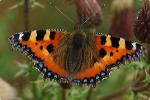
We did manage to record other species such as sloe bug, dock bug and green shield bug. Also a seven spot ladybird and a pill wood louse that did its party trick of rolling up into a ball. Jim’s sharp eyes spotted a Peacock butterfly as it sped by, and later we recorded a very fresh Red Admiral and a Small White.
Botanically the grey wilderness of the quarry is now becoming peppered with small pioneer plants. Sweet wild strawberries are everywhere, with Eyebright, Bird’s-foot-trefoil, St. John’s-wort, Basil, Thyme, Self-heal, Carnation sedge and the small yellow Lesser hawkbit making a tapestry of colour. The wide variety of plants bodes well for next years’ further regeneration.
Against the blue sky, buzzards flew overhead and green woodpeckers made their presence known by yaffling loudly amongst the trees. The weather was perfect and the company good fun as usual. The balmy atmosphere encouraged a lazy pace and a peaceful, relaxing day monitoring Lea Quarry.
Margaret Mitchell
Wednesday 27th August
After the recent long trips to the south and south-west of the county we were closer to home this week with a visit to Apley Woods. On this occasion we were joined by the Friends of Apley Woods who had invited us to carry out an invertebrate and botanical survey in support of their bid for Wildlife Site status.
We parked and met on Peregrine Way. As we waited for late arrivals it was clear that we had been transported to the Arctic as the cold wind howled down the road with nothing to deflect it. Once again I was forced to root out all the clothes that get abandoned in my car boot to achieve a reasonable comfort level. “It will be warmer in the woods” I was optimistically promised.
Recently a plan has been released for the development of 540 houses on the land between and behind the Maxell works that borders the wood and pool. Naturally the Friends and others are concerned and want to ensure that a suitable buffer area is left between the housing and the woods and pool to ensure minimum impact on the area. You can view the plans at <https://secure.telford.gov.uk/planning/pa-documents-plans-public.aspx?ApplicationNumber=TWC%2F2014%2F0746>. (This link works for me; I hope it does for you!)
In the prevailing overcast conditions the path through the wood was rather gloomy and not much could be disturbed but a couple of beetles were teased from their hiding place in a damp moss covered log.
The meadow area offered a much brighter prospect and so it proved keeping us richly entertained and rewarded until lunch. The meadow is mainly grass but is surrounded by rougher vegetation and trees; within it there is an area that is rich in wild flowers and another that support an ephemeral pool. In addition there are several free-standing mature oaks.
The margin provided us with sights of Dock bugs, Hawthorn shieldbugs and other insects associated with Nettles, Brambles, Docks and so on. When the sun made brief appearances hoverflies and other flies became active.
Moving on to the “wild flower” area, considering the cool weather, this was a hive of activity with plenty of hoverflies, bees and other insects.
From the wild flower area I moved on to the Oaks where I found Fagocyba carri, a yellow leafhopper, which appears not to have been recorded in the county previously. The national distribution map shows that there are currently only 26 records for this species. Although this will not reflect the latest position it does show that this bug is poorly recorded. I do not think it is rare just that recorders are put off by it being a Little Yellow Job which requires effort to identify.
We gathered for lunch around a handily placed log at the side of the pool. Here we had Pleasant Surprise Number 1. The Friends, who had disappeared, having to attend to other matters, had provided us with cake. An excellent Ginger Shortbread. Thank you it was splendid.
Lunch over, the Friends returned and we looked at what could be found in the vegetation around the edge of the pool. As we inspected some Water mint at the pool edge a male Banded demoiselle settled on an emergent stem.
We circumnavigated the pool finding as we went a Buff ermine caterpillar amongst the Ivy clinging to a poolside tree, a cluster delightfully marked late instar Parent shieldbugs clinging to Birch leaf and an oak tree which was the attention of a number of Buff-tip caterpillars.
Having completed our tour of the pool we made our way up the edge of the meadow where we observed a sapling that had been stripped of most of its leaves by Buff-tip caterpillars.
The area of the ephemeral pool drew my attention. It contained patches Forget-me-not (but no Forget-me-not shieldbugs were evident); a Bistort and Mayweed. I swept this area and had pleasant surprise numbers two and three. The first was an Adonis ladybird, a species I had not seen this year and the red and black Rhopalid bug Corizus hyoscyami. The photograph is of the C. hyoscyami in a glass tube as it flew away when I tried to photograph it “au naturelle”!
The day drew to a close. We gathered at the steps to the meadow for a last reflection and a cup of tea and there I had pleasant surprise number four. I realised that the sun was out and it was now pleasantly warm.
I unzipped my waterproof and fleece to celebrate.
Keith Fowler


 Posts
Posts