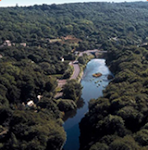
The latest instalment of “Hunt the Shieldbug” took place on Mayday (Wednesday, 1st May). Eight of us gathered outside the Seven Stars inn, Beckbury for a stroll along the banks of the River Worfe.
Resisting the temptation of the Inn we strolled down the road to find the footpath. On the way we passed a gentleman tinkering with his white car, and when I say white, it was WHITE. He must wash it in 1% detergent and 99% optical brighteners. If you have seen my car you will understand why I could never own a car like that.
The footpath started at a rather unpromising style (at least there was a FP sign and style) and took us initially along the side of a steep slope and through a Blackthorn thicket. Trying to keep upright whilst wielding a sweep net and avoiding the thorns was extremely tricky. We soldiered on and espied several Gorse bushes in full flower. The problem was getting to them. They were at the bottom of the 50% slope. A couple of brave folk descended to the bushes and searched and searched but found no Gorse shieldbugs. We moved on.
The path eventually descended to the side of the river passing a small conifer plantation where we found a longhorn beetle Pogonocherus hispidus and a couple of micro-moths 6 Eriocrania subpurpurella and 345 Phyllonorycter rajella. A refreshments break was in order.
After drinks we moved on about 200 yds and had lunch.
That 200 yards had brought us to a sheltered area of grassy vegetation with the river on one side and trees on the other with a small sandstone rock-face thrown in. Despite there being few obvious nectar sources the area was a-buzz with activity. We spent a long time exploring before lunching.
It was here that a shield bug found us. A Bronze shieldbug Troilus luridus landed on one of the group’s hand. Needless to say it was admired and photographed before being returned (with reluctance on its part) to the vegetation. It was the only shieldbug we saw all day.
As we were about to move on another longhorn beetle was spotted sunning itself on a fallen tree trunk – Rhagium mordax.
We continued to follow the river until we found a path that returned us to our starting point.
This turned out to be a delightful meander after the rather unpromising start and is worthy of a revisit later in the year. Its sheltered areas provided us with plenty of entertainment. We made about 80 records, many of which will be first records for the two tetrads we traversed.
Thank you to all who came.
Keith Fowler
.
.
.
.
8 May 2013
5 May 2013
Nature Notes – May 2013 - Pete Lambert
Stumbling out the back door to get to our various workaday destinations we were calmed by the suspended mist in the lightening morning. Duvet bands of vapour hung above the field behind the house and there a barn owl silently quartered the tussocky grassland for a breakfast snack. A few days later, another, or the same barn owl was seen at dusk near Aston locks. Barn owls, though in steep decline are still part of the local bird-scape. Open countryside with roosting opportunities in old buildings or ancient solitary field trees and rough grassland teeming with vole lunches is the favoured territory of the Hush-wing.
Questions of territory also tried to form themselves in my head yesterday as we soaked up the excitement of watching over 65 Red kites swirl around the feeding station at Nant Y Arian. These fork-tailed wonders had turned up for their 3 o’clock feast. Occasional aerial bouts would occur as dominant birds would try to dislodge a morsel from a fellow raptor, we saw some fatty meat drop into the lake below and the successful attackers dropped down to seize the prize. As the food was cleaned up the sated birds began to circle higher and wider and finally we realised that they were done. Each bird occupies in natural conditions very large foraging territories, the artificial feeding must do funny things to their behaviour and number. Recent reports suggest a Red kite feeding station if being considered in a location in South Shropshire. I am confident it will bring us pleasure but does it help us restore nature or merely create a kind of domesticated wildlife shadow show?
Llynclys Common is a favourite Sunday morning spot and on my circuit a narrow section of the footpath passes between two large and diverse gardens, small fields and hedgerows, some neat, some not, make up a delightful mosaic of habitats. Today this ideal spot delivered a clear view of a male Bullfinch, firstly he moved ahead of me flashing his distinctive rectangular white rump flash. Then settling on a hedge the full glory of Billy Blackcap was revealed, or shown off! Hunting-pink barrel chest, black cap, strong beak, all come together in a splendid ensemble. I had seen another male earlier the previous week along Middleton lane, this time also along a hedge near a lovely crowded garden of shrubs, fruit trees and mature trees. Down by the railway bridge in Haughton is such another collection of scrub, hedge and untidy woody growth, and of course bullfinch seen here last year. I don’t think I have to check the guide to discover the territorial preferences of the Bullfinch!
The mole is not an endangered species and I must confess our home colony having made a terrific mess of our lawn [?] I do have sympathy with those who consider them a perfect nuisance in the maintenance of a productive and level sward of grass. The molehills throw up stones to damage machine blades and the soil encouraging pockets of weed. An adept local mole-catcher to demonstrate that a landowners money was well spent has hung up the trapped gentlemen on the relevant field fence boundary. I counted 45 velvet clad vanquished earthmovers on a short stretch of narrow lane. Of considerably more interest on the last gibbet two large carnivores of a different calibre to the worm gourmand alongside. Just over 18 inches from head to tail and nearly uniform black except for a goatee patch of white beneath the mouth, the Mink is a very successful mammal indeed, though this pair had been outwitted by our pest control expert.
Mink were first brought to this country to be farmed for their lush coats. Being nimble and bright they had soon escaped , rampaged across the country, damaging fish stocks, oppressing our humble water vole and disturbing the sensitive balance of our native fauna. Rightly controlled their numbers have been in steady decline though efforts have to continue to allow our native wildlife safe conduct beyond the reign of terror brought by our shallow desire for the sensuous delights of fur.
And finally Summers herald, a White tailed bumblebee, the first of his order out and yes, bumbling in the weak but warming sun of Spring.
Pete Lambert
Questions of territory also tried to form themselves in my head yesterday as we soaked up the excitement of watching over 65 Red kites swirl around the feeding station at Nant Y Arian. These fork-tailed wonders had turned up for their 3 o’clock feast. Occasional aerial bouts would occur as dominant birds would try to dislodge a morsel from a fellow raptor, we saw some fatty meat drop into the lake below and the successful attackers dropped down to seize the prize. As the food was cleaned up the sated birds began to circle higher and wider and finally we realised that they were done. Each bird occupies in natural conditions very large foraging territories, the artificial feeding must do funny things to their behaviour and number. Recent reports suggest a Red kite feeding station if being considered in a location in South Shropshire. I am confident it will bring us pleasure but does it help us restore nature or merely create a kind of domesticated wildlife shadow show?
Llynclys Common is a favourite Sunday morning spot and on my circuit a narrow section of the footpath passes between two large and diverse gardens, small fields and hedgerows, some neat, some not, make up a delightful mosaic of habitats. Today this ideal spot delivered a clear view of a male Bullfinch, firstly he moved ahead of me flashing his distinctive rectangular white rump flash. Then settling on a hedge the full glory of Billy Blackcap was revealed, or shown off! Hunting-pink barrel chest, black cap, strong beak, all come together in a splendid ensemble. I had seen another male earlier the previous week along Middleton lane, this time also along a hedge near a lovely crowded garden of shrubs, fruit trees and mature trees. Down by the railway bridge in Haughton is such another collection of scrub, hedge and untidy woody growth, and of course bullfinch seen here last year. I don’t think I have to check the guide to discover the territorial preferences of the Bullfinch!
The mole is not an endangered species and I must confess our home colony having made a terrific mess of our lawn [?] I do have sympathy with those who consider them a perfect nuisance in the maintenance of a productive and level sward of grass. The molehills throw up stones to damage machine blades and the soil encouraging pockets of weed. An adept local mole-catcher to demonstrate that a landowners money was well spent has hung up the trapped gentlemen on the relevant field fence boundary. I counted 45 velvet clad vanquished earthmovers on a short stretch of narrow lane. Of considerably more interest on the last gibbet two large carnivores of a different calibre to the worm gourmand alongside. Just over 18 inches from head to tail and nearly uniform black except for a goatee patch of white beneath the mouth, the Mink is a very successful mammal indeed, though this pair had been outwitted by our pest control expert.
Mink were first brought to this country to be farmed for their lush coats. Being nimble and bright they had soon escaped , rampaged across the country, damaging fish stocks, oppressing our humble water vole and disturbing the sensitive balance of our native fauna. Rightly controlled their numbers have been in steady decline though efforts have to continue to allow our native wildlife safe conduct beyond the reign of terror brought by our shallow desire for the sensuous delights of fur.
And finally Summers herald, a White tailed bumblebee, the first of his order out and yes, bumbling in the weak but warming sun of Spring.
Pete Lambert
2 May 2013
Ercall Nest Boxes - Keith Fowler
In the depths of winter we installed 30 nest boxes on the slopes of the Ercall that were kindly donated to the Shropshire Wildlife Trust by C J Wildlife. Last week we gathered to monitor the boxes to see if any birds had taken advantage of the ready-made nest cavities.
We met at the car park opposite the Buckatree Hotel. Matt was not with us as he had at last been offered the chance to gain his Chain-Saw competency. Keep well clear next year when we are clearing scrub and trees. In his stead Stephen had been asked to lead the morning’s activity.
Some marched to the top of the hill, remembering ruefully that last time we did this we were carrying a bag and pushing a wheelbarrow each full of nest boxes. (A single nest box is not very heavy, but a dozen in a bag or more on a wheel barrow takes some effort to carry/push uphill.) Others plodded. But they were rewarded by the sound of the Wood warbler.
Once we had all reached the top Stephen gave instructions on what to do. It sounded complex but turned out to be very straightforward. We had to look in each box and record what we found on a piece of paper.
We split into two groups, one starting with the first box and working forwards, the other at the end working backwards. So, half of us trekked off to find number 30 (the boxes had helpfully been numbered 1 to 30 and were installed in numerical order). By the time we found number 30 David had already inspected 4 or 5 on the way!
The gist of the monitoring is that you unhook the lid, lift it, peer inside and record what you see. Is it empty, does it have a nest, or evidence of nest building? If there is a nest are their eggs, if so, how many, and which bird species?
First step was to find the box. Some were very easy, others were clearly installed by someone with a strange sense of humour, but more upsettingly three were missing presumed, after very extensive searching, to have been stolen or destroyed.
Having found the box do a quick physical inspection to check if it has been damaged. Two had had their hook broken off as some passer-by had tried, presumably) to force open the lid to look inside. It would have been easier to unhook the lid first. David and David managed to repair one of the damaged boxes but the other is now hookless until repaired.
Most boxes were empty, some had droppings so had been inspected as potential sites or used for roosting, others had nest material (mainly moss) and a few had nests which were unoccupied.
ONE HAD A BLUE TIT BROODING ITS EGGS.
So our efforts had all been worthwhile and with a bit of luck, and apathy from the local vandals and thieves, more will be used as the season progresses.
Keith Fowler
We met at the car park opposite the Buckatree Hotel. Matt was not with us as he had at last been offered the chance to gain his Chain-Saw competency. Keep well clear next year when we are clearing scrub and trees. In his stead Stephen had been asked to lead the morning’s activity.
Some marched to the top of the hill, remembering ruefully that last time we did this we were carrying a bag and pushing a wheelbarrow each full of nest boxes. (A single nest box is not very heavy, but a dozen in a bag or more on a wheel barrow takes some effort to carry/push uphill.) Others plodded. But they were rewarded by the sound of the Wood warbler.
Once we had all reached the top Stephen gave instructions on what to do. It sounded complex but turned out to be very straightforward. We had to look in each box and record what we found on a piece of paper.
We split into two groups, one starting with the first box and working forwards, the other at the end working backwards. So, half of us trekked off to find number 30 (the boxes had helpfully been numbered 1 to 30 and were installed in numerical order). By the time we found number 30 David had already inspected 4 or 5 on the way!
The gist of the monitoring is that you unhook the lid, lift it, peer inside and record what you see. Is it empty, does it have a nest, or evidence of nest building? If there is a nest are their eggs, if so, how many, and which bird species?
First step was to find the box. Some were very easy, others were clearly installed by someone with a strange sense of humour, but more upsettingly three were missing presumed, after very extensive searching, to have been stolen or destroyed.
Having found the box do a quick physical inspection to check if it has been damaged. Two had had their hook broken off as some passer-by had tried, presumably) to force open the lid to look inside. It would have been easier to unhook the lid first. David and David managed to repair one of the damaged boxes but the other is now hookless until repaired.
Most boxes were empty, some had droppings so had been inspected as potential sites or used for roosting, others had nest material (mainly moss) and a few had nests which were unoccupied.
ONE HAD A BLUE TIT BROODING ITS EGGS.
So our efforts had all been worthwhile and with a bit of luck, and apathy from the local vandals and thieves, more will be used as the season progresses.
Keith Fowler
Labels:
Ercall Nest Boxes - Keith Fowler
Subscribe to:
Posts (Atom)