5 Jul 2020

A Sting in the Tale (or not?)

Sunday, 5th July 2020

This report includes two unusual sightings, the first in Coalbrookdale, the second in Church Stretton.

Starting with this which was, according to my informant, seen on a bird feeder in Coalbrookdale:

Photograph: Les Hughes

An Andean condor!

As my informant tells me it is very good at keeping the squirrels away!

A very tall story.

Now for a far more believable but very unusual sighting in Church Stretton. I let the people involved, Graham Wenman and Mike Shurmer tell their story.

It is the middle of summer, the sun is shining and you are sitting on the lawn reading your latest e-book from the library on your phone when a Hornet lands next to you. 

What do you do? 
1. Try to remember where the epi-pen is. 
2. Squash it on the arm of the chair with your phone. 
3. Turn on your phone camera and take its picture?

Well, it was almost like that: Catherine and I were sitting on the lawn, with Mike and Jo (socially distancing of course), who had called in to help us put the world right in these difficult times!

And indeed, Jo suddenly announced that a Hornet had just landed on the small willow tree behind me.  “It’s a funny looking hornet” said Mike and picked up a pot and popped the beast into it.

What I have not explained is that Mike is the County Micro-moth Recorder and I am the Assistant Recorder and we were (as usual) discussing moths – hence the handy pot. And possibly of more interest is the fact that neither of us “experts” had noticed it! 

But now, with the “beast” in the pot it was identification time and yes, it was a “hornet”, but it was a “Lunar Hornet Moth” – Sesia bembeciformis – being quite harmless. It is also a wonderful example of Batesian mimicry, a form of mimicry described by English naturalist Henry Walter Bates, where a harmless species has evolved to imitate a more dangerous species, thus deterring potential preditors.

So the epi-pen was not needed!

So what? Well, here are a few statistics and a few facts. This was only the 20th record ever for this moth in Shropshire and only the third this century. It was also only the 4th ever record for Church Stretton. The other 3 records were in 1901, 1908 (F.B. Newnham) and 1938 (H.G. Burkhill) – maybe your relations? The last record for Shropshire was 4 years ago at Oswestry.

So squashing it would have been a very bad move

The female moth lays her eggs on Goat Willow and Common Osier trees (and some sallows) which are at least 6 cm. in diameter and the larva (caterpillar) eats the wood and remains there for up to 2 years before becoming an adult moth.  It makes one wonder how this moth can find a mate in order to ensure the survival of the species.

So taking a photo was a very good idea – as you can see:

Photograph: Graham Wenman

My thanks to Graham and Mike for providing this tale and the photograph.

As I have nothing else to tell you about I will finish with a few photographs that I have accumulated over the past week. As always, my thanks to the photographers for allowing me to use them.

To start, a pupa:

Photograph: Nigel Cane-Honeysett

It started to wriggle so Nigel kept an eye on it and out popped a Large white butterfly.

Photograph: Nigel Cane-Honeysett

Just to make up for taking such an interest in something that did not have eight legs he also provided this photograph of the spider Metellina merianae.

Photograph: Nigel Cane-Honeysett

And a couple of days later another of our eight-legged friends, Pseudeuophrys lanigera.

Photograph: Nigel Cane-Honeysett

This was followed by another eight legs, but this time on two animals (four legs each) discovered in his garden - Newts.

Photograph: Nigel Cane-Honeysett

Next a moth from my moth trap, a Spruce carpet.


On Thursday I visited Jinlye Meadows to look for the bilberry bumblebee, Bombus monticola. I was accompanied (socially distanced) by Debbie Vivers whose Bumblebees on the Long Mynd has unfortunately, been effectively scuppered by the virus preventing many of the planned activities. However she has ploughed on as best she could and invited me to take a look at the meadow. 

I did not find the target bee but Debbie did. The weather was awful so no photograph. However before the rains started I did manage to spot a Six-spot burnet.


Finally, in my last report I included a photograph of the assassin bug Reduvius personatus that turned up in a moth trap. Well like buses a second one turned up, also in a moth trap, a day or so later (and half a county away from the first).
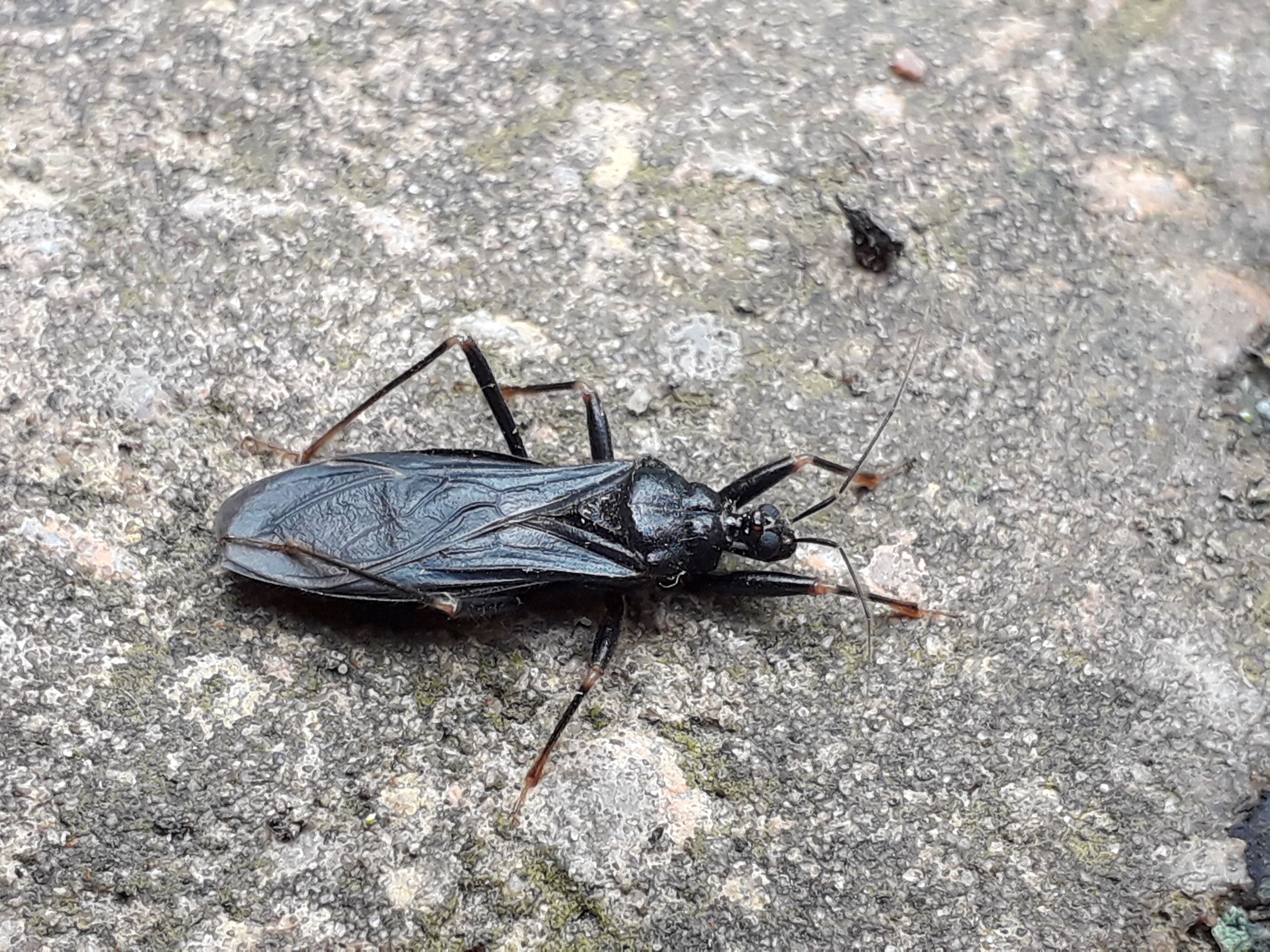
Photograph: John Martin

That's all folks.

Keep well.

28 Jun 2020

Not the 58 - Just the 1

Sunday, 28th June 2020

How do I follow up the epic tale of the pursuit of the 58 species of butterflies?

The simple answer is - "I have no idea".

Were I Charles Dickens or William Shakespeare I would be brimming with ideas, but I'm not!

If anyone wants to make a suitable suggestion for topics to keep us going over these days of guidelines and restrictions please let me know.

Over the past week a few of us (never more than six - keeping in line with the guidelines) have wandered about late in the evening looking for glow worms.

There are, apparently, three species of glow worms in Britain. However one of the species is only known from museum specimens, and the other is extremely rare, glows very dimly and is about half the size the Common glow worm, Lampyris noctiluca.

The Common glow-worm is the one we went searching for. The female is about 25mm in length, the males somewhat smaller; the female is flightless whereas the males are winged; the female is the one usually found by observing its quite bright glow. 

The females glow to attract the males for the purposes of mating. The adult life span of the female is only a few weeks, but once she has mated the female quenches her light, lays her eggs and dies. 

Much more information about glow worms is available on the UK Glow worm Survey website.

What about our efforts?

Our first outing was to Stretton Westwood quarry on Wenklock Edge.

I found one about 6 feet from where I parked the car in the car park for the site. Here it is:


In all we saw about 18 in the 90 minutes or so that we stayed on site. My find came after the other attendees had all found at least one and I was getting desperate to find one "all by myself". We had decided to call it a night, and were wandering back to the cars when I noticed it. Now I know how our hero felt when we found the Clouded yellow!

Our first sighting was about 10.45pm when David spotted one in the lowest section of the quarry. It was in low, damp, sparse vegetation. After that they were found quite regularly in the same and two other areas of the quarry.

Photograph: David Williams

Photograph: David Williams

Quite a few of the females hade males in attendance.

Photograph: David Williams

A couple of days later we went to the Wollerton end of the Hodnet Old Railway path. This is a well-know site for Glow-worms. The vegetation here was very different from the quarry. It was much denser and taller. 

As we walked along the lushness of the vegetation was causing us concern. We did not have the super-sensitive sight of the Glow worm males so would easily miss the glow when looking down into the growth. 

However, luck was on our side and there through a gap in the nettles was a tell-tale glow. Bob, never one for taking the safety first approach to the art of photography, plunged head first into the nettles and was able to get a snap of the insect.

Photograph: Bob Kemp

In all we saw 6 glowing females and a few males.

Finally we ventured out to Haughmond Hill. We followed the track from The Criftin up to the trig point. Fortunately we were not looking for a needle in a haystack as we had been told where they were most likely to be found. And that is where we found them! Just the two females plus one male.

So another successful little project - but we had found them where we expected to find them and not somewhere new - that is the next challenge, should we choose to accept it.

And now for a round up of wildlife sightings that have come my way over the last fortnight. (I did not include any of these in The 58 - Episode XII, so there is a bit of catching up to do.) Thank you to everyone who has sent me the photographs.

Mating Azure damselflies:

Photograph: Peter Hodgkison

A hoverfly, Chrysotoxum festivum: 

Photograph: John Martin

A robber fly, Dioctria rufipes taking an aculeate, ensuring the sting is well out of the way

Photograph: John Martin

A moth, from a Lincolnshire garden, Ethmia quadrillella:

Photograph: Liz Roberts

And another, a Broad-barred white:

Photograph: Liz Roberts

Back to Shropshire, a Four-spotted chaser:

Photograph: Peter Hodgkison

A Gasteruption jaculator employing its long ovipositor:

Photograph: Peter Hodgkison

Returning briefly to Lincolnshire, a host of Garden cross spiderlings:

Photograph: Liz Roberts

Returning, again, to Shropshire, mating Large red damselflies:

Photograph: Peter Hodgkison

A Speckled bush cricket nymph:

Photograph: Nigel Cane-Honeysett

A mining-bee with a serious mite problem:

Photograph: Nigel Cane-Honeysett

And an assassin bug, Reduvius personatus.

Photograph: Bob Kemp

In the week I visited Burnside Meadow in Shrewsbury and managed to photograph this longhorn beetle, Agapantha villosoviridescens.


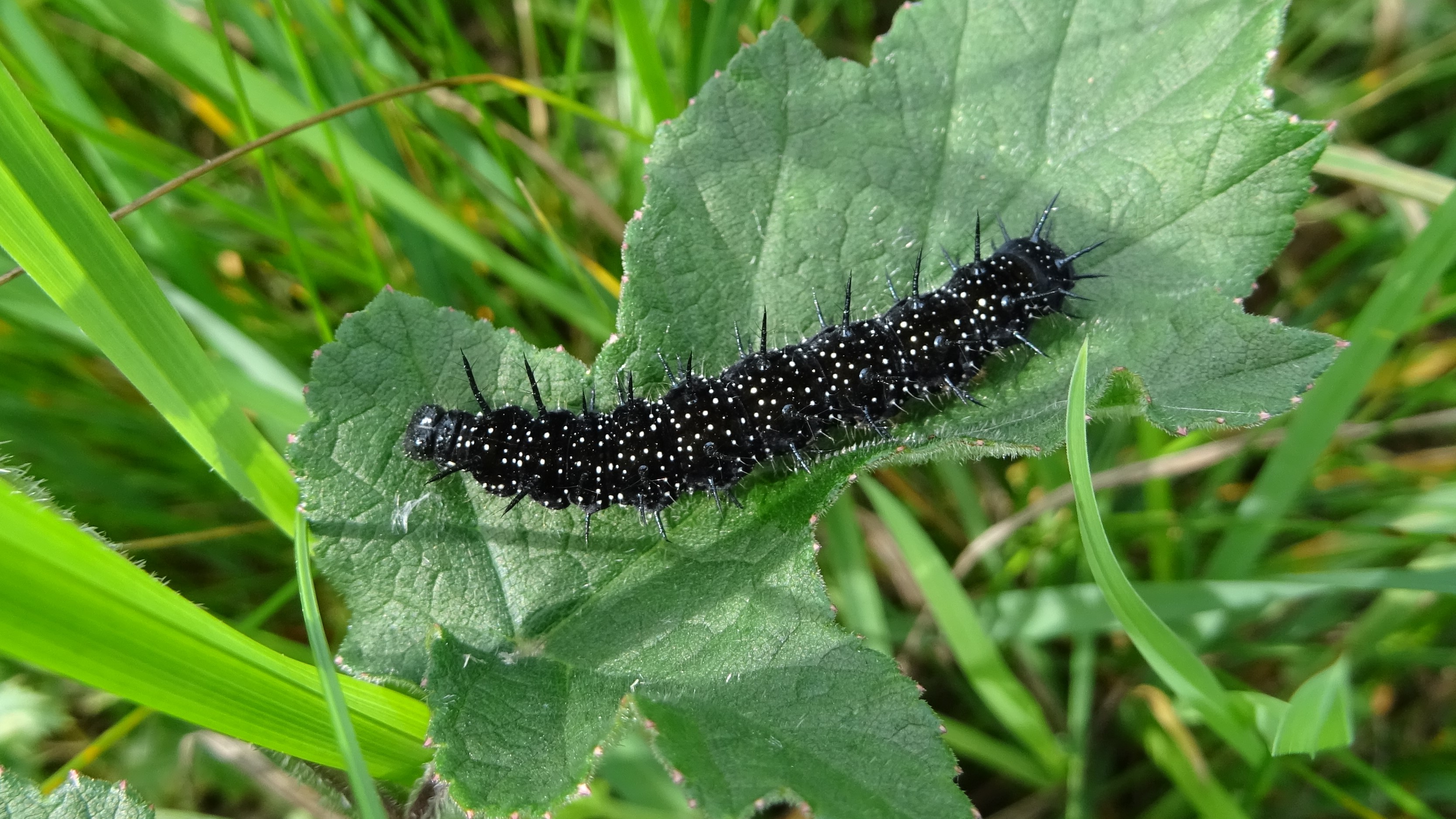
The nettles, and some hogweed plants in this site, supported a large number of Peacock butterfly larvae.


A few moths from the moth trap that I have run every few days in my garden.

Crambus pascuellus, a common moth found in most grasslands:


A very well marked moth, Enarmonia formosana. Regrettably the photograph does not do it justice.


A Figure of eighty


A Lime-speck pug


Another moth let down by the camera, or my method of using it, Phtheochroa rugosana, a punk rocker amongst the tortrix moths, with scales going in all directions.


And a rather more sombre moth, the Sycamore:


Finally a little Front Garden Envy. 

A couple of weeks ago I included a photograph of our front lawn which had benefitted from "No Mow May", (and is still benefitting). I was sent this photograph which put mine well into the shade.

Photograph: Catherine Wellings

Bravo!

To be fair Graham has a lot more to work with than I do but wouldn't it be great if all front lawns looked a little more like this than over-mown grass.

Keep well.

21 Jun 2020

The 58 - Episode XII - Grand Finale

Sunday, 21st June 2020

The first day of Summer!

And, as I have been reminded, the start of daylight getting shorter.

Breaking news - a Happy Event ...

If you have been following this series of tales, you will recall that during the lockdown David dug a pool in his garden. The pool attracted dragonflies and they laid eggs in the pool. The news is that some larvae have hatched.

Photograph: David Williams

Photograph: David Williams

To give you an idea of their size at this stage David photographed one next to his finger.

Photograph: David Williams

Back to the Quest.

It is now mid August in 2019 and our hero's tally stands at 57. 

Just one to go. Clouded yellow. Plenty of time to find one as their flight season persists until quite late in the year.

So far the policy for finding one, "it will just turn up at a site whilst we are out and about", had not worked. It was time for more targeted searching.

But where?

Clouded yellow is migratory, which means that it could turn up anywhere in the south of England or even, nearer home, in the Midlands.

An eye was kept on the internet for any reports of sightings but nothing much appeared.

Our hero is, by his own admission, a creature of habit. 

Where had he seen it before?

Martin Down, in Hampshire. So, on a warm sunny day our hero, accompanied by three "support staff" journeyed to this site.

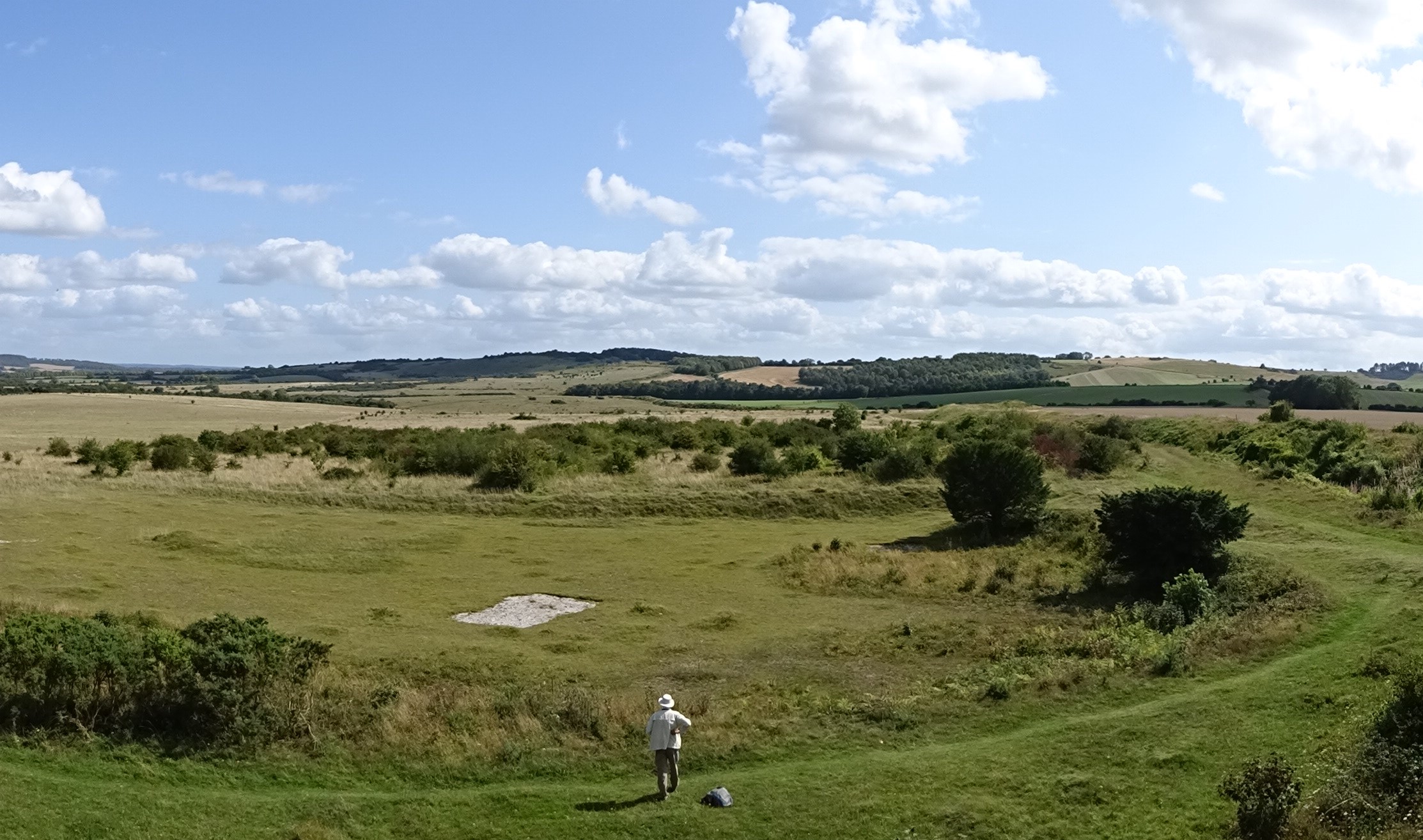
In case this site is unknown to you, here is a bit of  the description on the Hampshire County Council website:

"Martin Down is 350 hectares of unspoiled chalk downland where flowers and insects flourish and rare birds sing.

"The insects are attracted to the ancient sweeping grasslands that have dozens of different species of wildflower. Birdsong comes from cuckoos, yellowhammers, skylarks and even turtle doves.

"Although the landscape is not dramatic – a gentle rising vista of open meadows, scrub and ancient hedges - it feels ancient. The great Bokerly Ditch runs along one side while mysterious mounds and dells hint that this was once a populated area in forgotten ages. Now sheep have the run of it."


Although it is not obvious from the above photograph areas of the site were awash with flowers. We spotted a Frog orchid:


The morning passed. What we did not find was a Clouded yellow. In fact I do not recall seeing many butterflies, which was a surprise given the habitat and conditions. Time for lunch, which we took in the lee of the large mound where the photograph of the view above was taken.

Our hero wandered off and was soon out of sight.

As the support staff scoffed their lunches what should fly in and land close by ...

Yes ... a Clouded yellow.

Bob managed to get a photograph.

Photograph: Bob Kemp

Bob freely admits that it is not one of his best!

Where was Jim?

We shouted and shouted ... no response.

We then telephoned him. He did respond to this saying he was quite a way away but would come back as quickly as possible.

In the meantime we kept an eye on the very lively butterfly. 

Fortunately, although flighty, it did not stray far ... for a while ... but after that while, it flew further afield and out of sight.

Jim had not yet returned. We hunted high ...


And low. But there was no sign of it. 

When our hero returned we gave him the bad news. He took it philosophically.

No other Clouded yellows crossed our path that day but we did witness some curious cloud formations.

Photograph: Bob Kemp

It was now the last week of August and the prospect of failure was growing. Another possible site was plucked out of the air - Spurn.

On yet another very fine day towards the end of August our hero with two of his supporters set off for Humberside to that curious spit of land that projects into the entrance of the mouth of the Humber. We used the car park opposite the Spurn Visitor Centre and took the coastal path back towards Kilnsea, as that was where Clouded yellow had been seen in the past, affording us a view of the the tip of the spit, Spurn Head.


Enjoyable as the walk was, we did not find our target species. We continued our walk past Kilnsea and to the birding pools, where we enjoyed our lunch, doing a bit of bird spotting whilst waiting for a Clouded yellow to flutter past.


Our wait was in vain. Undeterred we made our way back along the eastern shore past the visitor centre and down the spit.

We found plenty of butterflies especially Painted ladies, which were feasting on Sea aster, but not the one we wanted to see.


Correction: the one our hero wanted to see as Bob and I had added the species to our lists at Martin Down. We did remind Jim of this periodically!

Our hero turned to the sea for inspiration.


I think he was hoping to see a cloud of Clouded yellows come into view, skimming the surface of the water and overwhelm him by landing at his feet.

Alas, it was not to be.

The walk continued down the spit. 

In the huge storms a few years ago the sea almost broke through the spit. A good deal of the land was washed away over a half mile or so stretch, leaving a shallow sand bank in its wake. It will not take much more erosion to turn Spurn Point into an island.


We resisted the temptation to walk all the way to the end and returned to the visitor centre for refreshments before journeying home.

August turned into September. Another site was plucked from the air, I cannot recall why, but we went, to the curiously named Barnack Hills and Holes in Cambridgeshire.

For those of you, like me, who have not heard of this site, here is a brief description from the Langdyke Countryside Trust's website:

"Arising from the rubble of a mediaeval quarry, Barnack Hills and Holes is one of Britain’s most important wildlife sites.

"Covering an area of just 50 acres, its grassy slopes are home to a profusion of wild flowers and butterflies.

"This type of meadowland covered in wild flowers is now all too rare; half the surviving limestone grassland in Cambridgeshire is found at the site."

Here is a view of part of the site:


The name of the site describes the landscape precisely. Although the hills are not particularly high, the sides are steep and it would have been very hard work walking up and down from valley to summit and vice-versa. Fortunately the paths tended to keep to the tops.

One plant that we found in good numbers was Clustered bell flower:


Time marched on. I think our hero was resigned to falling at the last hurdle. Lunch was taken. 

We moved to a flatter area of the site. Flatter in that the holes were less deep and the sides less steep.

I paused by a hole wondering why birch brash had been left in the hollow when there was a flash of yellow. I shouted for our hero who, as at Martin Down, had wandered off. The butterfly had settled, and, although, it was a few yards away, it was very yellow - and not a Brimstone. 

David heard me shout and also shouted for Jim, then he came over and confirmed that it was a Clouded yellow.

Would the butterfly stay or be gone by the time Jim got back?

David and I held our positions not wanting to disturb it.

Our hero had, thankfully, heard us and returned, trained his binoculars on the butterfly and sighed a huge sigh of relief.

Number 58: Clouded yellow

Photograph: David Williams

Unfortunately this photograph is not of the one we saw. As David moved in to take a photograph, it took umbrage and flew off. Despite half an hour or so of frantic searching nearby, it was not seen again. This is one that David photographed some time ago. 

This butterfly brought so much stress to Jim that it is worth another photograph (of one taken earlier, in France I think).

Photograph: Bob Kemp

Quest achieved!

Handshakes were exchanged - no hugs or kisses!

Our hero was ecstatic.

Having accepted that the Clouded yellow was not going to reappear, we wandered back to the car park. But we did not just walk off into the sunset, no, we continued to look for things of interest, including the following:

An oak acorn gall which I think is Callirhytis glandium:


A Tortoise shieldbug:


And finally, a butterfly, a Red admiral.


Home. And start planning for the next quest - the Damsel and Dragonflies of Britain.

That is the end of my tale. I hope you have enjoyed it as much as I enjoyed taking part in and now writing about it as a distraction form the circumstances in which we find ourselves.

My thanks to all the photographers who have provided me with their excellent photographs to supplement my own efforts.

I would particularly like to thank our hero - Jim Cresswell - whose diligence, persistence, cajoling and unbounded enthusiasm made the whole thing possible. Unlike him I did not see all 58 but I saw the vast majority including many species I had not knowingly seen before and would not have seen without his efforts.

Thanks Jim.