14 Jun 2017

Far, far away

Farfields Meadow SWT Reserve - Wednesday, 7 June 2017

This week we saw the sign. The sign that told us where to park. 

OK we were a bit late spotting it and drove a couple of car lengths past it. But we were able to reverse back and go into the drive where we had been invited to park.

Safely parked we were introduced to our hosts whilst we got ourselves ready.


Photograph: Sue Crichton

Farfields Meadow was part of the farm of our hosts but a neighbour bought the meadow on behalf of the Shropshire Wildlife Trust with our hosts retaining stewardship.

However the extended garden of our hosts was a big draw and it took some persuasion, with a promise to spend some time there at the end of the day, to get everyone to move to the meadows which were 100 yards or so down the road.

Eventually we got to the meadow but on the way we spotted 

A Tipula unca
Photograph: Jim Cresswell
A Pyrrhalta viburni beetle larva munching its way through a Guelder rose leaf
Photograph: Jim Cresswell
And a Green shieldbug
Photograph: Jim Cresswell
Once in the meadow we were soon at work.


So as not to trample the flowers that make the meadow what it is we tried to keep to the paths that were already made and to the edges. Along the edge, the meadow meets the hedgerow so there is often a greater variety of invertebrates as the two habitats mingle and is supplemented periodically with standard trees.

Exploring this environment we found a couple of hoverflies

Volucella bombylans - Photograph: Jim Cresswell

Leucozona lucorum - Photograph: David Williams
And a wonderfully marked moth with an equally evocative common name - Beautiful Golden Y


Photograph: David Williams
As we moved around the edge an opportunity arose to point out something of spidery interest.


Photograph: Sue Crichton
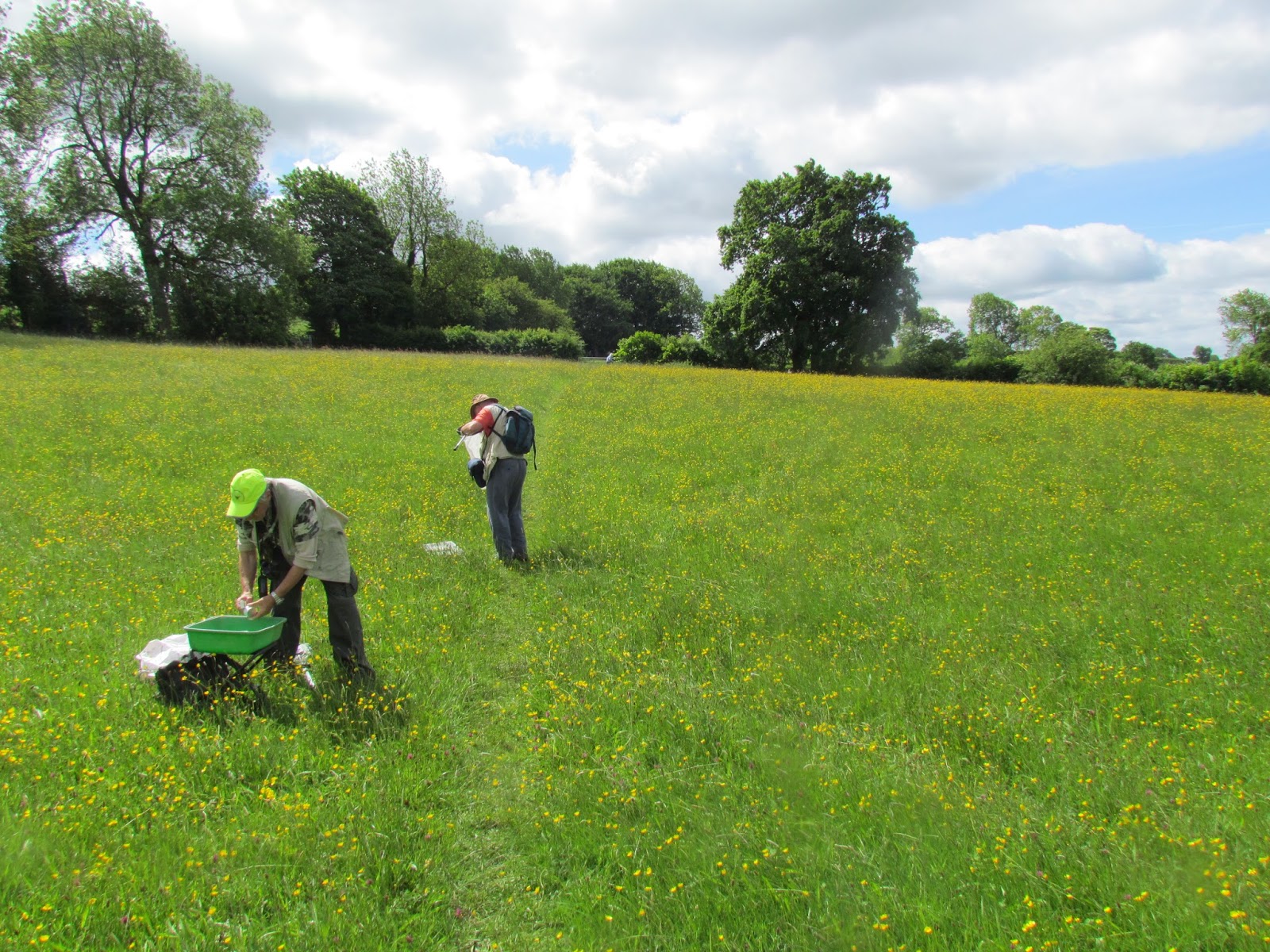
Note the rather splendid green, possibly a washing-up, bowl that has been pressed into service as a beating tray. 

Goodbye to the first of the fields


And hello to the second


 We continued to explore the boundary between the meadow and the hedgerow with one taking advantage of some shade under a tree.


Something told me that time was marching on. 

Was it that empty  feeling in my stomach? 

Yes.

Lunch was declared. And what a spot to picnic!


Rested and satiated we moved on. 

The conopid fly Sicus ferrugineus was photographed. It is a curiously shaped fly at rest with its abdomen curling under itself making it look almost circular. Surely a fly that has inspired the design of many a hunch-backed monster.


Photograph: Jim Cresswell
Nearby were a patch of orchids, probably Southern Marsh


Photograph: David Williams
We left the meadow and made our way back to our hosts' farm via a back lane. We gained altitude and were treated to a view to the east of Wolverhampton, Dudley and the Malverns. To be fair, if Wolverhampton and Dudley had not been pointed out to me I would not have noticed them as they were just blurs on the distant horizon.

Needless to say the lane verges and hedges caught our interest


Passing through another meadow


Photograph: David Williams
Our hosts' garden was reached, which we investigated (as promised earlier).


Herina frondescentiae - Photograph: David Williams
Eventually time and exhaustion caught up with us - together with the offer of tea and cake, so how could we resist? 

My thanks to Shropshire Wildlife Trust for giving us permission to do what we enjoy doing on this excellent site; to our hosts for showing us around and inviting us to investigate other areas of their farm and garden; to our hosts again for the wonderful tea and cakes and to the snappers who kindly allowed me to use their photographs in this piece.

6 Jun 2017

Creative Writing


The Hurst - Wednesday 31st May 2017

Prologue

The Hurst is the former home of John Osborne, the playwright. The house sits in extensive grounds bordering Sowdley Wood near Clunton. The grounds consist of woodlands, a lake, meadows and gardens. The house is now run as a training centre and retreat for writers. 

On with the story ...

Chapter 1, The Car Park

There are two car parks one by the house and the other a little further away. The house is approached along a drive which then divides. 

Which way to go?

There is a sign to the house. We followed it, failing to notice the additional sign that had been put there for us indicating that we should take the other branch. 

Out of the eleven of us visiting, seven went the wrong way! So much for our observational skills.

Eventually we all arrived at the correct car park, met our host for the day (who had put out the sign) and got ready.

As nearly always the car park proved to be a place of interest. The stream running through it at one end was an immediate attraction as we set about trying to identify the plants. There were also insects.

Chloromyia formosa - Photograph: Jim Cresswell

Rhagio scolopaceus - Photograph: Jim Cresswell

Green-veined white - Photograph: Jim Cresswell
Chapter 2, The Meadows

We tore ourselves away from the car park and entered a meadow.


Mating dock bugs were discovered, on dock. To preserve their modesty here is a picture of another.

Photograph: Jim Cresswell
We saw the first of many desmoiselles and damselflies but these will feature later. In the middle of the meadow stood a forlorn, lichen and moss encrusted tree.


A stream ran down the side of this meadow (and on through the car park) which divided it from a second meadow. As we crossed it we looked at some of the loose stones in the water.


And found one covered in caddis larval cases.

Photograph: Jim Cresswell

Chapter 3, The Dovecote

At the top of the second meadow stands a dovecote and this was the natural feature to gravitate towards.


This meadow is considerably larger than the first and looking around it occupied us until lunchtime. Here are some of the things we found.

A male Beautiful desmoiselle:
Photograph: Jim Cresswell
A "prey's eye" view of a female Beautiful desmoiselle:
Photograph: David Williams
 The hoverfly Eristalis horticola:
Photograph: David Williams
 Garden chafers busy making the next generation:
Photograph: Jim Cresswell
Red-headed cardinal beetle:
Photograph: Jim Cresswell
Common blue butterfly: 
Photograph: David Williams
 The hoverfly Volucella bombylans:
Photograph: Jim Cresswell
When we eventually arrived at the dovecote we witnessed Rhagio scolopaceus flies apparently involved in a "ménage à trois" 


It was lunchtime.

Did we stop for lunch?

No.

We pressed on.

Chapter 4, The Lake

We passed though a short section of woodland to the lake. Here some sofas made of iron at the lakeside provided an excellent but not too comfortable place to have a break for sustenance.


Whilst dining we kept our eyes open and cameras ready to immortalise any unwary little beasties.

A large red damselfly:
Photograph: Jim Cresswell
The tortoise beetle Cassida viridis:
Photograph: Jim Cresswell
A Gold swift moth:
Photograph: David W
Whilst others examined, intimately, the statues


For lichens, of course.

Chapter 5, The Quarry

Beyond the lake well hidden among the wood lies a damp and gloomy quarry. In here fungi were the reigning life force.

One tree lay across the quarry floor. Towards its base a Dryad's saddle was growing.

Photograph: Jim Cresswell
Other smaller fungi abounded. Unfortunately I do not know the species names but I am sure someone will tell me in due course.

Photograph: Jim Cresswell
Somewhere nearby a long horn beetle came into view and was photographed.

Rhagium bifasciatum - Photograph: David Williams
Chapter 6, Time To Go

Thus far we had looked at a tiny fraction of the grounds. We soldiered on but time was running out. We walked down the lane and then into the margin of the woods below and to the west of the house. One last find was a Clay triple lines moth.

Photograph: John Bingham
We took our leave of this intriguing site after another excellent day out.

Annex

I have two more photographs. Unfortunately I do not know where these were observed so I could not include them in the story, which, believe it or not, I do try to reflect what really happened, although some of the timings may be altered for dramatic effect (and poor memory)! 

These are excellent photographs of two insects that have not featured before.

A digger wasp Argogorytes mystaceus:
Photograph: John Bingham
 A robber fly Neoitamus cyanurus:
Photograph: John Bingham
Acknowledgements

My thanks to The John Osborne Avron Centre for granting us permission to survey the site; to Rob Rowe for being our host and guiding us around and to the photographers - Jim Cresswell, David Williams and John Bingham for providing the majority of the photographs.


1 Jun 2017

Triple Header

Despite my best intentions to write these reports as close to the events as possible sometimes real life gets in the way. And so it is that I am two weeks behind. As a result this report will include information from our last three outings.

Madeley Pit Mounds - Wednesday 17 May 2017

It was raining when we met and it continued to rain whilst we looked around Hills and Blists Hill pit mounds, two of the five mounds that comprise the recently designated Madeley Pit Mounds Local Nature Reserve. It was still raining when we went home.

Fortunately, following a request from Madeley Town Council and the Shropshire Wildlife Trust the focus of the day was on the sites' flora. This was just as well as any self respecting invertebrate had taken one look at the weather and decided to stay in bed.


Here we are inspecting the border of Blists Hill pit mound with a couple of dog walkers wondering what on earth is going on.

We started on Hills Pit Mound. The first challenge was to find a path as it looked impenetrable from the car park. A quick search revealed some steps up the mound that continued as a well formed path over the mound on down the other side.

The trees that covered the mound formed a good high canopy and there was a reasonable mid-level layer but the ground flora was poor, which is not surprising in view of its origin. Overall it was a pleasant wood.

On the way we did manage to tease some insects out of their hiding places:

A Parent bug -

Harlequin ladybird - 

And a winter moth larva - 

We moved on to Blists Hill pit mound. Initially the woodland was similar to the first mound but this gave way to some good beech woodland before reverting back. We did find some heathland with a few outbreaks of bilberry, some straggly heather and even wavy-hair grass. Interestingly this coincided with the area that clearly the most "social" activity took place, which may in fact have helped it to survive.

We lunched under the not very effective umbrella of an oak tree. The rain got heavier and heavier. We called it a day and went back to the cars. 

But on the way we lost our arachnologist. We thought he was in front (he was); he thought he had told us where he was going (he had); but somewhere something went awry and he disappeared. So whilst the others went home to dry out a colleague and I searched for our companion.

It did not take long to find him and we decided to celebrate our reunion with a glass of ale at the All Nations.

We will return to Madeley Pit Mounds later in the year.

Rhos Fidddle SWT Reserve - Wednesday 24 May 2017

What a contrast to the previous week (and our last visit to this site). The sun was shining, there was very little wind and it was hot.

We got ourselves ready then set off, well some of us did, others found the lure of the car park vegetation too hard to resist.


Rhos Fiddle is a large area of upland heath where the sound of birds is usually the only thing that breaks the silence. Today was such a day; skylarks singing, other birds joining in ... then the vacuum sampler was employed.


The noise of this is annoying but it is excellent for extracting animals from the denser vegetation that the normal techniques of sweeping and beating fail to dislodge.

We found clumps of milkwort


Photograph: Bob Kemp
As we came over the first rise we found swathes of cotton grass

Photograph: Bob Kemp
Sometimes you just want to be on your own


I have been to this site three or four times before and know there is a pool, but have I ever found it?

No.

So that became the objective. But where is it? Maps were consulted (on a mobile phone, we are nothing if not progressive).


OK, the pool was located, in theory, so the group set off in that theoretical direction. In the meantime a couple had gone off in a different direction so I set off after them.

I eventually caught up with them in the far corner of the site where they regaled me with what they had seen and photographed.

Common lousewort
Photograph: Bob Kemp
Green hairstreak
Photograph: Bob Kemp
Large red damselflies
Photograph: Bob Kemp
And an unidentified click beetle - if anyone can identify it please let me know.


Photograph: Bob Kemp
I told them where we were gathering and left them to it.

On my way back to rejoin the majority of the group I passed a fence post that was its own wild place


Eventually I found the pool. Hooray!


Overall the site was very dry, but not here. It was difficult to get near the pool due to the softness of the ground.

The others were taking afternoon tea a little way away. As I made my way towards them I noticed a movement just in front. I stopped, it stopped. I moved, it moved. I stopped, it stopped.... You get the gist.

Eventually I caught sight of the perpetrator ... a lizard. It kindly allowed me to take some photographs.


I moved on, passing a mound that was covered in polytrichum moss in flower.


I rejoined my colleagues. 

Then the adventurous duo returned armed with a peace offering for the spiderman


Agalenatea redii - Photograph: Bob Kemp
We made our way back to the cars.

On the way we passed stonechats sitting on vantage points


Photograph: Bob Kemp
Then we stumbled across some mountain pansy.


Photograph: Bob Kemp
I think my bemusement at the conversation of our photographers when discussing photographic matters is well known but you have to admire anyone who puts his body through so much stress and strain to get that "perfect" shot.


My thanks to Shropshire Wildlife Trust for giving us permission to do what we enjoy doing and to Bob Kemp for the additional photographs.

Oswestry Old Racecourse - Sunday 28 May 2017

Our first Sunday outing of the year was to a site which seem to have several names - Racecourse Common, Oswestry Old Racecourse Common, Old Oswestry Racecourse and the one I have used. I have no idea which is the correct one, so apologies to anyone I may have offended by using the wrong name.

Yes, its name is not misleading. It was a racecourse. Used from the early 17th century until the mid-19th by gentlemen of England and Wales. The information board by the car park does not hold back telling us that as well as horses it also brought "large crowds, drinking, gambling and pickpockets".

The site is common land and parts have developed into woodland with wide rides whilst the northern and highest part is open and dominated by bracken with a few patches of heathland.

The car park was large and busy with many people bringing their dogs for a Sunday walk. I tried to get the group to move away to quieter spots but they seemed to be glued to its surrounding vegetation. Here are some of the reasons why.

A Hawthorn shieldbug sunning itself on a rowan.

Photograph: Jim Cresswell
A leaf beetle Chrysolina fatuosa

Photograph: David Williams
A click beetle Ctenicera cuprea


Photograph: Jim Cresswell
Currant galls on oak caused by the the gall wasp Neuroterus quercusbaccarum


Photograph: Jim Cresswell
And a nymph of a Forest bug on oak.


Eventually we moved on. About 50 yards, where some picnic tables made a few think about morning coffee.

Here we found a mottled umber caterpillar

Photograph: David Williams
A wide ride runs through one side of the site parallel to the road. We inspected the vegetation and trees as we walked along it, slowly.


A cocksfoot moth was spotted

Photograph: David Williams
beat one tree and out fell a cockchafer


Remembering my photography lessons I tried placing it back in the tree on some leaves but it refused to leave my hand. I pulled it off (they are very sturdy) and placed it on a leaf. It fell to the ground. I found it again and placed it on another leaf - it fell off. This was repeated several times before I found a clump of leaves which supported its weight and took the above photograph.

Cockchafers are well known to moth trappers as they are attracted to the light of the trap. You can hear them approach, watch them enter, then listen to them blundering about in the trap until they settle down. And woe betide you if you are in their flight path as they will just fly into you.

This one was flying nowhere ... thankfully.

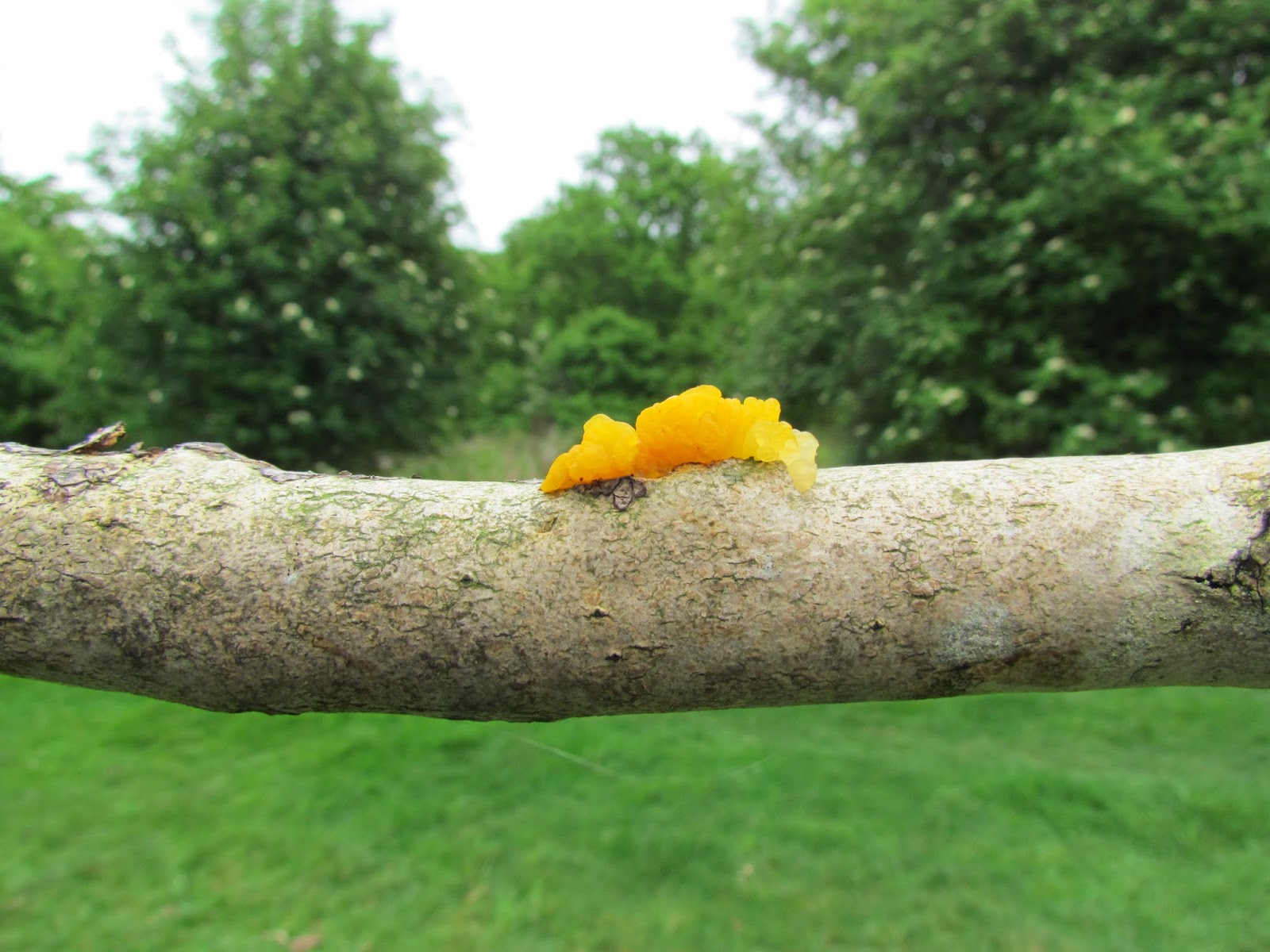
A stick was found with a orange jelly like fungus


(Notice how I am learning to take photographs with a more interesting background than a tray or net.)

Lunch was taken with our spider man regretting not packing his drain cover levers so that he could check the drain for cave spiders.


Over lunch we were visited by down-looker flies, Rhagio scolopaceus. They have earned their name by their habit of sitting on vegetation head down.


Photograph: Jim Cresswell
Nearby was a rowan. Some of the leaves had lots of small marks on them. These are galls caused by the mite Phyllocoptes sorbeus.


Photograph: Jim Cresswell
 Lunch over, we moved on. A little further along the ride, to the left, we found a small pool. 


This proved to be of great interest with lots of insects, spiders and plants attracting our attention.


Crowfoot - Photograph: Jim Cresswell
Cercopis vulnerata - Photograph: Jim Cresswell
Orange tip larva - Photograph: David Williams
The star attraction was a Blue shieldbug which somehow ended up on a hand. I have described the difficulty in persuading shieldbugs to return to the vegatation from a hand elsewhere. This one was no different. Not only that but it decided that the hand may provide sustenance. It stuck its rostrum into the hand. Ouch!

Normally such an attacker would be brushed off. But it had attacked a photographer. And never one to miss the perfect shot he grabbed his camera.


Photograph and hand: David Williams
The insect was not harmed but it did leave a hole in the hand.

I had placed my sweep nets and stick close to the pool to have a walk around the area. When I came back I was rather surprised when moving one of my nets to find a frog had taken up residence.


We did move on to the north of the site crossing the road that bisects the common. Here the woodland close to the road gave way to bracken dominated open space as the land gained. 
height.

Thoughtfully a seat has been placed at the northern end and highest point which provided some respite as the heat of the day increased. 

Nearby a small copper fluttered into view.


Photograph: Jim Creswell
From here we walked back to the cars. On the way we came across patches of heathland that had managed to survive.

Oswestry Old Racecourse proved to be an excellent site providing plenty of "things" for us to look at as well as glorious views to the east.

My thanks to Shropshire County Council for granting us permission to survey the site and to Jim Cresswell and David Williams for the additional photographs.