Nature Notes April 2012
A double junction closure was sending me south in to the flatlands of Cambridgeshire, not a landscape that I appreciate or wish to linger in. Congestion crushed us into a reluctant queue and being stationary a movement within the hawthorn scrub of the embankment alongside caught my eye. The red brown colour and prominent ears said fox but a little shift in the car ahead gave me a better view of a little Reeves Muntjac. I was pleased with the sighting though my pleasure has to be tempered as this tiny ungulate is also a very serious pest. The Reeves Muntjac is named after John Reeves who was a Tea inspector for the East India Company in the 1800’s who observed and gave his name to a number of south east Asian species including the Reeves pheasant. First released or escaped from Woburn Abbey following its introduction to this emparked estate in 1894, this deer originally from the subtropical forest of south- East Asia, has successfully survived and thrived in the southern parts of the UK. Muntjac tends to live alone or in pairs, rarely seen, they have tiny, un-branched antlers and a voracious browsing habit. The buck has prominent fangs and a v-shaped ridge marked with dark stripes running down its forehead, the doe has a dark triangular patch instead, I had seen a doe. Their success in the UK can be partially attributed to the lack of a breeding season and the rapidity of readiness following fawning. Muntjac slots have been seen in many urban areas and certainly they have reached Telford but I am sorry to say I do hope they stray no further.
Cambridgeshire is all big skies and occasionally our home county can offer some of the same. On an excursion to Melverley I was struck as ever by the flood trash combed into the hedges, a twiggy tidal line four feet or so above ground level. Stopping off to check directions before roaming any further down the meandering lanes I heard my first skylark of the year. This ground nesting bird is silent for the winter but now rises from early in the morning to late evening to pour forth a boiling stream of song and sibilant mimicry. Its song can last up to 15 minutes without break. My skylark had not gone unnoticed as a sparrow hawk bolted across the sky to attempt a mid-air snatch, an ill matched duel began and was quickly called off as the skylark now alerted, twisted and spiralled its way out of danger. As the excitement died another aerial conflict kicked off between a languid buzzard and a crow. The Carrion crow boldly harassed the larger bird who banked away and fled the scene, a victory for the little guy.
Lengthening days mean more time in the garden and the door does not need quick slamming to retain precious heat. Other changes are also to be welcomed, putting out the empties a moth flitted past my head and into the living room. A short ballet followed to everyone’s amusement and I had my first Angle Shades of the year. This Noctuid moth has a lovely crimped back edge to the forewings and a colour pattern a little like a Victorian ink swirl. The moth can be found in most places though can be difficult to see as in rest it can look like a dead leaf.
Other signs can be found of the arrival of spring, the rapidly greening hedges and the movement of species into their breeding territories. A pair of Dippers on the Upper Ceiriog had laid claim to their stretch of the river, somewhere nearby their prospective nest site, and an active upland stream to feed in, and I say ‘in’ as they can quite happily swim underwater! Elsewhere reed buntings are about gathering food, straying away now from familiar canal side haunts into local gardens.
And before February was out my first Lesser Celandine in flower, yellow, fresh and a herald for what’s to come.
Happy Wildlife spotting, Pete Lambert.
3 Apr 2012
4 Mar 2012
Nature Notes from Pete Lambert March 2012
I had accepted an invitation to speak at a double assembly at our village school and was intimidated by the prospect. They had been running a packed fortnight of activity that included making feeders and investigating their local wildlife. Concerned that my interest in wildlife would be met with glum indifference and boredom I set up my slides. I needn’t have worried as they threw up eager hands to tell of birdy encounters in their garden, ask bright and direct questions and a surprising number had had close encounters with barn owls. Inspired by their enthusiasm I reflected that the future was not as bleak as so many paint what with these young wildlife champions on the way.
At the Felton Butler slip road at the southern end of the Nesscliffe bypass a field with winter greens played host to a 200 plus strong flock of lapwing, and on today’s journey north a similar field had just said goodbye to an airborne mass of this crested wader.
The UK picture is not good for lapwing, though the local farming community are doing their best to accommodate the wet grassland preferences of this popular wild bird, re-wetting fields were possible and crop regimes adjusted carefully to generate the clumpy damp sward preferred by the ‘peewit’. Recent walks along wide field margins, left to encourage wildlife corridors in even our most intensely farmed landscapes, revealed other beneficiaries. A discarded sheet of broken hardboard when deftly flipped over exposed a common shrew, the thick feggy grass close by was riddled with bank vole tunnels. As the winter lingers the mixed flocks of fieldfare and redwing are still to be found, mainly raiding the last fruits of the hedgerow and occasionally into the garden for an apple treat.
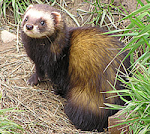
Driving down into the hollow our headlights were reflected back by what we took to be cats eyes, but these moved and rapidly too, turning tail and back into the hedge. It was a polecat, in its winter coat, which tends to be much denser than its slim summer incarnation so it looks lighter in colour and rounder.
Once known as the foul-mart because of its strong smell, this wily predator had faced near extinction. The pelt or ‘fitch’ was prized and it was felt the animal was considered a threat to game and livestock. Slowly as persecution by trapping has declined this nocturnal carnivore has expanded back out of its Welsh heartland to cross the border back into England. Polecats occupy family territories which they mark using stink glands located at the base of the tail, this noxious spray is also used defensively, urgh! The polecat has a distinctive Zorro-like face mask and white ears, its near relatives the polecat-ferrets and the ferret proper lack such a distinctive look. Occasionally they hunt during the day but our late evening sighting is the more likely viewing.
Only my second sighting in a lifetime, the leafless scrubby woods allowed a wonderful look at the leaping and fleeting display of the woodcock as it made its spectacular aerial escape.
The woodcock is a wading bird that has taken to the woods, the Llynclys area seeming to be a favourite haunt. Its long narrow bill is used to probe the ground for worms and other food, the high set eyes giving it near 360 degree vision. The woodcock is able to grasp its young brood during the breeding season and airlift them to safety, either clutched in its claws or between her thighs. A spooky beating of its territorial bounds through March to July is known as ‘roding’, this slow flight accompanied by frog like croaking and high pitched whistling. As the winter shows signs of its inevitable end I hope to return here to experience for myself the Roding of this enigmatic and remarkable British bird. Spring is coming, stay alert it waits for no man, so much to look out for!
Happy wildlife spotting,
fond regards,
Pete Lambert.
At the Felton Butler slip road at the southern end of the Nesscliffe bypass a field with winter greens played host to a 200 plus strong flock of lapwing, and on today’s journey north a similar field had just said goodbye to an airborne mass of this crested wader.
The UK picture is not good for lapwing, though the local farming community are doing their best to accommodate the wet grassland preferences of this popular wild bird, re-wetting fields were possible and crop regimes adjusted carefully to generate the clumpy damp sward preferred by the ‘peewit’. Recent walks along wide field margins, left to encourage wildlife corridors in even our most intensely farmed landscapes, revealed other beneficiaries. A discarded sheet of broken hardboard when deftly flipped over exposed a common shrew, the thick feggy grass close by was riddled with bank vole tunnels. As the winter lingers the mixed flocks of fieldfare and redwing are still to be found, mainly raiding the last fruits of the hedgerow and occasionally into the garden for an apple treat.
Driving down into the hollow our headlights were reflected back by what we took to be cats eyes, but these moved and rapidly too, turning tail and back into the hedge. It was a polecat, in its winter coat, which tends to be much denser than its slim summer incarnation so it looks lighter in colour and rounder.
Once known as the foul-mart because of its strong smell, this wily predator had faced near extinction. The pelt or ‘fitch’ was prized and it was felt the animal was considered a threat to game and livestock. Slowly as persecution by trapping has declined this nocturnal carnivore has expanded back out of its Welsh heartland to cross the border back into England. Polecats occupy family territories which they mark using stink glands located at the base of the tail, this noxious spray is also used defensively, urgh! The polecat has a distinctive Zorro-like face mask and white ears, its near relatives the polecat-ferrets and the ferret proper lack such a distinctive look. Occasionally they hunt during the day but our late evening sighting is the more likely viewing.
Only my second sighting in a lifetime, the leafless scrubby woods allowed a wonderful look at the leaping and fleeting display of the woodcock as it made its spectacular aerial escape.
The woodcock is a wading bird that has taken to the woods, the Llynclys area seeming to be a favourite haunt. Its long narrow bill is used to probe the ground for worms and other food, the high set eyes giving it near 360 degree vision. The woodcock is able to grasp its young brood during the breeding season and airlift them to safety, either clutched in its claws or between her thighs. A spooky beating of its territorial bounds through March to July is known as ‘roding’, this slow flight accompanied by frog like croaking and high pitched whistling. As the winter shows signs of its inevitable end I hope to return here to experience for myself the Roding of this enigmatic and remarkable British bird. Spring is coming, stay alert it waits for no man, so much to look out for!
Happy wildlife spotting,
fond regards,
Pete Lambert.
4 Feb 2012
Nature Notes - February 2012 by Pete Lambert
Just when I thought the winter was about to pass by in a gust of wet winds and swirling damp fog I awoke to find the garden decorated with a fine filigree of ice. A week ago we had sat in a bird hide sheltering from the drizzly attentions of the low cloud that had lain duvet like across the Pumlumon mountains. The object of our vigil, the Red Kite , or we hoped hundreds of kites as optimistically promised in the leaflet! Nant yr Arian is a Forestry Commission centre, an innovative building hosts a cheap, clean café and is the starting point for trails designed to please walker or off road cyclist. Each day throughout the year one of the Ranger team puts out raw meat scraps to attract the iconic Red kites to feed and enjoyed as they land and soar up and away once full.
The red kite represents the most successful reintroduction programme in the world. The UK population had been reduced to just two pairs by the late 1800’s, hiding out in remote mid Wales valleys and therefore making them extinct in England and Scotland. Last century captive breeding programmes were able to provide kites for planned release in Mid Wales amongst other locations. The Red kite though well known as a scavenger from Samuel Pepys description of the birds cleaning the filth ridden streets of Restoration London of offal and other detritus, also hunt rabbits and other prey. The bird soars buoyantly, its head and tail hang down slightly in flight and the characteristic forked tail constantly twists to help it maintain position. After 45 minutes of waiting since the bait had been cast and 5 tantalising glimpses of the kites wheeling away without landing just visible in the thick gloop of cloud, my young companions tummy began to rumble and we left the hide. Stopping occasionally to look back just in case the kites had noticed we had gone and swooped down in a russet swarm to gulp down the morsels, but no, and satisfied with the ghostly glimpses we both agreed to come back on a brighter day.
With the trees completely shorn of leaves identification is down to the subtleties of bud, bark, form , size and location. One little tree that gives itself away quite easily in the winter is the Crab apple. Piled at the foot of most Crab apples during the colder months we can find the yellow, hard fruits. Bitter and sour to the taste but they can be turned into the most grown up jelly for breakfast toast. The Crabapple’s scientific name is Malus sylvestris which means ‘apple of the woods’ and this small tree which grows rarely above 10m can be found in oakwoods and along hedge lines. The Crab is the rootstock from which all our orchard varieties are derived, the leaves of the domestic apple are usually wooly or hairy backed whereas the petioles or leaf stalks are hairy on the crabapple. My favourite Crab can be found on the flanks of Caer Caradoc, near Church Stretton, and in May a walk there will be rewarded by a profusion of white blossom. Closer to hand there are a few on the A5 and many in amongst the jumbled woodlands of Llanmynech and closer still the homebound hedged lanes play host as well.
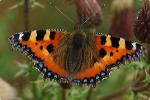
The Small tortoishell butterfly upstairs battered against the window, whilst the Small tortoishell downstairs created a subtle lightshow by flying around inside the lightshade. These hibernating adults had risen too soon, the nettles have not begun growing again and sadly I think the gently lengthening days and our central heating had summoned these sleepers prematurely. Snowdrops have been noted and the radio had spoken of the first daffodils being sighted. Hard times are still to come though and the loping fox on Grimpo Lane spied earlier this week will be working hard to find food to keep him going. But for nature watchers this is the time of year to look out for those coming signs of Spring, so happy wildlife watching, fond regards, Pete Lambert.
The red kite represents the most successful reintroduction programme in the world. The UK population had been reduced to just two pairs by the late 1800’s, hiding out in remote mid Wales valleys and therefore making them extinct in England and Scotland. Last century captive breeding programmes were able to provide kites for planned release in Mid Wales amongst other locations. The Red kite though well known as a scavenger from Samuel Pepys description of the birds cleaning the filth ridden streets of Restoration London of offal and other detritus, also hunt rabbits and other prey. The bird soars buoyantly, its head and tail hang down slightly in flight and the characteristic forked tail constantly twists to help it maintain position. After 45 minutes of waiting since the bait had been cast and 5 tantalising glimpses of the kites wheeling away without landing just visible in the thick gloop of cloud, my young companions tummy began to rumble and we left the hide. Stopping occasionally to look back just in case the kites had noticed we had gone and swooped down in a russet swarm to gulp down the morsels, but no, and satisfied with the ghostly glimpses we both agreed to come back on a brighter day.
With the trees completely shorn of leaves identification is down to the subtleties of bud, bark, form , size and location. One little tree that gives itself away quite easily in the winter is the Crab apple. Piled at the foot of most Crab apples during the colder months we can find the yellow, hard fruits. Bitter and sour to the taste but they can be turned into the most grown up jelly for breakfast toast. The Crabapple’s scientific name is Malus sylvestris which means ‘apple of the woods’ and this small tree which grows rarely above 10m can be found in oakwoods and along hedge lines. The Crab is the rootstock from which all our orchard varieties are derived, the leaves of the domestic apple are usually wooly or hairy backed whereas the petioles or leaf stalks are hairy on the crabapple. My favourite Crab can be found on the flanks of Caer Caradoc, near Church Stretton, and in May a walk there will be rewarded by a profusion of white blossom. Closer to hand there are a few on the A5 and many in amongst the jumbled woodlands of Llanmynech and closer still the homebound hedged lanes play host as well.
The Small tortoishell butterfly upstairs battered against the window, whilst the Small tortoishell downstairs created a subtle lightshow by flying around inside the lightshade. These hibernating adults had risen too soon, the nettles have not begun growing again and sadly I think the gently lengthening days and our central heating had summoned these sleepers prematurely. Snowdrops have been noted and the radio had spoken of the first daffodils being sighted. Hard times are still to come though and the loping fox on Grimpo Lane spied earlier this week will be working hard to find food to keep him going. But for nature watchers this is the time of year to look out for those coming signs of Spring, so happy wildlife watching, fond regards, Pete Lambert.
Subscribe to:
Posts (Atom)