6 Jul 2023

The Magnificent Three

Wednesday 28th June 2023, Prees Branch Canal

I was holidaying in Dorset and was unable to attend.

As these things happen, several other regulars were also missing due to holidays or other commitments.

I am grateful to one of the Magnificent Three for providing a summary of the day.

The group met at the Whixall Marina car park at 10.30am more or less.

Although it was overcast it was very warm and slightly humid.

They walked along a permissive path across a field which, although not a traditional hay meadow (too much Yorkshire Fog and other rank grasses), was very nice. There were lots of butterflies on the wing: Meadow browns, Ringlets and Large skippers. 

This path led to Dobson’s Bridge where they joined the towpath. 

Their walk can be split into two parts - the tow path as far as the end of the marina, and the part beyond which ends at Waterloo.

The first part is open but not mown, lots of nectar sources, lots of butterflies, now including a large number of very fresh Gatekeepers. Bearing right at the end of this part the canal is not navigable, there are some trees on the far bank and on the towpath side where there is also a hedge. 

The canal is on an embankment. The most shaded areas had open water but if sun could penetrate foliage seemed to fill the canal. 

At the start they did find a Small Skipper but under the shade Clegs and Mosquitos were in abundance.

They beat, swept and suction sampled quite a lot of diptera with smaller quantities of other groups, including some interesting ladybird finds.

Lunch was taken just after 12.

By 1.30pm it was raining and unlike earlier showers this one lasted much longer. They sheltered until about 2.30pm and then headed back to the cars quickly.

It had stopped raining as they arrived back at the car park!!

Full advantage was taken of the Marina’s café before returning home.

Here are photographs of some of the species found during the visit:

The nymph of a Spiked shieldbug;

Photograph: David Williams

A female White-legged damselfly;

Photograph: David Williams


An Essex skipper;

Photograph: David Williams

A froghopper which is probably Cixius nervosus;

Photograph: David Williams

A Water ladybird larva;

Photograph: David Williams

A harvestman, Nemastoma bimaculatum;

Photograph: Nigel Cane-Honeysett

And an Oak ladybird, Scymnus auritus, larva.

Photograph: David Williams

Oak ladybird larva feed on Phylloxera, a type of Hemiptera, related to aphids. The following photograph shows Oak ladybird larvae on a leaf occupied by several Phylloxera, probably Phylloxera glabra. You will notice that many of these insects are surrounded by circles of eggs. There is also a winged insect which is the form of the species that allows dispersal.

Photograph: David Williams

Other insects photographed were a nymphal and an adult Forest bug;

Nymph - Photograph: Nigel Cane-Honeysett

Adult - Photograph: Nigel Cane-Honeysett

And a 10-spot ladybird.

Photograph: David Williams

Thank you to Canal and River Trust for giving us permission to enjoy ourselves, to Whixall Marina for allowing us to use their car park (and café), to Jim for providing the summary of the day and to the to the photographers for their images to illuminate this tale.


4 Jul 2023

A Visit in Three Acts

Wednesday 21st June 2023, Donington & Albrighton LNR

Donington & Albrighton Local Nature Reserve spans Rectory Road close to St. Cuthbert’s Church, between Donington and Albrighton. The area to the west of the road is open to the public but the area to the east is restricted. 

Act I

We were met in the car park by one of the local volunteers who let us in to the restricted area, He left us with a warning that the path, although cut recently, was becoming overgrown.

He was not wrong!

The site is mainly woodland with an  understory of tall, lush vegetation, through which a stream gently flows.

Here is an image of one of the more open areas.


There was a lot of life amongst the vegetation. However as there was not a lot of variety in the habitats within the site we tended to find the same species repeatedly throughout the area.

Examples of what we found were:

A hoverfly, Volucella pellucens;

Photograph: David Williams

Larvae of Alder leaf beetle;

Photograph: David Williams

A Common wave moth;

Photograph: David Williams

Larva of Harlequin ladybird;

Photograph: David Williams

A Beautiful demoiselle;

Photograph: David Williams

A cucumber spider with its egg sac;

Photograph: Nigel Cane-Honeysett

Eventually we made it to a second bridge. 


Here the path divided. 

One possibility was to continue along the path, but a quick scouting mission soon discovered that the vegetation had won the battle with the path.

Another possibility was to cross the bridge and follow the path on the other side of the stream back to the earlier bridge.

Whilst we were deliberating, we noticed a window onto the outside world.

Photograph: David Williams

We opted for a third choice, return to the car park and visit the public area.

On the way we noticed an Alder whose leaves were covered in galls caused by the mite Eriophyes laevis.


Act II

Between the car park and the entrance to the restricted area there is an area of hard core that is being turned into a grassland.


This seemed to be an interesting habitat, so we paused in our trek to the public site to take a look at it.

But, first, lunch.

Refreshed we swept and suction sampled this area and turned up a nymph of a shieldbug that is much rarer in the county than the flower it is associated with, a Forget-me-not shieldbug.

Photograph: David Williams

Another find was the larva of a 16-spot ladybird.

Photograph: David Williams

Act III

Moving on, we crossed Rectory Road and made our way into the public area of the nature reserve.


There was a pool near the entrance where we established a base from which we carried out several forays around the site.


Early finds were this tiny but interestingly coloured mite;

Photograph: David Williams

An unidentified green beetle;

Photograph: Nigel Cane-Honeysett

And a pair of wasps, again we were not able to identify them.

Photograph: Nigel Cane-Honeysett

Inspecting the leaves of a tree revealed a Puss moth larva.

Photograph: David Williams

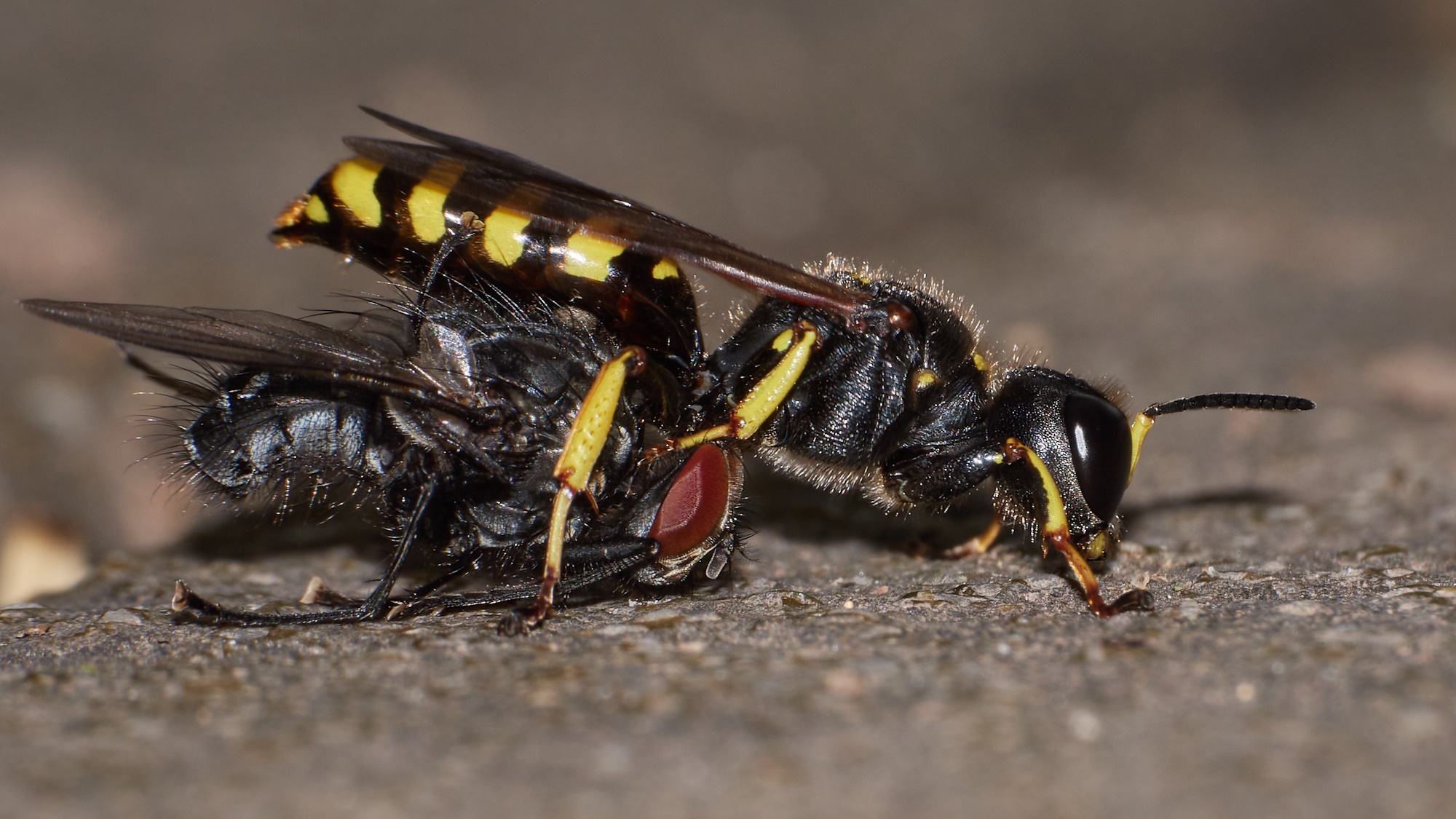
As we sat around our base we noticed a wasp carrying a fly which disappeared between the slats of some decking at the side of the pool. Later the same wasp (probably) returned with another fly. It was photographed.

Photograph: David Williams

The wasp was identified as a member of the genus Ectemnius but the unfortunate fly was not identified.

Dark clouds had gathered. We decided to call it a day and return to the cars, just about making it back without getting wet.

Other News

The moth group recently visited Severn Valley Country Park on a very pleasant evening. Some of the moths that were attracted to the traps were:

Swallow-tailed moth;

Photograph: David Williams

Elephant hawk-moth;

Photograph: David Williams

Blue-bordered carpet;

Photograph: David Williams

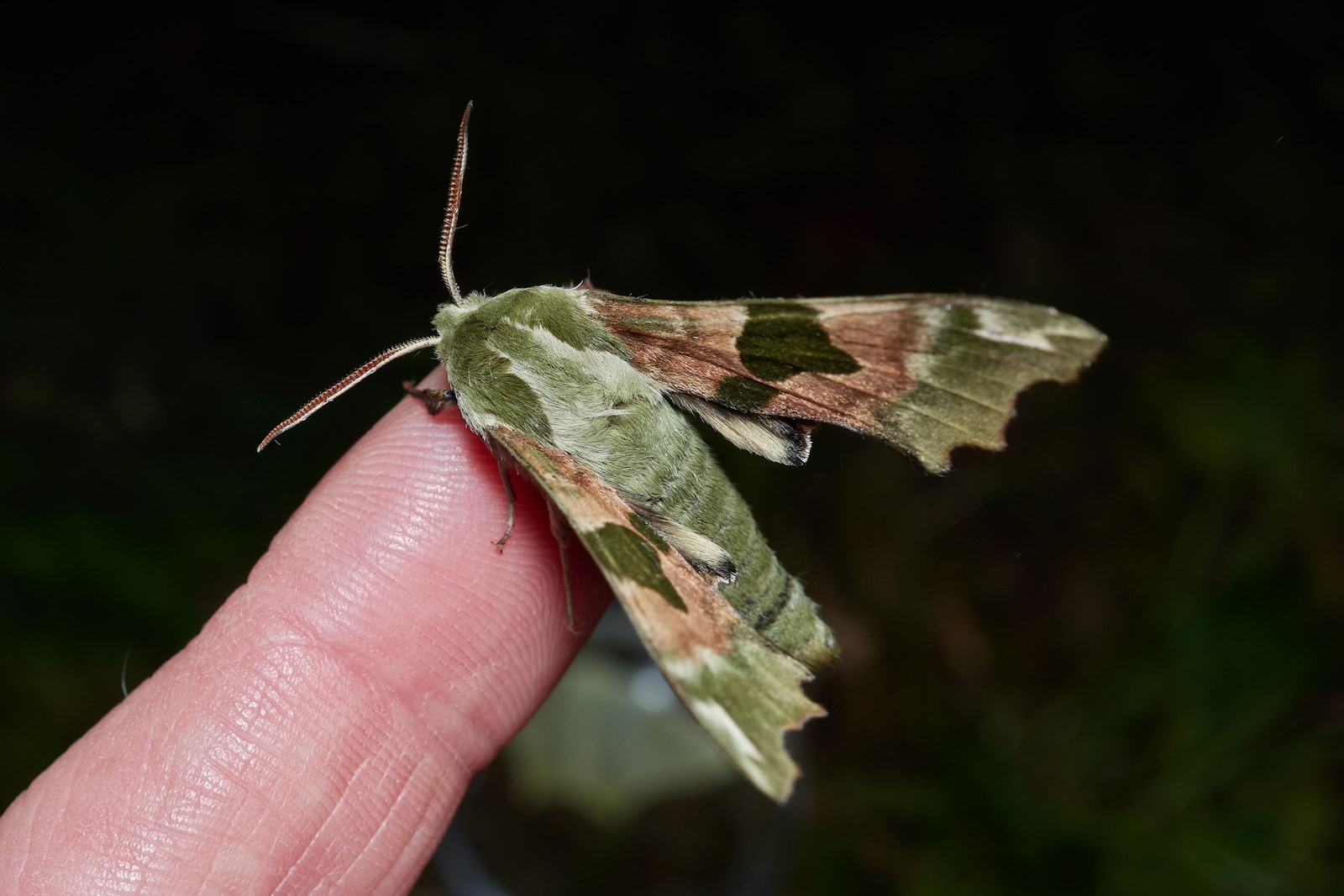
Lime hawk-moth;

Photograph: David Williams

Blotched emerald;

Photograph: David Williams

Small elephant hawk-moth;

Photograph: David Williams

And a Red-necked footman.

Photograph: David Williams

The underside of the same moth showing its orange abdomen.

Photograph: David Williams

In addition to the moths the lights of the traps attracted a large assassin bug, Reduvius personatus;

Photograph: David Williams

And a male Glow-worm.

Photograph: David Williams

Inspecting a large log at the side of the main track trough the site discovered a Lesser stag beetle.

Photograph: David Williams

Checking out the flowering bramble uncovered a Speckled bush-cricket nymph.

Photograph: David Williams

A trip to Cherhill Down in Wiltshire in search of Wart-biters was rewarded with the sight of several nymphs. Here are a male and female.

Male - Photograph: David Williams

Female - Photograph: David Williams

Also present on site was a very worn Marsh fritillary.

Photograph: David Williams

And whilst in Wiltshire why not nip to Swindon and look for Ant nest ladybird? 

A larva of this species was found.

Photograph: David Williams

A trip to Stroud (by-passing Winston’s Ice-cream delights) to visit Daneway Bank to see Large blue butterflies was undertaken.

No sooner had we arrived than we saw our first Large blue.


Many more were seen throughout our stay.

Other things of interest were this orchid which I believe is a Greater butterfly orchid.


Another speciality of this site is the bee-fly Villa cingulata.


This bee-fly has expanded its range immensely and has now been found in Shropshire.

As lunch was consumed a moth was flying around near-by. Suddenly it was no longer flying. It had been ambushed by a Robber fly which then proceeded to enjoy its meal.


A common sight during the day were Marbled white butterflies. They were mainly on the wing but we came across a small number that were more interested in feeding.


Finally, we found several rather nicely coloured mirid bugs, Calocoris roseomaculatus, each occupying its own ox-eye daisy flower.


Thank you to Shropshire County Council for giving us permission to enjoy ourselves and to the member of the site volunteers for turning out to unlock the restricted area. My gratitude to the photographers for their images to illuminate this tale.