Sunday, 3rd May 2020
At long last the weather came out in sympathy with our situation. It rained last Wednesday, when we had planned to visit Llynclys Common, making the cancellation of that outing less frustrating. I note the weather forecast for next Wednesday is warm sunshine. It is only a forecast, it may change.
In this episode we reach the halfway stage and it is on Monday, 3rd June that this milestone was reached and Wednesday, 5th June that it was passed.
In total six species of butterfly were added to the list, and a seed is planted on how to find one of our rarest butterflies.
We start in the Lake District.
On a lovely day at the start of June we set off early,. very early, on a trek northwards. Our hero volunteered to drive, for which I was very thankful.
It was a very easy journey as we made our way up the M6. As you leave the M6 at junction 36 you have a feeling of being nearly there. But we were, perhaps, only half way there in terms of time. We had to track west, following the coastline along the north of Morecambe Bay, then north following the Irish Sea coastline, before finally heading inland to Santon Bridge to get to Irton Fell, which is on the south side of the approach to Wastwater.

Our target for the day was Mountain ringlet, a montane species found, as described in my butterfly book, on a "few bleak mountain-tops in the English Lake District, the Grampians and other mountainsides in Scotland".
Irton Fell was our chosen destination as it is relatively easy for persons of a certain age to attain and is a well-known site for the butterfly.
Having parked we walked and ascended through pleasant woodland pausing every now and again to take in the view, and some oxygen.
After a comparatively short ascent we passed from the woodland onto the upland grassland that you can see in the foreground of the photograph above.
Mountain ringlets need sunshine. They hunker down in the vegetation on cloudy days and are very difficult to find. But when the sun comes out they will emerge from their cover en masse.
When we got there the sun was shining but there was a very stiff breeze. We did wonder if it was too windy. Fortunately it was not and we soon found plenty of the butterfly.
Number 29: Mountain Ringlet

The butterflies kept very close to the ground and did not fly far if disturbed, which made it easy to track them and get photographs.
We were not alone with the butterflies on the mountain top. Several other butterfly spotters were peering at the ground and chasing after flying objects.
One such was a taxi driver from Bath who had taken a few days off to look for butterflies. He had managed to see all 58 butterflies in each of the previous two years.
Our hero was awestruck!
Had he seen Chequered skipper this year?
No.
He had travelled to their sites in Scotland, and stayed three days to see the skipper, but it had rained the entire stay and he had not managed to see one.
Our hero was able to gloat, but not too overtly.
How about Glanville fritillary?
"Easy" said our new acquaintance.
Drive to Lymington, take the ferry to Yarmouth, taxi or bus to Compton Bay, see the butterfly, retrace your steps.
However, making this trip in a day from Bath is one thing, doing it from Staffordshire and Shropshire is another.
But the seed was planted.
Would it germinate?
You will have to wait to find out.
Back to the butterflies.
Having seen our target species we spent some time looking around for other things of interest which included this Fox moth:

In total six species of butterfly were added to the list, and a seed is planted on how to find one of our rarest butterflies.
We start in the Lake District.
On a lovely day at the start of June we set off early,. very early, on a trek northwards. Our hero volunteered to drive, for which I was very thankful.
It was a very easy journey as we made our way up the M6. As you leave the M6 at junction 36 you have a feeling of being nearly there. But we were, perhaps, only half way there in terms of time. We had to track west, following the coastline along the north of Morecambe Bay, then north following the Irish Sea coastline, before finally heading inland to Santon Bridge to get to Irton Fell, which is on the south side of the approach to Wastwater.

Our target for the day was Mountain ringlet, a montane species found, as described in my butterfly book, on a "few bleak mountain-tops in the English Lake District, the Grampians and other mountainsides in Scotland".
Irton Fell was our chosen destination as it is relatively easy for persons of a certain age to attain and is a well-known site for the butterfly.
Having parked we walked and ascended through pleasant woodland pausing every now and again to take in the view, and some oxygen.
After a comparatively short ascent we passed from the woodland onto the upland grassland that you can see in the foreground of the photograph above.
Mountain ringlets need sunshine. They hunker down in the vegetation on cloudy days and are very difficult to find. But when the sun comes out they will emerge from their cover en masse.
When we got there the sun was shining but there was a very stiff breeze. We did wonder if it was too windy. Fortunately it was not and we soon found plenty of the butterfly.
Number 29: Mountain Ringlet

The butterflies kept very close to the ground and did not fly far if disturbed, which made it easy to track them and get photographs.
We were not alone with the butterflies on the mountain top. Several other butterfly spotters were peering at the ground and chasing after flying objects.
One such was a taxi driver from Bath who had taken a few days off to look for butterflies. He had managed to see all 58 butterflies in each of the previous two years.
Our hero was awestruck!
Had he seen Chequered skipper this year?
No.
He had travelled to their sites in Scotland, and stayed three days to see the skipper, but it had rained the entire stay and he had not managed to see one.
Our hero was able to gloat, but not too overtly.
How about Glanville fritillary?
"Easy" said our new acquaintance.
Drive to Lymington, take the ferry to Yarmouth, taxi or bus to Compton Bay, see the butterfly, retrace your steps.
However, making this trip in a day from Bath is one thing, doing it from Staffordshire and Shropshire is another.
But the seed was planted.
Would it germinate?
You will have to wait to find out.
Back to the butterflies.
Having seen our target species we spent some time looking around for other things of interest which included this Fox moth:

On our return through the woods, in which Rhododendron was in full bloom, we found the long horn beetle Rhagium bifasciatum:


The journey home was, thankfully, without incident and we encountered remarkably little traffic.
The next two butterflies were ticked off on a Joy of Wildlife trip to a colleague's farm near Llanidloes. A report of this outing can be found by following this link: Awayday.
Number 30: Large skipper
Number 31: Small pearl-bordered fritillary
Our next target was Black hairstreak. This is a very rare butterfly found in a few woods in what my book calls the East Midlands. Not only is it rare but it has a very short flight period.
Due diligence is required, keeping a look out for any reports on any media that they have been spotted. When they have, action needs to be taken without delay.
They had been spotted.
Plans were made, weather forecasts checked, and off we went to the Oxfordshire/Buckinghamshire border regions.
But where was our hero?
Absent.
For some reason Jim was unable to come.
But we went anyway!
First to Bernwood Meadows where an extensive search of the blackthorn hedges yielded no sightings, then to Whitecross Green Wood.
The wood claims to be a hotspot for butterflies. It has wide rides through which grass paths have been cut with plenty of signs asking you to keep on the paths to avoid treading on the wild flowers. We set off down a path but did not find much of interest, then met a person coming the other way who told us where to go to see the Black hairstreaks. Having followed his instructions we came to a blackthorn thicket around some taller trees.
And there at the top of the tree were black hairstreak. And there were more in the bushes at the side of a small pool behind the thicket, which is where I took the following photograph.
Number 32: Black hairstreak

Fortunately Bob was able to get a better photograph.
Not only did his photograph capture the butterfly but also the black and yellow mirid bug Miris striatus in close proximity.
What a shame our hero was not there.
O how we enjoyed the fact that we had found a butterfly he had not seen!
Were we being a little cruel?
Not really. There were no rivalries in this quest, just a bit of good humoured ribbing.
When we got back we did tell him where to go and he made the trip a day or two later. Not only did he find Black hairstreak but he also found:
Number 33: Meadow brown
And Number 34: Marbled white


Back to our trip. Having found the butterfly we continued to explore the wood, taking care, as much as possible, not to stray off the grass paths.
I swept the vegetation and found a Forest bug nymph and Green oak tortrix moth:

You will notice a couple of the long horn beetle, Saperda populnea on a leaf in the net. These were restored to a tree and they carried on as if nothing had happened!

What brilliant antennae.
One unwelcome invertebrate was not noticed during our visit but was found a couple of days later as it started to tunnel its way into my foot.
A tic!
Fortunately it was not embedded and was easily removed and dispatched.
That's the end of the tale for this episode. Join me next week, all being well, to see if the seed planted earlier, on Irton Fell, germinated.
As before I have continued to receive photographs of what others have seen. So as an antidote to butterfly-itis here they are:
Black sexton beetle, Nicrophorus humator
A Cellar spider, possibly Pholcus phalangioides, carrying its egg sac.
Common rough woodlouse, Porcellio scaber, in two colour forms.
Dock bug, Coreus marginatus, not on dock.
A fungus Dryad's saddle, Polyporus squamosus, on a walnut stump.
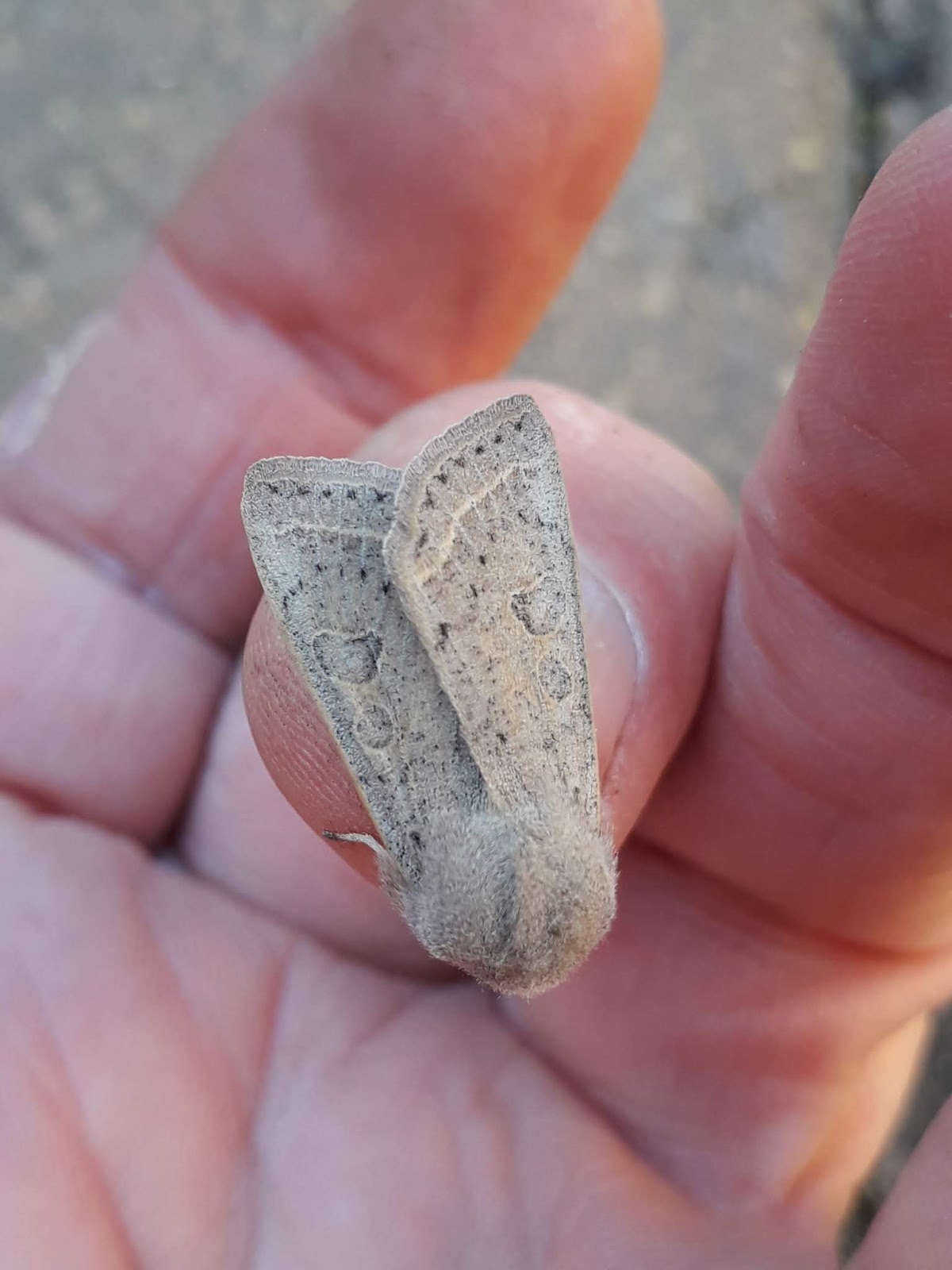
A moth, Powdered quaker, Orthosia gracilis.
A rhoplid bug, Rhopalus subrufus.
A cranefly, Tipula subnodicornis.
A snake-fly, Xanthostigma xanthostigma.
And just in case you are getting butterfly-itis withdrawal symptoms, a Dingy skipper, Erynnis tages.
A newcomer to my moth trap was a Lychnis, Hadena bicruris.

We have lots of things popping up in our front "lawn" at the moment including some grass! One thing I noticed was this plant:


I have been told that this is probably Thyme-leaved speedwell.
A Wild strawberry also put in an appearance.

It has been pointed out to me that Plantlife are running a "Citizen Science" project called "No Mow May". I am very happy to take part! Will you be able to resist mowing the lawn this month?
Here is a link to the project website: No Mow May
As I was staring out of the window watching the front lawn grow, I noticed some Lesser black-backed gulls performing a song and dance act on a neighbours' roof.


Finally you may be interested in this blog by Clare who had a pair of Sparrowhawks nesting in the woods in her garden: Sparrowhawks in a mid-wales garden.
Until the next time - keep well.
The next two butterflies were ticked off on a Joy of Wildlife trip to a colleague's farm near Llanidloes. A report of this outing can be found by following this link: Awayday.
Number 30: Large skipper
 |
| Photograph: David Williams |
 |
| Photograph: David Williams |
Due diligence is required, keeping a look out for any reports on any media that they have been spotted. When they have, action needs to be taken without delay.
They had been spotted.
Plans were made, weather forecasts checked, and off we went to the Oxfordshire/Buckinghamshire border regions.
But where was our hero?
Absent.
For some reason Jim was unable to come.
But we went anyway!
First to Bernwood Meadows where an extensive search of the blackthorn hedges yielded no sightings, then to Whitecross Green Wood.
 |
| Photograph: Bob Kemp |
And there at the top of the tree were black hairstreak. And there were more in the bushes at the side of a small pool behind the thicket, which is where I took the following photograph.
Number 32: Black hairstreak

Fortunately Bob was able to get a better photograph.
 |
| Photograph: Bob Kemp |
What a shame our hero was not there.
O how we enjoyed the fact that we had found a butterfly he had not seen!
Were we being a little cruel?
Not really. There were no rivalries in this quest, just a bit of good humoured ribbing.
When we got back we did tell him where to go and he made the trip a day or two later. Not only did he find Black hairstreak but he also found:
Number 33: Meadow brown
 |
| Photograph: David Williams |


Back to our trip. Having found the butterfly we continued to explore the wood, taking care, as much as possible, not to stray off the grass paths.
I swept the vegetation and found a Forest bug nymph and Green oak tortrix moth:

You will notice a couple of the long horn beetle, Saperda populnea on a leaf in the net. These were restored to a tree and they carried on as if nothing had happened!

What brilliant antennae.
One unwelcome invertebrate was not noticed during our visit but was found a couple of days later as it started to tunnel its way into my foot.
A tic!
Fortunately it was not embedded and was easily removed and dispatched.
That's the end of the tale for this episode. Join me next week, all being well, to see if the seed planted earlier, on Irton Fell, germinated.
As before I have continued to receive photographs of what others have seen. So as an antidote to butterfly-itis here they are:
Black sexton beetle, Nicrophorus humator
 |
| Photograph: Bob Kemp |
 |
| Photograph: Bob Kemp |
 |
| Photograph: John Martin |
 |
| Photograph: David Williams |
 |
| Photograph: Bob Kemp |
 |
| Photograph: John Martin |
 |
| Photograph: David Williams |
 |
| Photograph: John Lydon |
 |
| Photograph: Clare Boyes |
 |
| Photograph: David Williams |

We have lots of things popping up in our front "lawn" at the moment including some grass! One thing I noticed was this plant:


A Wild strawberry also put in an appearance.

It has been pointed out to me that Plantlife are running a "Citizen Science" project called "No Mow May". I am very happy to take part! Will you be able to resist mowing the lawn this month?
Here is a link to the project website: No Mow May
As I was staring out of the window watching the front lawn grow, I noticed some Lesser black-backed gulls performing a song and dance act on a neighbours' roof.


Finally you may be interested in this blog by Clare who had a pair of Sparrowhawks nesting in the woods in her garden: Sparrowhawks in a mid-wales garden.
Until the next time - keep well.


 Posts
Posts