As a result of a lunchtime conversation at the Shropshire Entomology Day we were invited to visit this delightful Local Wildlife Site in All Stretton. The site consists of 12 acres of semi and unimproved grassland, hawthorn scrub and open woodland with some mature oak, ash and sycamore and dingle woodland.
We met on site and immediately set about investigating a huge garden shed, the home, no doubt, of many spiders. An early find was the remains of a green shieldbug in a spider's web. Still it was a record - state:"deceased"!
We left the shed behind and out host took us on a tour of the site. Well at least that was the intention, no sooner had we gone through the gate of the first meadow than we came across a broom, bramble and a fence.
I made for the broom, the harbinger of many bugs, and was rewarded with the broom psyllid Arytaina genistae which is known by the local name "Broom Psyllid" which is confusing as there is another broom psyllid "Arytainilla spartiophila"!
Another of the group insisted on vacuum sampling the bramble and surrounding vegetation. His catch kept him and a couple of others entertained for ages.
And a third inspected the fence for springtails; he is the youngest of the group so his eyes are far better at spotting these tiny bouncy insects (I exaggerate, not all the species have the ability to spring and lead a more sedentary life).
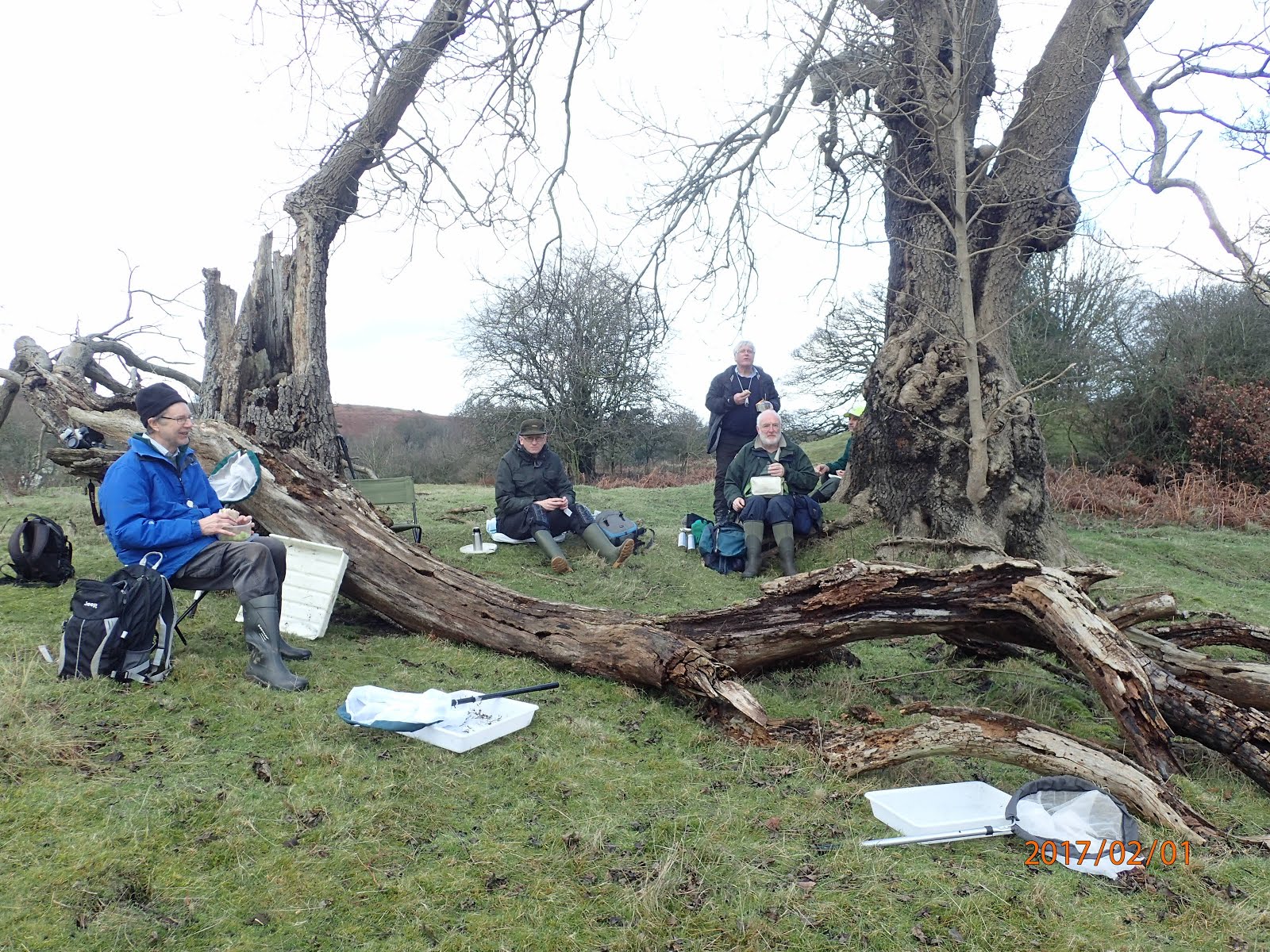
We wandered on and reached, by a circular route that drifted upwards through a wooded area, a second meadow. There a fallen branch and gnarled tree trunks provided a focus for investigation both of the wood and our lunch boxes.
Our circumnavigation continued. Someone spotted the lichen Ramalina fraxinea.

The fungus Jelly Ear was abundant on another tree.

From holly and ivy I captured two specimens of a rather attractive barkfly. As I could not identify it I had to take it home.
It was not in the key to British species!
It was not in the key to British species!

After much head-scratching and rechecking of keys, I looked at pictures on the Barfly Recording Scheme website and found a likeness. The website stated that it had only recently been found for the first time in Ireland. There was no mention of its arrival onto the British Isles. Excitement - was this a species new to Britain? Alas no. The National Recorder who confirmed my identification also informed me that it had been turning up all over the place. Ah well!
The species is Chilenocaecilius ornatipennis, and is normally found in Argentina and Chile. It must like our climate as it seems to have decided to stay.
We moved on, passing a group of overwintering Orange ladybirds tucked under a branch.

Time was passing and we drew to the end of our circuit of this excellent site. In all we gathered records for about 90 species, which I think, is very impressive for this time of year. My thanks to our host for the invitation, the guided tour and especially the refreshments at the end.
However, it was not all plain sailing, two mysteries remain. The first is a mite with "Popeye" arms. (It may be a member of the genus Pergamasus.)

The second a parasitic wasp with delightful body sculpturing which is clearly visible in this excellent montage. It makes you wonder why so few people tackle these attractive insects. (You should be able to click on the image to see an enlarged version.)

Whixall Moss - Wednesday 15th February 2017
Where better place to go in mid-February than Whixall Moss? I'll leave you to answer that question.
There was a target species for the day - Gyphesis cottonae - a tiny money-spider. It is about 1mm in size, black, with short legs and lives in sphagnum moss. Now if there is one thing that Whixall has it is a lot a sphagnum. And looking for something not much bigger than a full stop with legs - to quote a colleague "What could possibly go wrong?"
The meeting point was the Morris Bridge car park on a surprisingly mild but greyish day. The first sound that greeted us was not birdsong or other sounds of the countryside but the wailing of a hedge as it was flailed by the team maintaining the margins of the canal.
We walked purposefully up the entrance track and onto the moss and started to look for sphagnum that was accessible without having to take undue risk, being careful where to put our feet in case there was some hidden ditch underneath.

The green patch in the middle of the pool in the photograph is sphagnum moss, out of reach unless you want an early bath. We looked in many of the pits and they were just like this. The sphagnum was teasing us. Eventually we found one that allowed us to extract some sphagnum on the end of a walking pole without danger. It was dumped in a tray and painstakingly examined. Nothing was found - sorry, lots of things were found but not our target species. We resorted to the vacuum sampler.

Yes, we had seats with us and a table for the tray. Bending over a tray on the ground for long periods is hard work. Please do not begrudge us a minor luxury.
In the meantime, if we had a collective noun for excellent wildlife photographers I would have to use it here, as they gathered to discus f-stops, ISOs, lenses, diffusers ... But, they do produce brilliant photographs and they are always willing for me to use the results of their labours in these reports.

Then we heard it.
Bang
Bang
Bang
It was coming from the direction of the scrapyard so we assumed, quite wrongly, that work was being done there following its acquisition by Shropshire Wildlife Trust.
Bang
Bang
You get the picture. On and on, then a pause - had it stopped - no - Bang etc.
A passing walker told us that the noise was from the canal maintenance team.
One relief was that there were no helicopters, the usual plague of this area. And then one flew over. Or at least we heard it, we could not see it. Thankfully that was the only one.
Back to the search. A small sample of very wet sphagnum had been separated and there was excitement that a candidate for the target species had been spotted. A photographer moved in to record the event and it promptly disappeared. No amount of searching could find it. As it had probably not left the sphagnum the sample was put in a tube for checking later.
We did find a Whixall speciality, the raft spider Dolomedes fimbriatus.

And a Tibellus sp.

We lunched then moved back towards the entrance to a patch of heath in amongst very tussocky wet grass. This was quite a sheltered spot and it proved to be easier to find things of interest. (The banging continued.)
A springtail with a purple stripe down its abdomen was referred to the European expert and identified as Isotomurus plumosus

Cladonia lichens were in flower

Some caterpillars were found. This one is the larva of the Dingy footman moth

There was even an adult moth flying about - a Beautiful plume

There was a target species for the day - Gyphesis cottonae - a tiny money-spider. It is about 1mm in size, black, with short legs and lives in sphagnum moss. Now if there is one thing that Whixall has it is a lot a sphagnum. And looking for something not much bigger than a full stop with legs - to quote a colleague "What could possibly go wrong?"
The meeting point was the Morris Bridge car park on a surprisingly mild but greyish day. The first sound that greeted us was not birdsong or other sounds of the countryside but the wailing of a hedge as it was flailed by the team maintaining the margins of the canal.
We walked purposefully up the entrance track and onto the moss and started to look for sphagnum that was accessible without having to take undue risk, being careful where to put our feet in case there was some hidden ditch underneath.

The green patch in the middle of the pool in the photograph is sphagnum moss, out of reach unless you want an early bath. We looked in many of the pits and they were just like this. The sphagnum was teasing us. Eventually we found one that allowed us to extract some sphagnum on the end of a walking pole without danger. It was dumped in a tray and painstakingly examined. Nothing was found - sorry, lots of things were found but not our target species. We resorted to the vacuum sampler.

Yes, we had seats with us and a table for the tray. Bending over a tray on the ground for long periods is hard work. Please do not begrudge us a minor luxury.
In the meantime, if we had a collective noun for excellent wildlife photographers I would have to use it here, as they gathered to discus f-stops, ISOs, lenses, diffusers ... But, they do produce brilliant photographs and they are always willing for me to use the results of their labours in these reports.

Then we heard it.
Bang
Bang
Bang
It was coming from the direction of the scrapyard so we assumed, quite wrongly, that work was being done there following its acquisition by Shropshire Wildlife Trust.
Bang
Bang
You get the picture. On and on, then a pause - had it stopped - no - Bang etc.
A passing walker told us that the noise was from the canal maintenance team.
One relief was that there were no helicopters, the usual plague of this area. And then one flew over. Or at least we heard it, we could not see it. Thankfully that was the only one.
Back to the search. A small sample of very wet sphagnum had been separated and there was excitement that a candidate for the target species had been spotted. A photographer moved in to record the event and it promptly disappeared. No amount of searching could find it. As it had probably not left the sphagnum the sample was put in a tube for checking later.
We did find a Whixall speciality, the raft spider Dolomedes fimbriatus.

And a Tibellus sp.

We lunched then moved back towards the entrance to a patch of heath in amongst very tussocky wet grass. This was quite a sheltered spot and it proved to be easier to find things of interest. (The banging continued.)
A springtail with a purple stripe down its abdomen was referred to the European expert and identified as Isotomurus plumosus

Cladonia lichens were in flower

Some caterpillars were found. This one is the larva of the Dingy footman moth

There was even an adult moth flying about - a Beautiful plume

The clouds grew more threatening and there was rain in the air so we made our way, slowly, back to the cars and then home.
Later the sphagnum was examined under a microscope and it did contain the target species - a male Glyphesis cottonae; mission accomplished. I do not have a photograph, but here is a photograph of the other animals there were in the sample.

My thanks Natural England for granting us access to the site and to Bob Kemp, David Williams, Jim Cresswell, Mags Cousins, Nigel Cane-Honeysett and Stephen Barlow for providing most of the photographs.
Later the sphagnum was examined under a microscope and it did contain the target species - a male Glyphesis cottonae; mission accomplished. I do not have a photograph, but here is a photograph of the other animals there were in the sample.

My thanks Natural England for granting us access to the site and to Bob Kemp, David Williams, Jim Cresswell, Mags Cousins, Nigel Cane-Honeysett and Stephen Barlow for providing most of the photographs.


 Posts
Posts