14 Jul 2016

What a magnificent slime mould

Rectory Wood and Field - Wednesday 13th July

The words of the title are not words that I could have imagined being associated with each other. You will have to wait to see if they are justified!

Nine of us gathered in the sunshine at the car park off Cunnery Road in Church Stretton at the southern end of Rectory Field. Our host for the day explained that Shropshire County Council had handed over the land to Church Stretton Town Council to look after. An "interest" group had been formed to produce a management plan for the site. This had now been prepared and presented. The group welcomed any records we could make during the day.

I had visited the field for bioblitzes in the past but never made it past the edge of the wood so my initial interest was to walk through the wood, then, time permitting, look at the field.

However to get to the wood you have to pass through a bit of the field, so it was a little while before we entered the wood as members of the group split off to pursue their interests as we meandered along. An early find was an adult Red-legged shieldbug.

My interest was taken by the fairly steep climb to the wood entrance in the "top" corner of the field. Thankfully there was a seat where I could pause, take in the view and get my heart rate back to normal whilst waiting for others to catch up.


One of the group arrived clasping a Volucella pellucens which did not fly away immediately, so I was able to get a snapshot.


I mentioned earlier that we met in sunshine. Mmm...

You will note, no doubt, the lack of blue sky in the photograph of the view above.

Yes, grey then black clouds had rolled in and it started to rain!!!!!!!!


We moved rapidly into the woods to seek shelter. 

Over the past few weeks I have begun to learn which trees to seek out to act as an umbrella. The Horse chestnut at Preston Montford was magnificent. The trees in this part of Rectory Wood were rather porous in comparison, but they were better than nothing.

After a while it seemed to ease off so I moved on and was checking out an elm when the rainfall increased. I am not sure which tree I was under this time but it was better than the first, but still not in the Horse chestnut league.

Blue sky was spotted. It must be a clearing-up shower. And the rain stopped. We moved on. Well, some did, others decided to take a coffee break.

Being in a wood various techniques were used to find things of interest. 

My standard techniques are sweeping or beating the branches to see what I can dislodge. 

Others are content to find low branches and turn over the leaves to see what is there. If you are searching an oak you may find the "sputnik" shaped egg sack of the spider Paidiscura pallens. If you are really lucky you will find two egg sacks and the spider.


Some like to make an intensive close up inspection


Whilst others prefer the more laid back approach of a seat and binoculars


Yet others go rooting in the ground and unearth such delights as a "Witch's egg" - the initial stage of a Stinkhorn fungus.


And it was using one of these techniques that one of our fungi hunters returned holding a small piece of wood and declared "What a magnificent slime mould". You can be the judge thanks to some excellent camera work (not by me).


I cannot attempt to explain the workings of slime moulds here but it is well worth ferreting around the internet or in books as they are fascinating organisms.

Exhausted by all this activity we lunched.

It rained briefly, the sun returned, we moved on. A large cranefly was spotted sunbathing on some braken - Tipula maxima.


As we approached the end of the wood and the vegetation was opening out a Southern hawker dragonfly appeared.


We reached the end of the wood and paused for a group photograph.


A hoverfly was spotted going about its business on bramble - Xylota segnis, then a second rather more spectacularly marked hoverfly appeared. And posed, so we had to photograph it.


The golden tip to its abdomen is actually hair. This was Xylota sylvarum.

You will note that the sun was shining at this time, but five minutes later it was pouring down. Again we tried various trees for protection but somehow all ended up under an Ash which was a bit like using a sieve for an umbrella.

The rain stopped eventually and we squelched our way back to the car park and headed home.

My thanks to Church Stretton Town Council for giving us permission to do what we enjoy doing and to Bob Kemp for the use of his photographs to supplement my efforts.


9 Jul 2016

Dry, sunny and warm

Hilton Sand Pit - Wednesday 6th July

After three weeks of rain I was relieved to hear the weather forecast suggest it was going to be a dry fine day with a little more cloud and slight chance of rain after lunch I was even more relieved when the forecast turned out to be incorrect - the cloud and rain did not materialise; it was a lovely day. Have we turned the corner weather-wise? Hearing the advance forecast for next week suggests not!

Enough about the weather.

What happened?

Five of us met in Hilton on the appropriately named Sandpit Lane and made our way to the entrance where we were to be met to be let onto this closed site. When we got there we were the only people present. Had all my planning been for nought? Don't panic.

I wandered off in the hope of finding the missing keyholder leaving the others to twiddle their thumbs by the gate.

Whilst I was wandering in my vain search I heard the screech of a metal gate being opened. If we were being let onto the site they would contact me on my mobile phone. 

They did but I could not hear it. It was in my bag - which I had left by the gate. I have not quite got the hang of these modern gadgets.

The screech tweaked my curiosity so I returned to find the gate open and the rest of the group on the site. Relief!

(In my absence owner arrived a few minutes later and let us in. The person who was due to meet us had, unexpectedly, had to go to work.)


The site turned out to be far more extensive than I expected. It was mainly grassland but there were patches of scrub, woodland and bare sand and plenty of slopes and banks. Although there were no pools there were signs of where ephemeral pools would form in very wet weather.

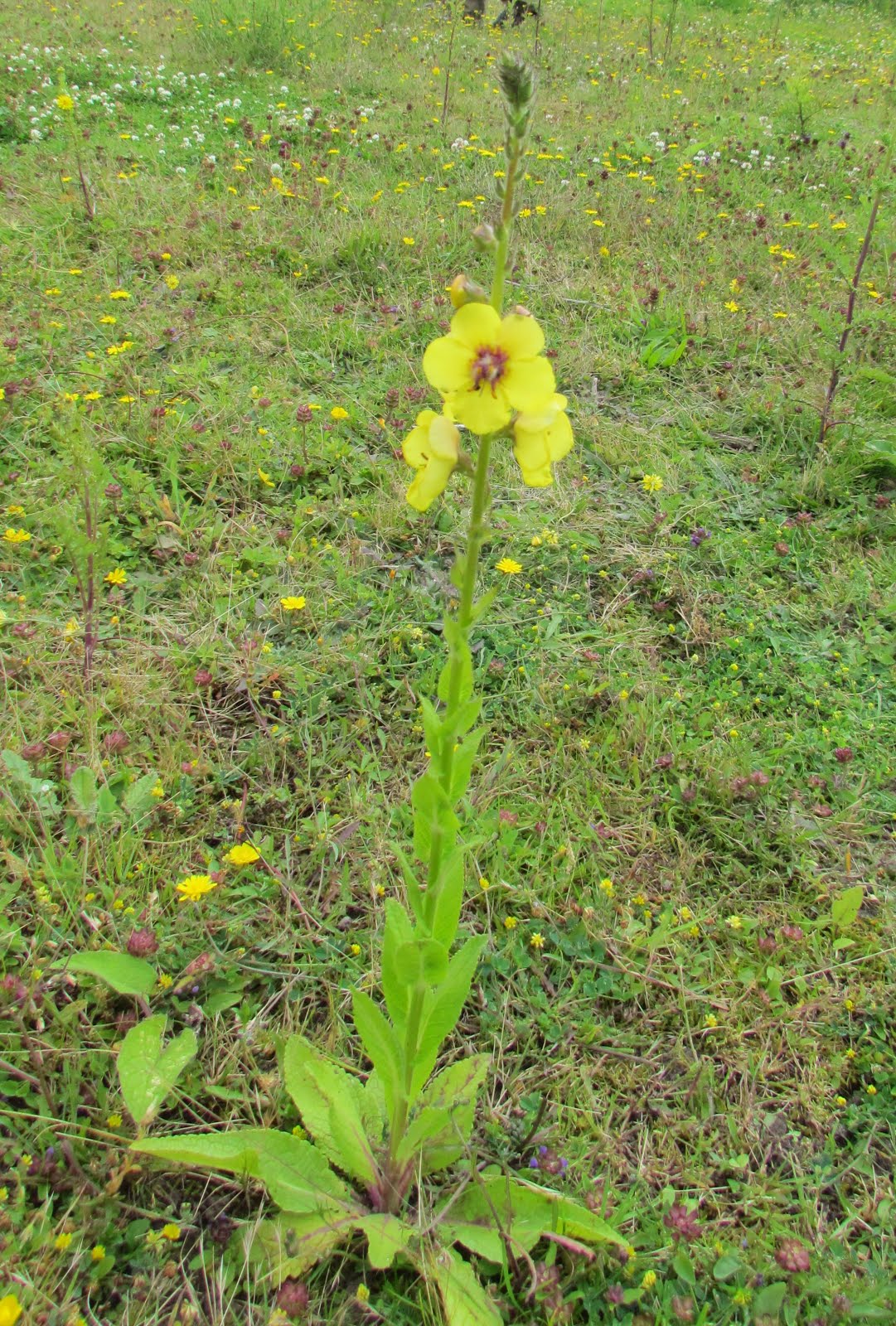
An early find was Dark Mullein (at least that is what I was told it was).


And all around this the sandy ground was covered in various low growing yellow and purple plants.


Swallows flew overhead, a kestrel passed through, the unmistakable sound of a green woodpecker was heard in the distance and we were accompanied by the continuous chatter of anonymous small birds.

We looked at the flora


And we looked for invertebrates.


Amongst those we found were a woundwort shieldbug


And a mirid bug Deraeocoris ruber


We lunched.

After lunch we explored the further reaches of the sand pit. We found a sandy bank where bees had nested and watched as a leaf cutter bee arrived holding a leaf section and disappeared into its nest.

I found an evening primrose.


One of its flowers was a cafe for at least 20 pollen beetles


Amongst our other finds in the afternoon were a micro moth which I think is Pyrausta purpuralis (which had to be photographed in a tube - hence the haze).


Also an adult Forest bug allowed itself to be found.


We were just thinking of packing up and going when the owner reappeared and offered us a cup of tea. 

How could we refuse?

Refreshed we expressed our thanks for being allowed to visit this excellent site then returned to our cars and made our way home.


5 Jul 2016

You guessed it ...

Abdon Churchyard - Wednesday 29th June 2016

... it rained


Not just the rain we have experienced on our recent trips - showers followed by a soaking as the finale. But steady rain that started early and did not relent.

It even caused one of our group to cry off in the morning as he did not want to dissolve!

A couple of us made the journey and were met at Abdon Village Hall by our drenched but stoical host for the day.

He and his wife moved to Abdon recently. If he was expecting a quiet life in the country he was to be disappointed as his fame had preceded him. He was soon recruited to help form a local wildlife group for the area. And, being who he is, he suggested that the group ought to have an objective. A decision was reached to attempt to record 1000 species in a nine tetrad square centred on Abdon, within a year.

The total currently stands at about 450 and we had been invited to help boost this number!

We made our way to the churchyard and did a quick inspection of the church's small car park before entering the grounds.


The car park had been relatively sheltered but in the churchyard we were met by the full force of a stiff wind as well as the rain. Undeterred we explored the grounds around the church.

I vacuum sampled the uncut vegetation in the foreground of the above photograph, tipped the collection into a tray and then watched helplessly as the wind blew it away.

Fortunately the church had an entrance porch which was open. We took full advantage of this to provide respite from the wind and rain.


We made quick dashes to various parts of the grounds, did a quick collection by vacuuming or beating, then returned to the safe haven of the porch to see what we had found.

And it was a dry spot for lunch.


We carried on for a little while after lunch before the wind and rain started to get the better of me when we called it a day.

Despite the weather we were able to record about a couple of dozen species to help meet the target. Not a lot, but better than nothing and we may be able to try again later in the year.


Unfortunately it was not like this.