5 Sept 2011

September Nature Notes from Pete Lambert

Nature Notes – September 2011

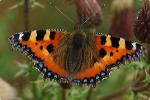
At long last the final camping gizmo was put back into the camping cupboard, and the warm mist of remembering took me back down the Anglesey lanes. Wall brown, Meadow brown, Gatekeeper and Red Admiral butterflies had risen as I pedalled past. Small delicate micro-moths took short hesitant flights when disturbed and a Small Copper butterfly had a narrow squeak with my rolling front tyre. This very pretty small creature enjoys flowery places though its larval food-plants are the undistinguished docks and sorrels. The Small Copper has dark chocolate hind under-wings fringed with a bright orange ripple and the forewings are a kind of negative with a striking orange centre marked with black spots and edged with brown. When the adult is in the early stages of its flying life it is a very tidy butterfly which cannot be said for location that day.

The untidy hedges of Ynys Mon do provide plenty of colour, the aged wrinkly leaves of Woods age are paired below spikes of tiny yellow flowers, bold purple ‘Hardheads’ of the Knapweed, Red Campion still in flower, flaming nodding spikes of Montbretia [a man made hybrid though to my delight this was everywhere], button blooms of rich yellow Tansy and green rosettes of what at a glance looked like Rusty back fern added depth to the hedge plant parade. The hedge shrubs of hawthorn or blackthorn invariably grew on top of banks or loose dry walls inter-filled with soil. There were none of the unbearably neat, flailed and tamed hedges here, but an older, wilder and unruly network of field divisions.

I was on my way to Cemlyn Bay to visit the Tern colony, apparently the third largest Sandwich tern colony in the UK. Terns like to roost and breed on shingle beaches and here at Cemlyn an artificial shingle ridge has been maintained by the North Wales Wildlife Trust and the National Trust. I had not seen a tern colony before and heard it first before seeing the busy thin winged birds feeding. Arctic Terns have reddish beaks and a neat grey, black and white plumage. Sandwich Terns are our biggest resident tern, my best views were of individuals returning from the open sea with a fish clasped firmly in their black and yellow tipped beak, a rakish crest clear to see, flicking cavalier like from their aerodynamic heads. Around the lagoon Oystercatchers hung around, their simple black white body pattern and bright red-orange beak reminding me of the bad penguin in The Wrong Trousers. A solitary Dabchick or Little Grebe pottered around another pool close by, with the ubiquitous Coots in the far distance.

The coast is a harsh place for plants to survive, adapting as they must to inundation by salt water, coated in briny spray or blown flat by unrelenting winds. On the banks and salt marsh flats I encountered the sea hardened cousins of our milder local plants. Sea mayweed, tall bobbly spikes of Sea Arrowgrass, the maritime Rush and the rubbery Spear leaved orache were easily found. Each subtly evolved to cope with the stress imposed by saline exposure. One of our commonest groups of native plants are the plantains, tolerant of a wide variety of soil types and trampling, they are found everywhere. Out of the six UK plantain species I found four together, Greater, Ribwort, Sea and Bucksthorn plantain. The last two very much associated with coastal locations and surprisingly main roads and motorways, the connection being salt in this case winter cast rock salt. Each plantain has a rotund spike of very tiny flowers best appreciated with a hand lens, that day they were shyly at their best.

Much of bays history as a wildlife site is tied to the story of a wealthy eccentric bird enthusiast, Captain Vivian Hewitt who first came to Cemlyn Bay in the 1930’s. He constructed a dam and weir, replacing tidal salt-marsh with a large and permanent lagoon which he intended as a refuge for wildfowl. He also had a scheme to nurture an area of woodland within the grounds of Bryn Aber, his home, to attract smaller birds. To this end he began construction of an imposing double wall, which was intended both as a wind-brake for the trees, and a means for observing the birds – the gap between the two walls had viewing holes. After Captain Hewitt’s death the house was left to his housekeeper’s family, but the walls themselves remain, and lend the site its mysterious, even foreboding presence. I enjoyed and treasured my day at Cemlyn and only yesterday did I clear away the last dried stem of rush, plucked and tucked in a forgotten pocket till now.

Happy wildlife spotting, Pete.  

If you would like to share your wildlife encounters please feel welcome to email me at petewoodman@thewoods12.fsnet.co.uk


2 Aug 2011

Grimpo Nature Notes from Pete Lambert

Nature Notes August 2011


I thought it was but doubted my gut reaction. The Village Shop hanging basket lush with bright flowers had a visitor, as I approached it dropped and whirled away. A few days later I received an email confirming the sighting of a Hummingbird Hawk moth in the area. This attractive moth will quite literally hover in front of flowers to feed, its wings beating so fast they make an audible hum.


I had first encountered this migrating marvel in Kent, then as now it had been attracted to an over flowing hanging basket. I was very excited by this exotic creature, I did at first think it was a humming bird my only reference material being the BBC! This very swift flying moth is actually often reported as a hummingbird. The orange brown hind-wing, together with the black and white on the abdomen sides, which are usually evident in flight, can help with identification. It is most frequently seen in the southern half of Britain and Ireland, particularly coastal counties, though the distribution maps being produced as the result of Butterfly Conservation’s survey work has revealed sightings from as far north as the eastern Scottish coast.

The full range of the Hummingbird Hawk moth extends throughout Europe, North Africa, to India, Korea and Japan. The moth is most frequently observed hovering and flitting from flower to flower, such as those of buddleia and Red Valerian, although sometimes seen flying around the eaves of houses, and examining cracks and holes in walls, possibly looking for a resting spot. The caterpillar likes to feed on Lady’s Bedstraw, Hedge Bedstraw and Wild Madder. Butterfly Conservation have been monitoring the Hummingbird Hawk moth, you can add your own sightings by going to http://www.butterfly-conservation.org/sightings/1096/humming_bird_hawk_moth.html . There are many ways to record your sightings try out the website www.naturalshropshire.org.uk for wildlife records in our area.

The frantic cacophony of spring has hushed now, strong sunshine along the lanes draws out the Ringlet butterflies feeding hungrily on the bramble flowers, occasionally testing out a Dog or field rose bloom. A Small Tortoiseshell butterfly having laid its eggs on the nettles at the edge of the garden now basks on the lawn. Meadow Browns and Gatekeeper butterflies enjoying the long grasses of neglected corners of our local field network. In the evening micro moths and their larger friends visit such as the Bee moth Aphomia sociella.  Bee moths are sexually dimorphic, which means that the males are more brightly coloured and patterned than the females. Like some other members of the Galleriinae tribe, the larvae feed on the comb inside bee and wasp nests. We have a set of hives in the copse close by which is worrying though the more serious pest of beehives seems to be the Wax-moths. One of a number of natural causes of concern for our endangered bee friends, though fortunately we cannot include bears in this country, well at least so far!

Despite the bits and pieces hanging in the window she had not seen it and the collision was fatal. The female blackbird possibly avoiding another danger had not been able to see the glass and now we were solemnly burying her in the corner of the garden reserved for wild or domestic animal friends at the end of their free wheeling days. Earlier that week though we had been spooked on a late evening cycle by a barn owl, very much alive, gliding across the road in front of us and very skilfully negotiating a rhododendron thicket, perching briefly before silently moving on.

Our cycling preparations were for a longer trek which took us alongside two other perching specialists, firstly a Stonechat male on the moors above Llangynog, characteristically atop a hawthorn shrub calling out to its mate. Secondly at Maesbury a Reed bunting cleverly swaying atop a flag iris leaf contemptuous of the breeze pushing him to and fro. Many birds give their names away by their behaviour; careful observation can eliminate an insecure identification in favour of the correct one. So it was that I had been given a lift home and could without endangering my usual passengers look very closely at the bird as she flew in front of us, very low swooping flight, powerful and finally a tight dive up and down the back of the hedge. The dark brown plumage and barred tail combined with this distinctive flight gave us the lovely bird of prey the Merlin. The Pied wagtail and singing Yellowhammer both enjoy characteristic calls and habits making them great birds to watch and enjoy, and finally our first Goldfinch to the table, must be the new mix in the feeders, must top them up and put on the kettle!

Happy wildlife spotting, Pete.

If you would like to share your wildlife sightings please email on petewoodman@thewoods12.fsnet.co.uk , thanks
.
.
.

27 Jul 2011

Devil’s Dingle Moth Night

 
Glow worm Devil's Dingle Moth Night 080711 009

What a great night July 8th, 2011 turned out to be!

Our second trip to Devil’s Dingle was a fine, mainly dry night with just a light breeze, the temperature dropping down to just 13.5 deg C and a light shower at around 3am - not that we really noticed that, tucked up as we were in our sleeping bags then, but come dawn we were emptying the traps and a busy time it was for the three of us who remained all night.

And if you’re wondering what the opening pic is all about - it’s not actually an eerie-looking UFO about to descend on the unsuspecting clan of moth-ers with the threat of possible abduction and integration into an alien society - oh… it’s amazing what imaginative thoughts grab you in dark and remote places very late at night!    No… it was in fact a glow worm - one of 2 we found not far from one of the traps. A search in the vicinity, however,  gave no further records but a useful addition to this wonderful Wildlife Site.

But moths we had galore. Having finally identified her last remaining specimens Liz has added 4 more species to the already impressive count giving no less than 586 individuals across 85 species.

One of Liz’s additions was this lovely micro with the equally lovely name of Aethes cnicana. We didn’t manage a pic on the night so this one comes courtesy of the UK Moths website

Aethes cnicana

We also saw Elephant Hawkmoth

Large Elephant  Hawkmoths 2 July 4 - 2009 097

Poplar Hawkmoth, Nutmeg

Poplar Hawk moth Devil's Dingle Moth Night 080711 028 Nutmeg DD 080711 004

This rather striking Beautiful Golden Y also popped into one of my traps

Beautiful Golden Y Devil's Dingle Moth Night 080711 017

And a micro that I haven’t seen before (in fact this was one of 9 moths new to me from the night). This is Nemapogon cloacella, otherwise known as the Cork Moth. The larva feed on various types of bracket fungus

216 Nemapogon cloacella, the Cork Moth Devil's Dingle 080711

Another first for me was the Brown-line Bright Eye not to be confused with the more common Bright-line Brown-eye, of course!

Brown-line Bright-eye Devil's Dingle Moth Night 080711 016

So an excellent night once again at Devil’s Dingle and my thanks go to Mary Thornton, Community Liaison Officer of the Ironbridge Power Station who kindly arranged access for the night staying with us to help set up and record in the morning.

Devil's Dingle Moth Night 080711 001

Thanks also to Tony and Andy for their records and help with ID’s, not forgetting Keith’s sheet and torch which proved to be a very worthwhile addition with a nice white sheet spread out over his cars’ bonnet proving to be an excellent way to get up close and personal to the moths of the night.

Fellow WuFuV’s Stephen and Margaret also came along and were a great help with erecting the moth pavilion, traps and generally assisting with ID’s etcetera.

Last, but by no means least, for Liz’s contribution using Les’s old trap which for some reason seems to be bringing in far better results than Les ever had! Liz puts this down to the blue handles she’s attached. As that seems to be the only modification I can only assume that’s the reason for her success!

Devil's Dingle Moth Night 080711 003

Catch up with you all soon

Paul Watts
.
.
.