12 Apr 2020

The 58 - Episode II - Numbers 11 - 19

Sunday, 12 April 2020

As I fidget in frustration at not being able to get out and about in these last few days of glorious weather I turn my attention to some more butterflies found by our hero (Jim) in his great Quest.

(If you need a reminder the Quest was to see all 58 species of butterflies normally found in Great Britain.)

(A second reminder - I have tried to include photographs of each of the butterflies where they were found. Where this is not possible I have used photographs from other occasions that they were observed. Please do not be concerned if you see late season ivy in a photograph of a butterfly seen in Spring!)

As promised I have used a more imaginative title for this week's account, I hope you appreciate the effort!

And so we come, as mentiond in Episode I, to an outing to the delightfully named Sharpenhoe Clappers, at the end of April 2019.

For those of you who were not intrigued enough to investigate earlier, it is the site of an Iron Age promontory fort and associated earthworks, situated on a chalk escarpment that rises from the generally flatter ground that surrounds it, just north of Luton.

Why did we choose to go there ...?

… It was a nice day.

And what was the butterfly that we went all that way to find?

Number 11: Large white

Photograph: Bob Kemp

Photograph: Jim Cresswell
No, we did not really go to Sharpenhoe Clappers just to find one of our most common butterflies, it just happened that was where our hero saw his first Large white of the year.

Whilst we were there we also found a Small yellow underwing:

Photograph: Jim Cresswell
According to the County Moth Recorders for Bedfordshire this was the first time this moth had been recorded at this site. The trip was worthwhile.

After finding Large white our hero had to wait 11 days before finding number 12. There was a definite tension in the air as the days sped by. Then the floodgates opened and in the next three days EIGHT more were added to the list of sightings for the year, and none of them required a visit to far off lands.

Number 12 was Wood white which are found in some woodlands in the south west of Shropshire. Bury Ditches is a well known Shropshire site for this butterfly. However, our hero found his in Radnor Wood, a Forestry Commission plantation just south of Bury Ditches. In recent times the Forestry Commission has been undertaking work in this plantation to encourage the wood white by opening up the rides with, it seems, some success.

I do not have a photograph of the wood white Jim saw but the Joy of Wildlife group visited the wood, as part of its programme, a few weeks later, on a damp and dreary day and we found half a dozen. They were very docile due to the inclement weather.

Photograph: David Williams
The following day our hero and I went to Lower Butchers Quarry which is situated in the north western Corner of Llynclys Common. Here we found Number 13 - Dingy skipper:

Photograph: David Williams
And number 14 - Grizzled skipper, which our hero did manage to photograph:

Photograph: Jim Cresswell
This following photograph was taken a couple days later:


Despite finding the two skippers the quarry was not "buzzing", although we did find a Hairy shieldbug:


The lack of activity encouraged us to move on to Llanymynech Quarry, which was nearby. As we left the first quarry we passed a large patch of Wild garlic amongst which we found the hoverfly closely associated with this plant, Portevinia maculata.


Part of Llanymynech Quarry is in Shropshire but some of the quarry and the majority of the hill lie in Wales, and it was to Wales that we headed. This was the area receiving the afternoon sun.

And here at the sides of one of the paths along the side of the hill we found three more new species.

Number 15 - Common blue:


Number 16 - Red admiral


Number 17 - Small heath


Heroes do not require any rest!

The following day, reinforced by the presence of Bob, we went to the Wyre Forest in pursuit of Pearl-bordered fritillaries, which would bring the count for the year to eighteen.

We parked in the Earnwood Copse car park, crossed the road to enter the woodland and walked down the ride until we got to the wide clearing that opens out to the right.

Along the vegetation that bordered the rides at the side of and leading away from the clearing we were very pleased to find a good population of our target species for the day. They were quite flighty in the sun and breeze but we did manage to take a few photographs as they fed at some bluebells.

Number 18 - Pearl-bordered fritillary


Rather like Lower Butcher's Quarry, apart from the fritillaries, there was very little else about. The only thing of note from our point of view was a longhorn beetle, Rhagium bifasciatum.


As, for some strange reason, it was decided that Wenlock Edge was on our way home from the Wyre Forest, we travelled to the Edge's Presthope car park. From here we made our way through the trees to the top of Lea Quarry, a well known site for Wall butterfly.

Rather like the Wyre there was not much about but we did track down a couple of Wall butterflies. These were very successful in evading the camera lens. The one below was photographed a few months later.

Number 19 - Wall


That brings us to the end of this instalment. Everything was going smoothly and most had been found close to home. This could not continue … or could it?

Before I finish I must tell you of a chance encounter in the Earnwood Copse car park. Here we met a couple who had travelled from afar to see the Pearl-bordered fritillaries. As always when meeting fellow well-travelled lepidopterans, our hero quizzed them about sites for the more difficult butterflies.

This conversation led us to travelling to Incombe Hole the following day; but you will have to wait to hear about the outcome of this trip.


Finally I was sent a couple of excellent photographs of a Hairy-footed flower bee that I would like you to see:

Photograph: David Williams

Photograph: David Williams

5 Apr 2020

The 58, Episode 1

Sunday, 5 April

I should be writing about our first outing of this year's Joy of Wildlife Programme which would have been to The Ercall last Wednesday, on a cold but reasonable early spring day. It was not to be as we remain under the "stay at home" restrictions.

What, therefore, can I write about?

I suppose the first question is whether I should be writing at all. However, in the strange circumstances we find ourselves in, we need to keep some constants in our lives as we try and muddle our way through to what we hope will be a more normal life.

Back to the question - what can I write about?

Taking my lead from the TV companies who, having almost run out of "new" programmes, are turning to repeats to keep us entertained, I have decided to take a similar course. Not actual repeats, although they would be far quicker to produce, but to look back to last year and record the achievement by one of our group to observe all the butterflies resident on mainland Britain.

There are, to my knowledge, 59 butterflies on the British checklist. One of these, the Cryptic wood white is found only in Ireland, so the mainland count is 58. The clue was in the title of this!

58 does not sound many to see in a year, but, as most of you are aware, the numbers and range of many butterfly species have declined significantly in recent times, This means that some of the butterflies are very hard to find and require special effort to locate them. Add to that the short lifespan of the adults, the challenge of seeing them all in a year is immense.

What follows is an epic tale of detailed planning, hard work, epic journeys, disappointments, stress, wonderful sites and sights, companionship and ultimately triumph.

(I will illustrate the unfolding events with photographs of each butterfly species plus anything else of interest observed on the same outing. Some of the photographs are Jim's own of the actual butterflies he saw, but many are not.)

Like Dickens I will relate the story in instalments. The number will rather depend on how many weeks we remain in lockdown. 

Enough of this rambling! Are you sitting comfortably? Then, let us begin ...

Once upon a time (about three years ago) a person, who we shall call Jim, announced that he would like to see all fifty-eight butterflies that are resident in mainland Britain. This was a feat he had achieved in long, long ago but he was very keen to do it again. Unfortunately life's ups and downs got in the way and he was unable to realise his dream.

Then, last year (2019), he announced that "This will be the year!". And so it proved.

Although many butterfly species are rare and difficult to find there are a good number that can be seen when you are out and about locally. Of these quite a few are found early in the year as they emerge from hibernation. Our hero was able to get an early start on his labours with three species in February and one in March.

The first two, as it happened, were not found locally but whilst he was out and about around Bicester.

The first was a Brimstone:
Photograph: Bob Kemp
This was a chance encounter as one our hero's companions was able to capture a Brimstone with its wings open. A more common site is:


And here is a Brimstone's egg:

Photograph: David Williams
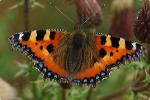
Number two for the year was a Small tortoiseshell, which he photographed:

Photograph: Jim Cresswell
The third butterfly, found in February, was a Comma, during an winter Joy of Wildlife outing to Loamhole Dingle.


The second photograph shows the pale "comma" mark on the underside of the wing.

There was now a long period of "no new butterflies" until nearly the end of March when number four, a Peacock, was spotted.


Here is a photograph of the body and underside of the wing.

Photograph: David Williams

And finally a larva.

Photograph: David Williams
Early in April numbers five and six were both found on a Joy of Wildlife outing to Corbet Wood.

5. Orange Tip:

Photograph: David Williams
The photograph below shows orange tip's egg, usually found attached to the stem of cuckoo flower. If you are lucky enough to find an egg you will normally only find one on a plant as the larvae are canabalistic!

Photograph: David Williams
6. Speckled Wood


If you recall my report on our visit to Corbet Wood "Herding cats" (April 2019) you may remember that we thought the stand of Scot's pine may support Callicera rufa, the hoverfly found in Caledonian pine forest which seems to have been attracted to Shropshire.

And so it proved.

The following month the county dipterist recorder visited and found the hoverfly. A few of us visited a few days later and found about half a dozen flies on several trunks.


Number seven, the Green hairstreak, was found the day after our visit to Corbet Wood. It required our hero to drive to the Glacial Boulder on Cannock Chase. Fortunately, this was not very onerous as he lives close by. The railway cutting which passes behind the boulder site is, where legend has it, a site where the butterfly is often found. And the legend turned into reality when one was seen and photographed.

Photograph: Jim Cresswell
A few months later we found a green hairstreak larva on an outing to Rigmoreoak.

Photograph: David Williams
Our next Joy of Wildlife outing was to the Shropshire Wildlife Reserve at Crickheath Meadows on 17 April 2019. After spending time in the meadow we made the short walk to another reserve - Blackbridge Quarry. Number eight, Green-veined white, was observed in the quarry.

Photograph: David Williams

The following week on our outing to Wollerton Wetlands, near Hodnet, number nine, a small copper, was spotted.


Number ten, and the last butterfly of this first instalment, was a Holly blue found very close to our hero's home.

Photograph: David Williams
OK, so far, so easy! No alarms, no dramas, no epic journeys. But stay with me, all that will change, starting with number eleven on a visit to the delightfully named Sharpenoe Clappers.

Until next time, keep safe.


29 Mar 2020

A Winter's Tale

Sunday 29th March 2020

As I write this we should be looking forward to the start of the new "Joy of Wildlife" programme which was due to start next Wednesday (appropriately April Fool's Day) at The Ercall. Unfortunately the programme along with many other things that we accept as a normal part of life has fallen victim to the current situation in which we find ourselves. We can only dream about when we will be able to recommence.

Please respect the restrictions that have been put in place and keep yourselves and others safe.

A time to bring you up to date, therefore, with what some of the group have been doing since the previous programme came to an end last September.

A small number, and indeed on occasions a large number, of us have continued to venture out most Wednesdays during the off-season. There is no programmed structure to these outings. Where we go is usually decided only a few days beforehand.

But we did have a target species to concentrate on - Boreus hyemalis commonly known as the snow flea. As the common name implies, this is an animal of the winter season, the adults being found between November and February.

Photograph: Bob Kemp
The snow flea is a distinctive insect, about 5mm in length, with a long "beak" that resembles a miniture scorpion fly. The insect in the above photograph is a female, which has a long, curved, pointed ovipositor; the male's abdomen is more truncated. They live and feed in moss and seem to be associated with Polytrichum moss within woodland where there is dappled sunlight.

Their name arises from them often being seen wandering about on snow covered ground, when they are much easier to see.

We have looked for these insects before but have only found them in The Wyre Forest where we know they are resident. Thus, the challenge of the winter was to find them elsewhere in Shropshire.

Historically their are 12 records within Shropshire. Nine of these records are from the Wyre Forest and 2 from Burrow near Aston-on-Clun, all found this millennium. The remaining record was the first for the county, found in 1954, on the Long Mynd. So there was plenty of scope to investigate how far ranging this species is within the county.

Secretly we hoped to discover enough sites to make the distribution map look similar to this:


However this fancy would require us to find it in at least 76 sites, which, even by our standards of dedication, was way beyond our capabilities on the 15 or so Wednesdays available to us. We set our sights a little lower.

To cut a long rambling story short we did find snow fleas in five new sites and failed to find it in many others. The new sites were Catherton Common, Sowdley Wood, Eastridge Wood, Pontesford Hill and Bucknell Wood, where we found well over a dozen including this mating pair:

Photograph: Bob Kemp
After all these words, a few other highlights of the winter in pictures:

A large aggregation of what are probably large willow aphids at Venus Pool.

Photograph: Bob Kemp
The ground bug Heterogaster urticae found in Bucknell Wood:

Photograph: Bob Kemp
A pseudoscorpion, Neobisium carcinoides closing in on a springtail at Black Hill:

Photograph: David Williams
The nest of a common earwig, Forficula auricularia with a female and eggs found in a clear fell area of Nesscliffe Country Park. The female tends the eggs throughout their incubation period.
Photograph: David Williams
A spider, Ozyptila atomaria found in Eastridge Wood:

Photograph: Nigel Cane-Honeysett
And a bagworm, Psyche caste. The larva surrounds itself with blades of grass or rush and is found on the tree trunks, tall vegetation and posts.

Photograph: David Williams
On New Year's Day we welcomed the new year in style as a group of us took to the hills. In magnificent winter weather we headed up to Rodney's Pillar. Our goal achieved we had a picnic then made our way down again. What better way to spend the day.

Photograph: Bob Kemp
That just about brings us up to date. However the "stay at home" instruction, coinciding with an excellent spell of weather, encouraged people into their gardens and, being frustrated at not being able to get out and about, they photographed visitors. Here, to bring some cheer into our lives, are a few photographs that were sent to me.

A couple of photographs of the bee-fly Bombylius major:

Photograph: Nigel Cane-Honeysett
Photograph: David Williams
A small tortoiseshell butterfly:

Photograph: David Williams
Finally, a curious blackbird:

Photograph: Bob Kemp
To finish; as all these "keen" gardeners prodded and poked their flower beds and manicured their lawns I found Wally - can you? (You should be able to click on it to get a larger version.)


As always my thanks to the photographers for allowing me to use their photographs. The distribution map was created using DMAP v 7.5 (copyright Dr Alan Morton).