Showing posts with label "Happy New Year" by Keith Fowler. Show all posts

2 Jan 2025

Happy New Year

By the time this report is available it will be 2025. May I wish you all a Happy New Year and thank you for the interest you have shown in the activities of the group.

Wednesday 11th December 2024, Blakeridge Wood

After Storm Darragh had done its worst throughout the country, I half expected our long-planned trip to Blakeridge Wood to be cancelled due to fallen or unsafe trees in the conifer plantation.

When I received an email from Forestry England the day before the visit, I expected the worst but, to my surprise, they were perfectly willing for our visit to go ahead even though, at that time, they had not inspected the wood for damage. 

Forestry England did place some reasonable conditions on our visit: to keep away from any wind damaged areas; and not to venture past any fallen trees that blocked the forest track, as an emergency vehicle would not be able to reach us in the event of an accident.

Having agreed to these conditions, and finding no roads closed due to fallen trees (or road works), we met at the westernmost of the two entrances to the wood.

Following the entrance track into the wood we soon came across promising looking patches of Polytrichum moss.

Despite two suction samplers being trained on each patch we found, we did not, regrettably, find any snow fleas. They are proving highly elusive at present.

What we did find were several pseudoscorpions, which all turned out to be the same species Neobisium carcinoides.

Photograph: David Williams

This species is known as the “Moss neobisium”. This name was most appropriate as they were found in and around moss.

Also uncovered in this early flourish of activity was a staphylinid beetle, Syntomium aeneum.

Photograph: David Williams

We continued to follow the forest track as it slowly gained altitude. To the right side there was a narrow band of ground vegetation before the woodland took over on a gentle rising slope. To the left there was a larger band of ground vegetation before it fell away as woodland.


The above photograph is looking back at a section of the track we had followed. But it was taken a little later where the track had levelled out a little. However it gives you an idea of the terrain.

Finding an isolated fallen Douglas fir, we had the opportunity to search the upper branches, a treat normally denied to us.

Why?

Because it normally is out of reach.

In the event not much was found but we did notice a couple of Pine cone bugs, Gastrodes grossipes.

Photograph: David Williams

Finding a slightly sheltered spot with a convenient ledge in the banking we settled down for lunch.

Over lunch we spotted a flock of about 40 Siskin flitting about in the tops of the trees. 

During the day we heard Crossbills but I do not remember any being spotted.

Refreshed we continued our gradual climb until we reached a more open area.

This area proved too attractive to the assembled company and quite a long time was spent exploring the area although invertebrates proved hard to find. 

Whilst the others busied themselves in this area I had a little wander further along the track. The scenery changed very little until it suddenly opened up briefly on the left as the ground fell away sharply in a steep-sided valley.


When I came across a couple of trees lying across the track I remembered Forestry England's conditions and returned to the rest of the group.

Time was marching on, and the cold wind was starting to penetrate our defences so we returned down the track to the entrance.

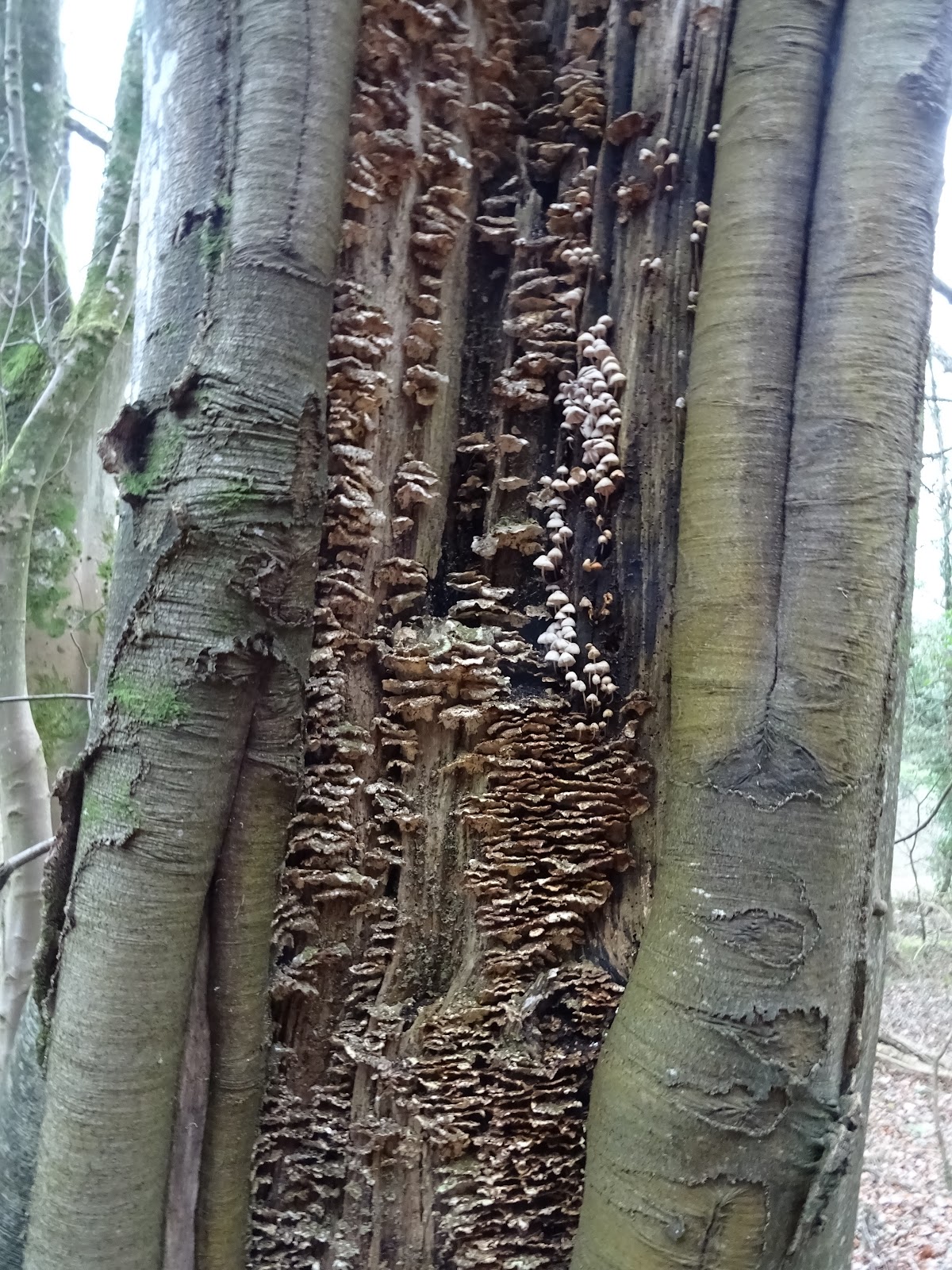
At the entrance we noticed this gash in a tree that had grown a fungal garden.

Despite the difficulty we had in finding invertebrates our dipterist reported that he had found 16 species of a fly family known as Lesser dung flies, a record for a day’s visit to a site. This is no mean feat as these flies are very small, black, and, with a few exceptions, indistinguishable in the field.

Similarly our botanist stated that the flora found at the side of the track provided a selection of species that wasn't bad for December in an upland conifer wood. He felt that the limestone-rich track must have increased diversity on the edges.

Whilst not an exciting day out, the site still provided rewards for our efforts.

Wednesday 18th December 2024, Shelve

Another Wednesday, another trip to a Forestry England plantation!

This visit was to their plantation at Shelve.

On arrival we found other cars present in our chosen parking spot. This made it difficult for us to get all our cars in, as the site had attracted a bumper turn-out for this last outing of the year.

Fortunately, just as we were about to give up and move to an alternative parking spot, the owners of two cars returned and drove away providing us with enough space.

Phew!

That unexpected hitch had gone away.

I have started recent reports by noting our lack of success in locating our favourite winter invertebrate, Boreus hyemalis (Snow flea).

Well…

On this occasion we were SUCCESSFUL!!

Hooray!

A suction sample of some small Polytrichum patches about 10 yards into the woodland edge, revealed FOUR – 1 male and three females.

We were all delighted. Several of the attendees were excited as this was the first time they had seen this species. They have now been inducted into the Snow Flea Appreciation Society.


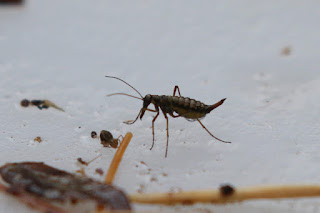
Here is one of the females, distinguished by its ovipositor at the tip of the abdomen.

Photograph: David Williams

And here is the male, with the blunt tip to its abdomen and short erect wing stubs.

Photograph: David Williams

Unfortunately, despite inspecting lots of other patches Polytrichum during the visit, we did not find any more.

From the car park we followed the main forestry track at snail-pace as it rose gently between lines of conifers. There was a generous amount of ground vegetation at the edge of the track.


We searched this thoroughly looking for things of interest, uncovering:

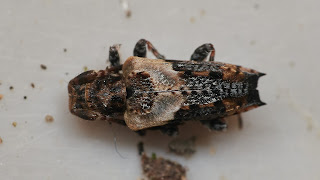
A Long-horned beetle, Pogonocherus hispidus;

Photograph: John Martin

A fungus, Lycoperdon excipuliforme, known as the Pestle puffball;

Photograph: Liz Roberts

A weevil, Otiorhynchus singularis, known as the Clay-coloured weevil;

Photograph: Nigel Cane-Honeysett

An attractive red and black staphylinid beetle, Scaphidium quadrimaculatum;

Photograph: David Williams

And a second staphylinid beetle, Ontholestes tessellatus.

Photograph: David Williams

We eventually came to a clearing where most of us spent the rest of the morning exploring the vegetation on the banks and slightly beyond.

Just to give you an idea of our progress we were now about 150 yards from the car park!

Finds around this time were:

A beetle, Loricera pilicornis;

Photograph: Nigel Cane-Honeysett

A gall on Gorse caused by the weevil, Stenopterapion scutellare;

Photograph: John Martin

And a liverwort, Diplophyllum albicans, known as White earwort.

Photograph: John Martin

We lunched in the clearing then retraced our steps to a footpath that followed a wayleave, intending to follow it to the edge of the plantation, which bordered the road, then walk back along the road back to the cars.

Unfortunately, a tree blocked the path.

Plan B was enacted.

We followed a winding track through the woodland that we believed would also lead to the edge.

After a while we met another path that led back to the car park, visible through the trees.

Looking up we noticed the darkening clouds and after a little indecision(!) we decided to follow the path back to the cars.

It was just as well that we did, as no sooner than we got back to the car park than it started to rain.

My thanks to Forestry England for granting us permission to do what we enjoy doing, and to the photographers for their excellent images and allowing me to use them in this report.


1 Feb 2022

Happy New Year

Saturday 1st January 2022, Bury Ditches

Our second New Year’s Day walk took place at Bury Ditches. We met in the sizeable car park just in time as it was quite full, but with just enough room to squeeze us in.

After 256 Happy New Years to each other (we were seventeen in number) we set off along the forest track to the south of the hill fort.

As we approached the first bend the column had become quite strung out so a halt was called whilst the tail caught up. 

What had delayed the back markers?

An Orange ladybird.

Photograph: Maria Justamond

This process was repeated when we came to the first major junction of paths.

On setting off again the “leader” (i.e. me, as I had the map with the proposed route) found himself in the middle of the pack. And as I was busy being social with my walking buddy at that time I failed to notice the path on the right that the route suggested we took.

The track, which until that point had been fairly level, started to go down. 

So what?

Then it took a gentle but considerable turn to the right.

The leader became concerned and on consulting his map found that we had overshot the right turn by a good distance.

And if we had not missed the turning we would not have seen this Bronze shieldbug!

Photograph: Maria Justamond

A committee meeting was held and Plan B hatched. We would continue until we came to a path on the right which would take us to the path Plan A had us on.

We walked and talked on.

On arrival at the “Plan B path on the right” a quick scouting mission showed thatit was unsuitable for some of the group. 

Another committee meeting was held and Plan C hatched. We would return to the turning onto the path Plan A suggested we took.

Pause to take in the view lent a certain mystery in the murky light.

Photograph: Maria Justamond

We walked and talked as we made our way back around the bend and up the hill.

This time we found the “missed” turning BUT time was getting on and stomachs were rumbling.

A further committee meeting was held and Plan D hatched. We would ignore to the turning onto the path Plan A suggested and take the quickest route to the Hill Fort.

And that is what we did.

A broom psyllid, Arytaina genistae was found on the way.

Photograph: Maria Justamond

The Hill Fort is quite exposed and, although it was very warm for the time of the year, the strong wind made it feel much cooler.

A sheltered spot was sought for lunch.

Photograph: Catherine Wellings

The best shelter we could find was between two of the ramparts.

Photograph: Stephen Mitchell

After a leisurely lunch we made our way to the toposcope to admire the view which was magnificent.

Photograph: Catherine Wellings

Here we had a surprise when one of the group announced that he had built this structure 40 years ago.

This reunion prompted our toposcope builder to remember an earlier occasion when he had returned to see his work which had inspired him to prose:

[About 30 years ago, over two or three days, I built the small round stone cairn on the top of Bury Ditches, which holds the stainless steel topograph with direction markers.
Someone has since attacked it with an axe or similar and I imagined that maybe those dents had come from the other side!]

WORN THIN 

On the top, the fabric of time is worn thin, tattered and tugged by the wind. There are glimpses of a silver tongued story teller who holds a dented disc of stainless steel. A modern doorway on which our iron aged, gold torqued, proud walking ancestor is beating out a greeting. Or a warning, calling us to account. The gateways still defend and welcome.  Pulsing with the ins and outs of the earth dragon's breath. War dogs patrol.

Like soil and stones slumping down the banks the stories settle deep in the ditches.  Still, children hide here, lying in soft turf safe from the obvious. Free to reach back and forward through the years.   In dense, dizzying, silence, the tales are waiting to be told.
   
The jets came up the valley. Two of them, too low. On a level with me. I held them as they turned. Wing tips joining heaven to earth. Moving around me, around the hill, screaming out their metal madness. Then they were gone leaving only the sound of a steel circle etched in the sky and the silence rolling back.

Whether then or now, the gorse is still a sweet, bright yellow and thyme and wood sage share their scents down the years. Dry, dead grasses silhouette against the westering sky. The wind whispers its love for all. Down the years the hand is held out in kinship. Soaring high the buzzard holds the line.

Rob Rowe

We left the toposcope and made our way by the most direct route back to our transport (spotting a Larch ladybird en route) and returned home.

Photograph: Maria Justamond

Wednesday 5th January 2022, Heath Farm, Dudmaston

Such a beautiful day to greet the New Year
Such a cloudless sky, so bright and so clear.
With nets at the ready we walk through the woods
Shaking the bushes and looking for bugs.

Photograph: Stephen Mitchell

Perhaps a spider will fall in the tray,
Hurrying, scurrying and dashing away.

Pseudoscorpion - Photograph: David Williams

Or maybe some ladybirds, sleepy and still
Posing for photographs, patient until
They return to the pine trees there to await
The warmth of the spring when they will awake.

Cream-streaked ladybirds - Photograph: David Williams

Rhyzobius litura (dark form) - Photograph: David Williams

A jingling sound through the trees I hear,
With bells on his collar a large dog appears.
With a flick of his tail and a twitch of his nose
And a smile on his face, onward he goes.
Despite the bright sun the snow and ice lingers
Biting our toes and numbing our fingers.
Time for hot chocolate to drink with a sigh
And gaze at the rainbow arc in the sky.
Down came a shower of misty, cold rain,
We stay under cover then venture again.
Trek up the hill impatient to see
If the patches of moss hold the tiny snow flea
Then a cheer burst forth and excitement spills,
Jim’s trusty vac all our hopes have fulfilled.

Snow flea - Photograph: John Martin

Through the dense pines to the heart of the wood
Where nestled remotely, a small cottage stood.
Hidden from sight by the shadowy trees
A fairy tale cottage held in fast-freeze.
Did a woodsman dwell there, sadly alone?
Or a witch with a cauldron stirred with a bone?
We escape to a meadow bathed in sunlight,
Sandy and rough we climb to the heights
Where badgers have tunnelled down under the hill
And sleep through the daytime, silent and still.

Phosphuga atrata - Photograph: David Williams

Retracing our weary steps homeward we go
Happily chatting with nothing to show
Except all of these memories stored in our minds
Of Dudmaston Heath amongst the tall pines.

My thanks to Margaret Mitchell for providing these lines.

Wednesday 12th January 2022, Callow Hill

It was a gloriously sunny day as we approach Callow Hill. However as we neared the parking spot it was clear that we would not see the sun again for some time as the folly of visiting a steeply sloping north facing site dawned on us. Hey ho!

It was bitterly cold as we set off in the shade of the hill towering above us with Flounders’ Folly silhouetted on the ridge line by the bright sun on the other side.

Did the cold deter us?

Well, we hesitated a bit maybe, before getting on with the business of the day – talking, keeping warm etc. and looking for any invertebrates that poked its head up out of its refuge from the winter weather.

A short walk up the forestry track brought us to a clearing. This was searched with vigour, more in the need to keep warm than in the hope of finding anything, but we were rewarded with a few overwintering ladybirds together with several tiny flies.

However the flies included one that was new to Shropshire, a Chloropidae - Lasiosina herpina. (Sorry I do not have a photograph.) An excellent find.

Tempting as it was not to tackle the hill, we did.

Unfortunately the path was extremely slippery but with careful navigation we progressed steadily upwards without incident stopping at likely looking patches of Polytrichum moss to check for snow fleas.

Alas, no snow fleas were found on this trip.

Having reached the top of the sloping path we made our way along the ridge line to the tower.

We were in the sun at last!! 

And it was relatively warm, but I stress ”relatively”.

However, it was ideal weather for soaring camera.

The tower and the view to the north east:

Photograph: Bob Kemp

And the view to the south west.

Photograph: Bob Kemp

Lunch was taken taking advantage of the small picnic area, bench and other suitable objects in the clearing that surrounded it.

A search of the vegetation in the clearing yielded the larva of an Angle shades moth.

Photograph: David Williams

Two Red kites passed by in the valley below, then three Buzzards soared from the valley and in the distance a flock of Lapwing flew low over the horizon.

The tower itself proved to be a refuge for ladybirds, including two forms of the 2-spot ladybird, and flies as they benefited from the warmth of the sun stored in the stones.

2-spot ladybird f. typica - Photograph: David Williams

2-spot ladybird f. quadrimaculata - Photograph: David Williams

Calliphora vicina - Photograph: John Martin

And as the sun progressed around the tower it reached the most northerly facing wall, its rays binging the stones of the tower wall into relief..

Photograph: Bob Kemp

After all this excitement it was time to make our way back down the slope to the cars.

Wednesday 19th January 2022, Eardington Quarry

Eardington Quarry is a former sand and gravel quarry. Quarrying at the site ceased in the mid-1990s after which it was used as a ready-mixed concrete plant until 2010.

The site is now managed as a nature reserve by Shropshire County Council in partnership with Friends of Eardington Nature Reserve who are a local community and volunteer group.

The area of most interest is the central area which has exposed sand and gravel and is a valuable habitat for solitary bees and other invertebrates. Unfortunately preventing scrub encroachment in this area is a continual battle. 

The central area is surrounded by grassland and woodland, It also contains a couple of pools.

We arrived at the site in rain.

But the weather forecast stated that kit would cease at 10.30am – and it did!!

We then had periods of sunshine and cloud. However, there was a bitingly cold breeze so the day was spent being very cold in the wind or too warm in the sun when sheltered from the wind. What tricky conditions we have to put up with! But it was JANUARY.

I am sad to report that yet again we failed to find any snow fleas.

Never mind, we were more than compensated by finding a leatherbug that has not been recorded in the county before – Fallen’s leatherbug, Arenocoris fallenii.

Photograph: David Williams

According to the British Bugs website (www.britishbugs.org.uk) their usual habitat is coastal sand dunes between Norfolk and south Wales and also the East Anglian brecks. But in recent years it has been found increasingly in gravel pits and sandy habitats. So, Eardington Quarry seems an ideal home for this bug.

During the day we moved between the central area, the woodland and grassland until a heavy shower of rain drove us back to the cars. Here are some of the other highlights:

Galls on a Ganoderma fungus caused by the Yellow flat-footed fly, Agathomyia wankowiczii;

Photograph: Nigel Jones

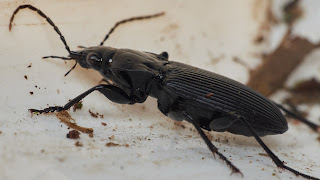
A ground beetle, Pterostichus niger;

Photograph: David Williams

A pseudoscorpion, Neobisium carcinoides;

Photograph: David Williams

A springtail, Dicyrtomina saundersi;

Photograph: Ed Phillips

An inconspicuous ladybird, Rhyzobius lophanthe;

Photograph: David Williams

 A spider, Gibbaranea gibbosa;

Photograph: David Williams

 A longhorn beetls, Pogonocherus hispidus;

Photograph: David Williams

 A Juniper shieldbug;

Photograph: David Williams

 A harvestman, Platybunus triangularis;

Photograph: David Williams

 Another springtails, Sminthurinus aureus;

Photograph: Ed Phillips

And an Orange ladybird.

Photograph: David Williams

Wednesday 26th January 2022, Harton Hollow Nature Reserve

At our third attempt we finally made it to Harton Hollow. Weather and preparations for Christmas had prevented earlier attempts. But we finally made it! An were greeted on a chilly day by a glorious blue sky and full sun. Excellent condition for a photograph of the site from the aerial tripod.

Photograph: Bob Kemp

As this has been rather a long report I will keep this part brief although I will not skimp on the photographs which, of course, provide the main interest!

We arrived; walked about looking for things of interest in the vegetation; found things of interest; identified many of them; looked at but failed to identify some others; and returned home.

What an excellent way to spend a winter’s day.

And now the important bit – the photographs.

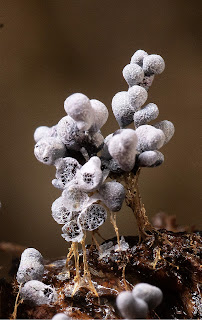
A slime mould, not yet identified. What you can see in the photograph are the fruiting bodies. 

Photograph: Bob Kemp

A weevil, Apion cruentatum.

Photograph: Emm Cane-Honeysett

Thrips – found on the trunk of a tree. Research by the photographer has revealed that they may be a member of the genus Hoplothrips.

Photograph: David Williams

And what may be their eggs.

Photograph: David Williams

Another organism, as yet unidentified, a fungus.

Photograph: Bob Kemp

Limacus maculatus, Irish yellow slug.

Photograph: Bob Kemp

A overwintering Hornet tucked up in the hole in a dead branch.

Photograph: David Willams

And finally the welcome return of the Wednesday Weevil of the Week. This week it is Ischnopterapion virens.

Photograph: Emm Cane-Honeysett

My thanks to Forestry England, Shropshire Wildlife Trust and Shropshire County Council for giving us permission to do what we enjoy doing and to the photographers for their fabulous images. My gratitude to the additional contributors of text for the report.
 

Where’s Wally

I am not aware of anyone who found Wally in the picture I posted in the previous report. Sorry it was so difficult – blame the jigsaw makers not me!
Here he is circled in yellow.


Keep well.