5 Sept 2017

Artistic lichen

Tittertstone Clee Hill - Wednesday, 30 August 2017

We went almost to the top of Shropshire when we visited this site. Only on Stiperstones and Brown Clee could we have got any higher.

The first thing that strikes you when reaching the car park is the excellent view, even in the changeable weather that greeted as we arrived.


South west from the car park
(There will be a few panoramas in this report - clicking on any of the photographs should display them in a larger window)

The second is how much of the landscape has been shaped by human activity, from the sculptured hillside as a result of quarrying to the remains of buildings.


As we surveyed the extensive quarrying we pondered what the hill would have looked like in times past.

I was "caught" in the act of taking the above photographs

Photograph: David Williams
We had two areas that we wanted to explore, one of the main quarries and the scree slope. They were in opposite directions from the car park so a decision on which way to go first had to be made. Eventually I suggested that we went to the scree slope first but found I was the only one going that way as the rest headed off to the quarry.

As I walked to catch up the others I noticed a half buried cylindrical metal thing.


Checking this I found that there was a round hole in the top and there was life inside.


I caught up the rest at the entrance to the quarry just as one of the group was pointing out something in the pool


What had he seen of such great interest?

Here it is


Can you make it out?

Here's a clue - I've highlighted the outline of the object in the water.


Yes, someone had dumped a car in the pool.

Back to wildlife! An angle shades moth was found on thistle


Although the moth is clearly visible in the photograph it is quite an effective camouflage when giving the thistle a quick glance.

The quarry is huge


Photograph: David Williams
There were plenty of things of interest such as this mottled grasshopper


Photograph: David Williams
But the star attraction was a Wall brown butterfly that made a brief appearance.


Photograph: David Williams
We lunched at the far end of the quarry then meandered our way back. On the way I was moved to take a photograph of a waxcap Hygrocybe persistens.


To take the photograph I lay prone on the quarry floor. This caused much amusement to one of our snappers who regularly gets into unusual positions to take that perfect shot.


Passing the car park we found bank that was covered in Carline thistle. The happy snapper encouraged me to take a landscape shot.

"Won't most of it be out of focus?" I asked innocently

"Set the camera to f8. That will give you the better depth of field" was the reply

"And do it as a portrait" was added

Not having a clue what 'f8' meant, but knowing it was a setting on the camera I did as instructed and here is the result.

As we walked along we were able to enjoy the view to the west and be thankful we were not under the downpour visible in the distance.


Photograph - Dave Williams
Looking back we could see how the area where the cars were parked had been moulded by quarrying activities.


At last we made it to the scree slope which was caused by and has remained intact since the last ice age. 

Amongst the bracken and gorse that had invaded the scree a single tall plant with large yellow flowers stood out.


A Perennial sow-thistle. 

We investigated the slope for some time

Excitement mounted as we found Lichenomphalia umbellifera which, I am told, is one of the very few gill fungi associated with lichen.

Photograph: Bob Kemp
Eventually most of us decided to rest, enjoy the views and the ambience of the site.


Photograph: David Williams

One advantage of a commanding view is you get advance notice of the weather. The large clouds in the far distance got nearer and darker. It was time to retreat.

On the way we came across a clearing. I had a quick look around and found a lichen on a rock that looked as though it had been painted rather than grown.


I am told this may be Porpidia macrocarpa. It forms on flat surfaces and the orange staining is caused by the iron in the rock.

On that artistic note we left just as the threatening clouds and their accompanying deluge arrived. Good timing?

My thanks to Shropshire County Council for granting us permission to survey; to David Williams and Bob Kemp for the additional photographs.


29 Aug 2017

A happy fungus

Walkmill Meadows, Market Drayton - Wednesday 23 August 2017


Photograph: Jim Cresswell
Walkmill Meadows is a long strip of grassland with patches of woodland sandwiched between houses and the sewerage works to the north and the River Tern to the south in Market Drayton.

We met in the site's car park. Unfortunately the first impression was of litter. Not the best start. As we passed through the entrance gate and the information board we then noticed a couple of reminders that this is a dog-walking area. 

(Dog-walkers - please clean up after your dog does what a dog has to do.)

At the bottom of the entrance path we crossed the main path along the site and made our way through a thin strip of trees to the bank of the River Tern. The bank was nettle infested but these together with the bordering trees provided an abundance of things for us to look at. 


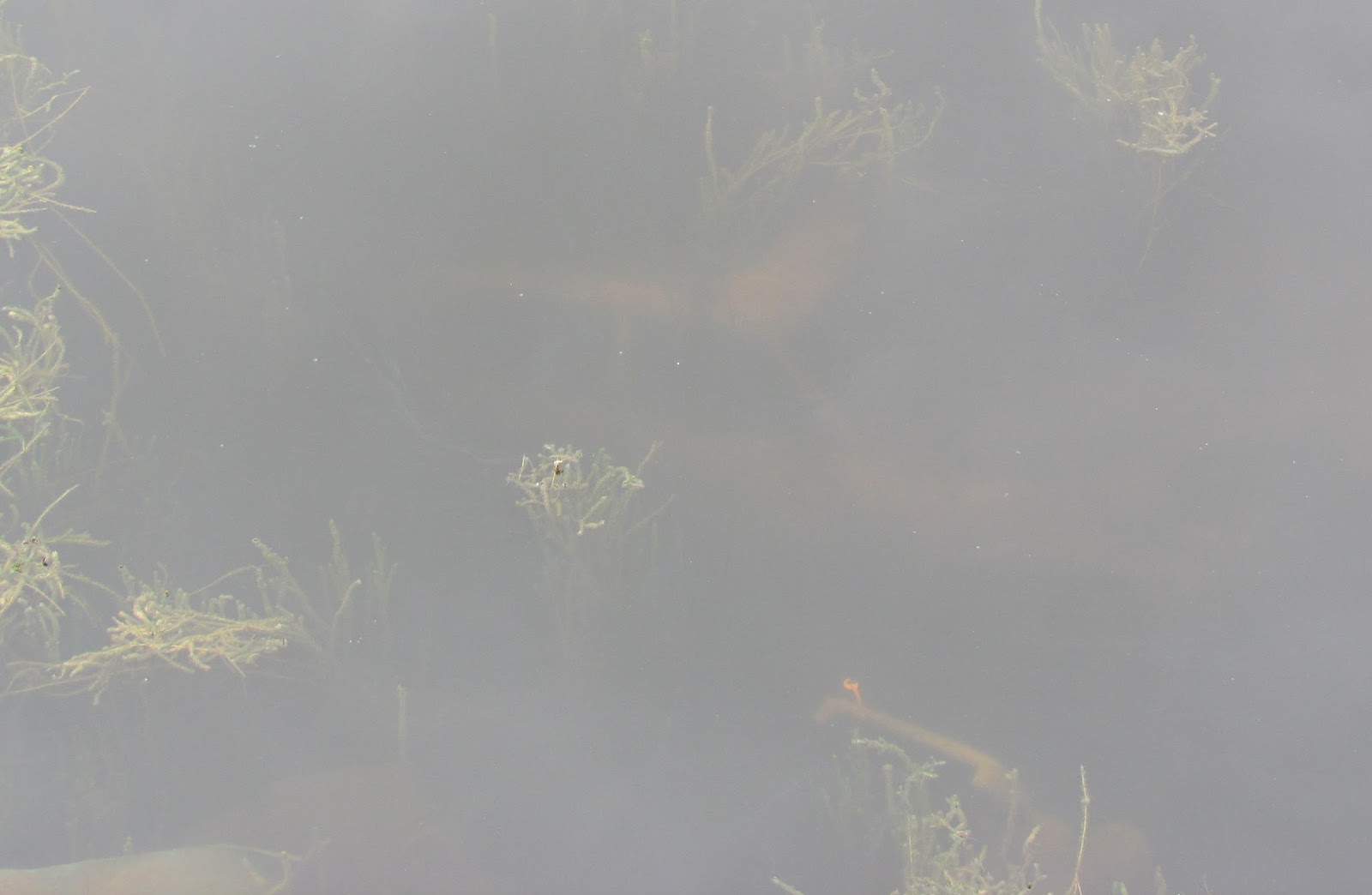
 Yes, there is a river in the above photograph! Here it is at a slightly different angle


If you look very carefully at the first photograph in the lower middle you will see some hints of an orange flower. Here is the same plant species further downstream


It is Orange balsam


In an alder bordering the spot where we stood we found the Alder tongue fungus.

Photograph: Jim Cresswell
A neighbouring sallow harboured a colony of buff tip caterpillars

Photograph: David Williams
Evidence of the caterpillars' earlier existence was found on a nearby leaf which was covered in cast-off skins.


We moved on. The site opened out into a meadow that had not been "managed" for a long time and was now home to nettle, dock, hogweed and thistles amongst other things. There were a few patches where grass could be found together with some stands of ragwort that provided late season nectar for hoverflies, bees and other insects.

Despite the "poor" quality of the grassland it provided a home for plenty of insects including many species of shieldbugs and their allies. Here is one - a dock bug, on dock.


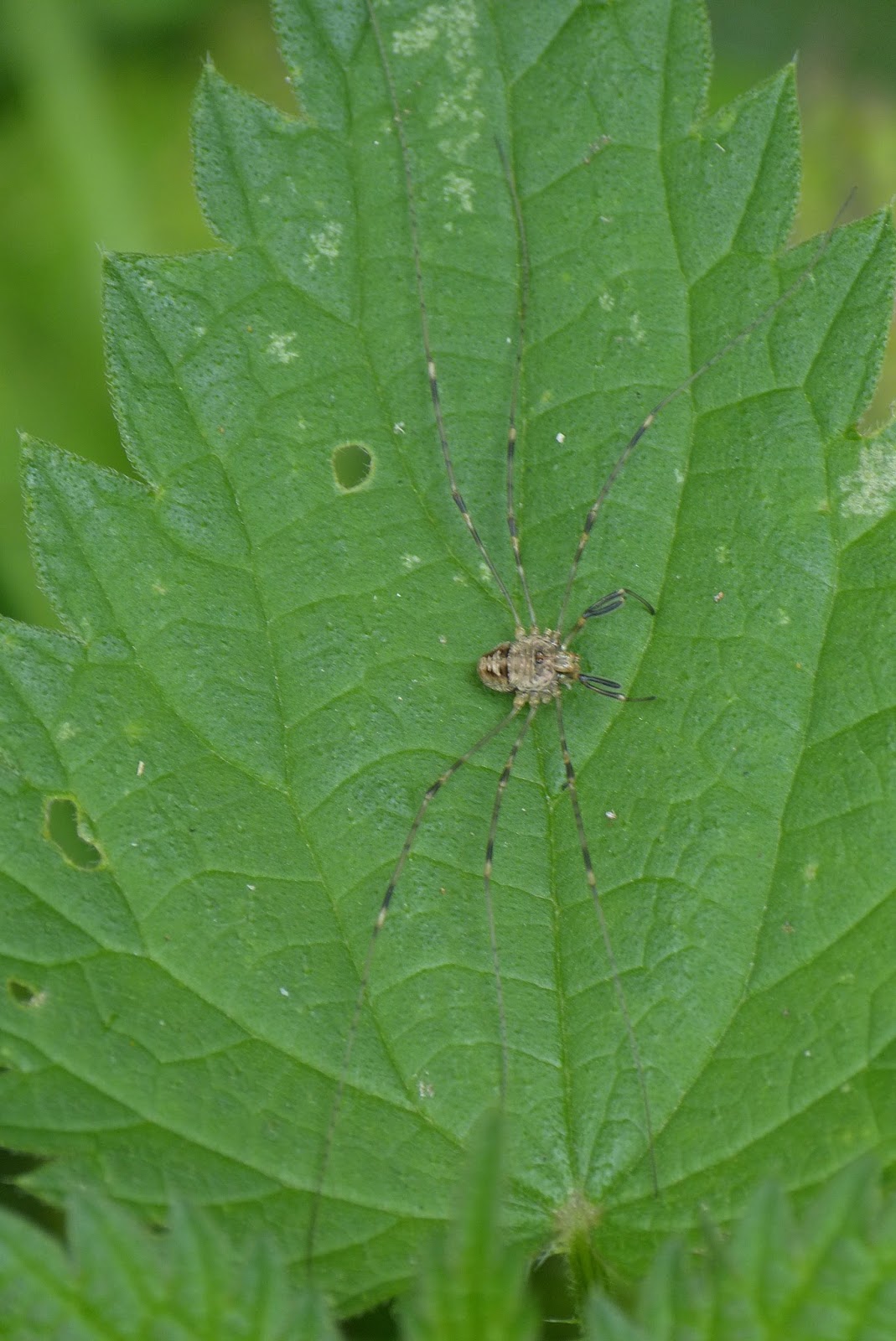
A harvestman was found clinging to a nettle leaf.

Dicranopalpus ramosus - Photograph: Jim Cresswell
A pair of the hoverfly Eristalis intricarius were also making use of a nettle.

Photograph: David Williams
We then had a rare event - we spotted a mammal. Not the just the signs of a mammal but an actual furry thing. Unfortunately Mr Mole had breathed his last

Photograph: Les Hughes
A bench was spotted and occupied - morning coffee.

Now, as you will know, morning coffee time for most is lunchtime for some, especially me. But I resisted for half an hour or so as there was plenty to look at in the grassland, then made for the bench that some morning coffee-ers were still occupying.

Amazingly it became lunch-time for everyone.

Lunch over, passing the next small area of woodland, we moved into a second meadow that looked very much like the first. Like the first it supported an abundance of life. They may not have been rare or unusual species, but they were there!

I glanced at some woundwort and to my amazement saw a couple of Woundwort shieldbug nymphs.

Photograph: David Williams
I turned around and noticed a longhorn beetle on a bindweed leaf

Leptura quadrifasciata - Photograph: David Williams
A few leaves away from the woundwort a Light brown apple moth was resting


And very close by were two dock bugs enjoying the afternoon sun. (No photograph - you have already had one today.)

Nearby the River Tern flowed on.


So, despite the apparent "poor" quality of the grassland, it was bursting with life.

We wandered past another clump of trees into the third meadow. This was very much like the others but with a slightly different, more dense, plant population that hemmed in the path. However, the river did occasionally come into view.


A common plant along this part of the river bank was Marsh woundwort.


We came to a fallen tree that blocked the path. This seemed to be a sign that it was time to turn around. We did. We backtracked and assembled around a riverside bench for afternoon tea. (We are a very civilised group.)

One of the group was carrying a stick. It turned out to be two sticks stuck together by Glue fungus


The gist of the process, as I understand it, is that the fungus present in the first stick somehow detects when another stick is resting against it. The fungus then invades the second stick for additional nutrition and creates a crust that glues the two objects together. In this state the fungus is now a happy fungus. Happy enough to produce a fruiting body as seen in the following photograph.


On that happy note we returned to our transport and made our way home passing as we did a couple more shieldbug species

Hairy shieldbug

Photograph: David Williams
And a Spiked shieldbug

Photograph: David Williams
This site is a bit of a conundrum. It cannot be said to be a site of "good" habitat, it will need a lot of careful management to achieve that, but it was brimming with life of interest to most of us.

My thanks to Shropshire County Council for granting us permission to survey and to Jim Cresswell, David Williams and Les Hughes for the additional photographs.


24 Aug 2017

A Site of Two Halves

Coppice Leasowes, Church Stretton - Wednesday, 16th August 2017

Another double-header! 

No, I have not been slow to write about the first visit.


Most of the words on Coppice Leasowes were written before the second visit, to The Hem, took place.

But as there are two visits this week I thought I would write a combined report. 


On with the first part of the report.


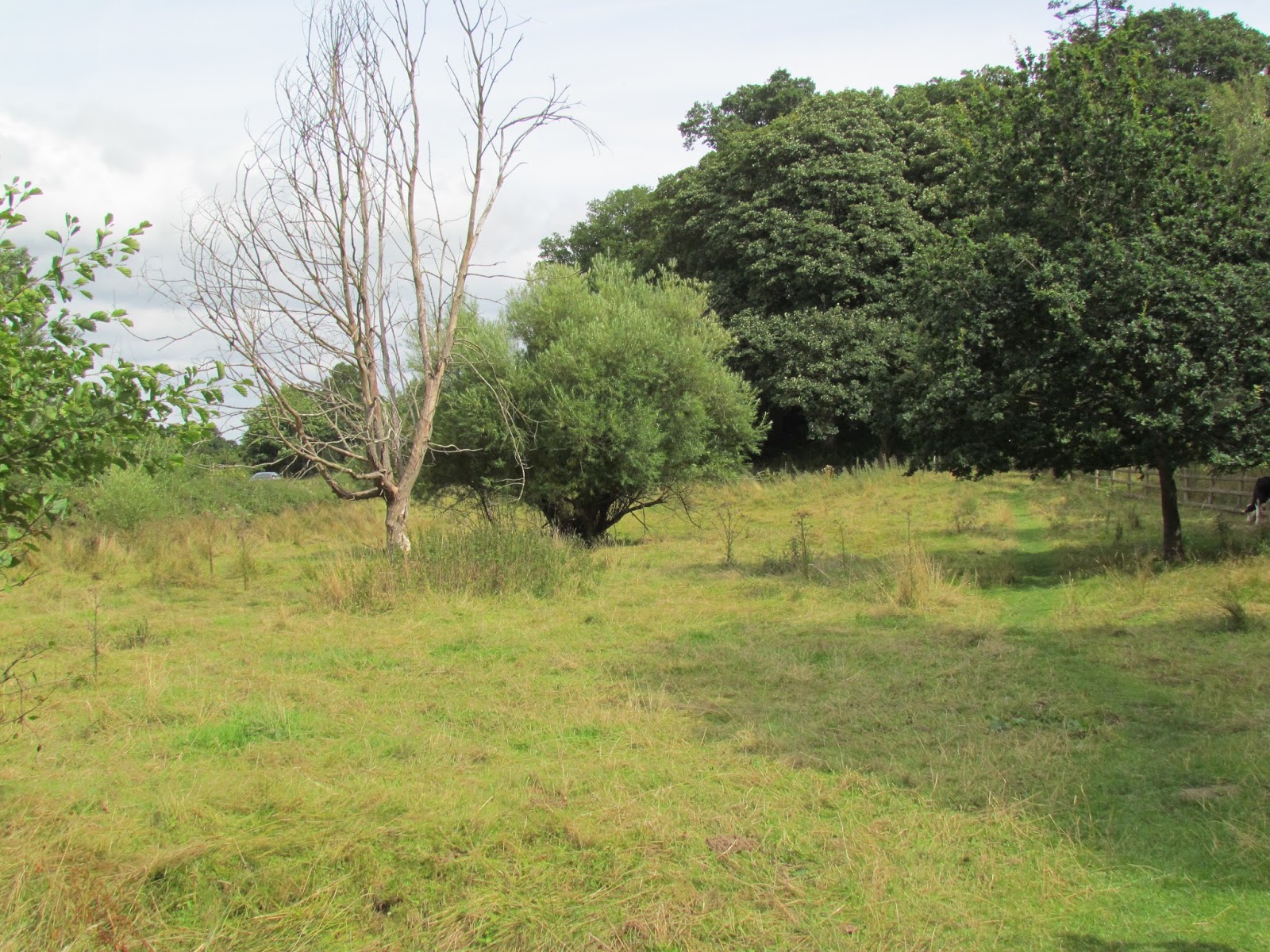
Coppice Leasowes is a site that straddles the A49 as it approaches Church Stretton from the north. On the left hand side there is an area of pasture and woodland. On the right hand side an area of grassland which is bordered on one side by a stream and the other by a ditch.


We met and parked close to the left hand half in the recently constructed housing estate off Watling Street North. When I was devising the directions to the site the online map I was using did not have a name for the street on which we parked, but I now know it is Leasowes Close.


After the usual delays in getting kitted up, including such crucial decisions as wellingtons or boots; net, tray or both, we entered the site.


The first thing to make an impression was a tree


This was identified by one of the group as possibly Metasequoia glyptostroboides (Dawn redwood). The foliage looks like anaemic yew tree leaves and is very soft.


The next things that caught my eye were three cattle settled in a rush bed. I was not expecting this - must change the risk assessment!

Apart from a brief period when I used moth-vac they were completely uninterested in our activities and got on with their own business. As we did with ours.


The grasses, plants and trees in this area did not look very exciting but they yielded a good selection of wee beasties. Certainly enough to keep most of us busy until lunchtime


Several spiders were caught, identified and photographed.

Female Araneus quadratus - Photograph: Richard Burkmar
Male Araneus quadratus - Photograph: Richard Burkmar

Female Nursery Web Spider on web - Photograph: Richard Burkmar

Female Larinioides cornutus - Photograph: Richard Burkmar

What have we here?
Photograph: Bob Kemp
I am informed that these are lacewing eggs. What a curious construction? What purpose does it serve?

I did not go into the woods as there was plenty for me to look at in the pasture but a few did, reporting that it was mainly sycamore with some oak and little ground flora. One emerged with a female Southern hawker dragonfly. 

Photograph: Bob Kemp
Lunch and where to have it was the next pressing issue. Should we go 300 yards through the wood to a designated picnic area, as advertised on the site's information leaflet, or stay we we were? 

One of the woodlanders told us that the picnic area had been re-seeded and access discouraged so we stayed where we were.

Lunch over, it was time to cross the A49. Ought we cross in a file like primary school children, or in dribs and drabs?

As I had not brought my hi-visibility vest to act as a shepherd for the school children I allowed the adults to cross under their own supervision. As it turned out the road was not very busy, so crossing it was not an issue.

The right-hand half was also grassland but with several damp, rush dominated areas, a few trees and a pool. The stream had dried up.


Like the first half plenty of insects and spiders were found so we were kept busy and time soon passed.


Photograph: Charlie Bell
A Forest bug was photographed on one of the trees.

Photograph: Bob Kemp
Sometimes it is easy to identify an animal from a photograph, but at other times it is not. The following photograph was taken on a poplar.

Photograph: Bob Kemp
It is a planthopper and planthopper's are one of my things. It looks like Populicerus confusus, which is normally found on Salix, but as this was photographed on a poplar it may be the similar looking Populicerus nitidissimus. Unfortunately I am unable to check out the features that would determine which of the two it is. Hey-ho, never mind.

Our penultimate activity was to investigate the pool and its surrounding vegetation and show some high spirits for the photographer.

Photograph: Bob Kemp
The pool proved of great interest. One find was the hoverfly Eristalinus sepulchralis. A feature of this fly is its spotty eyes.

Photograph: David Williams

Another was a Small china-mark moth

Photograph: Graham Wenman
Nearby a red admiral caterpillar was disturbed

Photograph: David Williams
In and around the pool we saw many damsel- and dragon-flies. Here are a sample


Common darter - Photograph: Jim Cresswell

Emerald damselfly - Photograph: Jim Cresswell

Female Brown hawker ovipositing - Photograph: Jim Cresswell

Common blue damselfly - Photograph: Jim Cresswell
As we observed the brown hawker laying her eggs we were treated to the sight of a common blue damselfly deciding to use her abdomen as a perch.

Photograph: David Williams
Our last activity? To re-cross the A49 to get back to the cars. Thankfully, the road was still quiet.

We may not have visited this site at its best floristically but the abundance of insects, spiders, harvestmen, etc. more than compensated.

My thanks to Church Stretton Town Council for giving us permision to survey, the Friends of Coppice Leasowes for making the arrangements and Bob Kemp, Jim Cresswell, David Williams, Richard Burkmar, Charlie Bell and Graham Wenman for the additional photographs.


The Hem, Telford - Sunday, 20 August 2017

This was our second visit to this site this year. Our first visit was in May when the spring flowers were in full bloom. This time the site was in its late summer colours with taller plants and grasses dominating.


As has become the custom we made camp in the shelter


But, unlike our recent visits the charcoal burners were not in use.


This did not mean our host was taking it easy. On the contrary, as we swanned around his site making ourselves look busy, he really was busy removing large logs of wood from where they had been cut, to his store. It looked to be hard, exhausting manual work.

An early "find" was one our host pointed out - a stinkhorn egg.


I am told these are edible - but I am not going to try.

Other fungi of interest located during the day were a bracket:

Photograph: Jim Cresswell
And a common earthball:

Photograph: Jim Cresswell
This time of year turns many persons' thoughts to fungi but it is also a peak time, to my delight, for bugs, especially shield bugs. A couple were photographed at The Hem.

Birch shieldbug - Photograph: David Williams

Forest bug - Photograph: David Williams
There were several patches of Enchanters nightshade scattered about the earliest coppiced areas. Where I see this plant I look immediately for the bug that is generally found on it. Searches are often fruitless but this time one was located - the rather elegant Metatropis rufescens, beautifully captured on this photograph.

Photograph: David Williams
One insect we have seen a lot of this year is the hornet. I do not know if this is because we are better at spotting them or they are having a particularly good year. Whatever the reason, we observed them on this visit.

Photograph: David Williams
Another character we have seen before that took us by surprise when we first saw it is a "hairy" snail. The common hairy snail species is Trochulus hispidus but there are others. The hairs normally wear off in adulthood.

Photograph: David Williams
To finish this report here is a buff ermine caterpillar posed (I suspect) on a fallen oak leaf.

Photograph: David Williams
My thanks to Mark Ecclestone for allowing us to do what we enjoy doing and also apologies to him for only watching him work so hard. Thank you also to Jim Cresswell and David Williams for allowing me to use their excellent photographs and to Mags Cousins for information about the hairy snail.