2 Jan 2014

Benthall Edge Wood Fungi Foray - 9 October 2013 - Margaret Mitchell

This post regrettably comes hot on the foot of Pete Lambert's retirement from his regular submission of his much-loved monthly Nature Notes. Best of luck for the future Pete and I know I speak for all fellow WuFuV's and followers of this blog, from all corners of the world, when I say that your fascinating articles on wildlife in and around Grimpo will be sorely missed. 

So... now we need more content to keep this blog alive and don't forget it's not just WFV members that read it - bizarrely there are now more followers in China than in the UK! So if you have anything suitably wildlife and natury (is that a word?) with or without pics, please let me have a Word file or just raw text in Notepad with pics separately and I'll get it published for all to see.

Thank you

Paul Watts

And now over to Margaret Mitchell for another very interesting post that was created following a fungus foray last October. 

Over to you Marg...

A beginners view

Our summer invertebrate challenge tetrads completed, Les suggested some fungi days instead.  Les, Steve and I attended this first foray.  We duly set off from the National Trust car park at Benthall Hall and entered the woods.  September was very dry after an already long, hot summer – Les had been praying for rain, especially as he had an event planned for the following Sunday for the National Fungi Day.


My first find was growing on dead wood, 
Turkeytail. There are many similar ones
but I think I will recognise this one now,
the most common bracket fungus.


We found many varieties of bonnet mushrooms, which are difficult to identify, and often had to record them as mycena species, but the Lilac Bonnet was quite distinctive with its pinkish-grey cap.  It can also be recognised by its smell, reminiscent of radishes.  It is poisonous and can cause hallucinations! 


In all we found about 35 different fungi, many with intriguing, colourful common names, such as Ivory Woodwax, Blushing Bracket, Wood Woollyfoot, Brown Rollrim, Golden Waxcap and Candlesnuff.

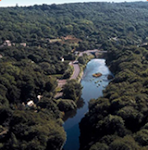
By 1 o’clock the sun had ventured from behind the clouds and we found a viewpoint overlooking the Ironbridge Gorge.  Les pointed out features of interest including his own house nestling amongst the trees on the far wooded hillside.

We climbed over a fence that bordered the public footpath and scrambled through a tunnel of trees to surprisingly find ourselves in a cavernous dell, the remains of an old quarry and mine workings.  It is now colonised by wild flowers and grasses.  Prevalent in the late summer/autumn were nodding heads of Devil’s-bit Scabious, delicate but hardy.


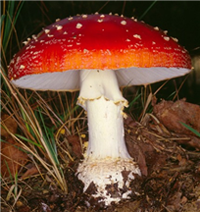
In the quarry bottom were flushes of Honey fungus with black bootlaces spreading across the field.  Then came the unusual Common Earthball, which when cut open reveals a dark spore mass at its centre.  When mature the egg will crack open to discharge the spores.

Returning through the woods we took time to find a hidden footpath, which became progressively overgrown, until we found ourselves squeezed between a fence and an encroaching thicket of hawthorn and nettles.  We finally emerged, scratched and stung, much to the surprise of some curious sheep.

Tired, scratched and happy we had survived another intrepid expedition of exciting discoveries.

Margaret Mitchell
Wrekin Forest Volunteers

24 Nov 2013

Moth Night at Coalmoor

Welcome to the first post by a new contributor and one of the most consistent members of the Wrekin Forest Volunteers in recent years - Margaret Mitchell - who, with husband Stephen, form that formidable couple endearingly known as The Bicker Twins!

So... over to you Marg...

-------------------------------------------------------------------------------------
July 5th, 2013

The weather was warm and still with wispy clouds, good conditions for a busy ‘mothing.’

We arrived at the site by 8.30 pm with plenty of time to set up our moth traps.  On previous occasions access had only been to the old coal-washing site of two small lagoons with sunny banks, fringed by surrounding trees.  But this time we were also able to explore the restored landfill site.  It was very atmospheric, if not a little scary to pass the vent where the escaping gas was being burnt, later to be seen as a deep blue plume against the night sky.  As we walked up the stony track it was strange to feel the heat emanating from the ground, warming our cheeks.

The hillside was awash with colour from wild flowers.  These included birds’ foot trefoil, buttercups, self heal, tufted vetch, common spotted orchids and most special of all, bee orchids.


Bee orchid
Photo by David Williams

The night’s catch proved to be the best this year so far.  The daytime temperature had been in the high twenties and did not fall below 14C until midnight.  There were many ‘firsts’ for this season, such as the spectacular Drinker moth. - a rich chestnut brown with a hugely thick body, a very feisty moth doing a whirling Dervish impression at the bottom of the trap.


The Drinker
Photo by Stephen Mitchell

Other highlights were Peach Blossoms with their distinct markings of cream and brown circles.  Many moths have such intriguing names conjuring up delightful mental pictures.  Pale Emerald, Brimstone Moth, Beautiful Hook-tip, Dusky Brocade and Beautiful Golden Y were all caught.

Between 11 and 12 o’clock we had over 40 moths across 30 species in one trap alone (four traps operating in all) and we were reluctant to pack away and leave this very special and remote location, impatient to visit again in what is now proving to be a great summer for British moths.

Margaret Mitchell
Wrekin Forest Volunteers


\

6 Nov 2013

Death's-head Hawkmoth

It's always exciting when an unusual record of any sort pops up and October 31st saw one of the greatest finds in the Shropshire moth world for many a year! 

A live Death's-head Hawkmoth was discovered at the Telford Ricoh plant and later formally verified by Tony Jacques who recognised it instantly as a female. It now resides at Jacques Towers where it has since given birth to a handful of eggs. Time will shortly tell whether these are fertile or not and whether we will eventually hear the patter of tiny caterpillar feet. I popped over to Tony's yesterday to take a couple of pics - it's a bit of a beast (the moth not Tony!)!


And these are a few of the eggs laid which Tony is nurturing and keeping a very close eye on... 

The Death's-head Hawkmoth is the largest moth to appear in Britain with a wingspan up to 130mm. It's a migrant that can't survive our winter and may have arrived here on the winds heading this way from southern Europe - Tony is doing some research on weather patterns around the date it was found.

The moth is rarely found in Shropshire - the previous record was September 2006 at Ellesmere and according to records I hold, there have only been 84 records since 1895, so it's a bit special.

Well done to the crew at Ricoh!

Paul Watts