2 Aug 2011

Grimpo Nature Notes from Pete Lambert

Nature Notes August 2011


I thought it was but doubted my gut reaction. The Village Shop hanging basket lush with bright flowers had a visitor, as I approached it dropped and whirled away. A few days later I received an email confirming the sighting of a Hummingbird Hawk moth in the area. This attractive moth will quite literally hover in front of flowers to feed, its wings beating so fast they make an audible hum.


I had first encountered this migrating marvel in Kent, then as now it had been attracted to an over flowing hanging basket. I was very excited by this exotic creature, I did at first think it was a humming bird my only reference material being the BBC! This very swift flying moth is actually often reported as a hummingbird. The orange brown hind-wing, together with the black and white on the abdomen sides, which are usually evident in flight, can help with identification. It is most frequently seen in the southern half of Britain and Ireland, particularly coastal counties, though the distribution maps being produced as the result of Butterfly Conservation’s survey work has revealed sightings from as far north as the eastern Scottish coast.

The full range of the Hummingbird Hawk moth extends throughout Europe, North Africa, to India, Korea and Japan. The moth is most frequently observed hovering and flitting from flower to flower, such as those of buddleia and Red Valerian, although sometimes seen flying around the eaves of houses, and examining cracks and holes in walls, possibly looking for a resting spot. The caterpillar likes to feed on Lady’s Bedstraw, Hedge Bedstraw and Wild Madder. Butterfly Conservation have been monitoring the Hummingbird Hawk moth, you can add your own sightings by going to http://www.butterfly-conservation.org/sightings/1096/humming_bird_hawk_moth.html . There are many ways to record your sightings try out the website www.naturalshropshire.org.uk for wildlife records in our area.

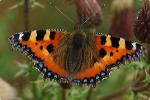
The frantic cacophony of spring has hushed now, strong sunshine along the lanes draws out the Ringlet butterflies feeding hungrily on the bramble flowers, occasionally testing out a Dog or field rose bloom. A Small Tortoiseshell butterfly having laid its eggs on the nettles at the edge of the garden now basks on the lawn. Meadow Browns and Gatekeeper butterflies enjoying the long grasses of neglected corners of our local field network. In the evening micro moths and their larger friends visit such as the Bee moth Aphomia sociella.  Bee moths are sexually dimorphic, which means that the males are more brightly coloured and patterned than the females. Like some other members of the Galleriinae tribe, the larvae feed on the comb inside bee and wasp nests. We have a set of hives in the copse close by which is worrying though the more serious pest of beehives seems to be the Wax-moths. One of a number of natural causes of concern for our endangered bee friends, though fortunately we cannot include bears in this country, well at least so far!

Despite the bits and pieces hanging in the window she had not seen it and the collision was fatal. The female blackbird possibly avoiding another danger had not been able to see the glass and now we were solemnly burying her in the corner of the garden reserved for wild or domestic animal friends at the end of their free wheeling days. Earlier that week though we had been spooked on a late evening cycle by a barn owl, very much alive, gliding across the road in front of us and very skilfully negotiating a rhododendron thicket, perching briefly before silently moving on.

Our cycling preparations were for a longer trek which took us alongside two other perching specialists, firstly a Stonechat male on the moors above Llangynog, characteristically atop a hawthorn shrub calling out to its mate. Secondly at Maesbury a Reed bunting cleverly swaying atop a flag iris leaf contemptuous of the breeze pushing him to and fro. Many birds give their names away by their behaviour; careful observation can eliminate an insecure identification in favour of the correct one. So it was that I had been given a lift home and could without endangering my usual passengers look very closely at the bird as she flew in front of us, very low swooping flight, powerful and finally a tight dive up and down the back of the hedge. The dark brown plumage and barred tail combined with this distinctive flight gave us the lovely bird of prey the Merlin. The Pied wagtail and singing Yellowhammer both enjoy characteristic calls and habits making them great birds to watch and enjoy, and finally our first Goldfinch to the table, must be the new mix in the feeders, must top them up and put on the kettle!

Happy wildlife spotting, Pete.

If you would like to share your wildlife sightings please email on petewoodman@thewoods12.fsnet.co.uk , thanks
.
.
.

27 Jul 2011

Devil’s Dingle Moth Night

 
Glow worm Devil's Dingle Moth Night 080711 009

What a great night July 8th, 2011 turned out to be!

Our second trip to Devil’s Dingle was a fine, mainly dry night with just a light breeze, the temperature dropping down to just 13.5 deg C and a light shower at around 3am - not that we really noticed that, tucked up as we were in our sleeping bags then, but come dawn we were emptying the traps and a busy time it was for the three of us who remained all night.

And if you’re wondering what the opening pic is all about - it’s not actually an eerie-looking UFO about to descend on the unsuspecting clan of moth-ers with the threat of possible abduction and integration into an alien society - oh… it’s amazing what imaginative thoughts grab you in dark and remote places very late at night!    No… it was in fact a glow worm - one of 2 we found not far from one of the traps. A search in the vicinity, however,  gave no further records but a useful addition to this wonderful Wildlife Site.

But moths we had galore. Having finally identified her last remaining specimens Liz has added 4 more species to the already impressive count giving no less than 586 individuals across 85 species.

One of Liz’s additions was this lovely micro with the equally lovely name of Aethes cnicana. We didn’t manage a pic on the night so this one comes courtesy of the UK Moths website

Aethes cnicana

We also saw Elephant Hawkmoth

Large Elephant  Hawkmoths 2 July 4 - 2009 097

Poplar Hawkmoth, Nutmeg

Poplar Hawk moth Devil's Dingle Moth Night 080711 028 Nutmeg DD 080711 004

This rather striking Beautiful Golden Y also popped into one of my traps

Beautiful Golden Y Devil's Dingle Moth Night 080711 017

And a micro that I haven’t seen before (in fact this was one of 9 moths new to me from the night). This is Nemapogon cloacella, otherwise known as the Cork Moth. The larva feed on various types of bracket fungus

216 Nemapogon cloacella, the Cork Moth Devil's Dingle 080711

Another first for me was the Brown-line Bright Eye not to be confused with the more common Bright-line Brown-eye, of course!

Brown-line Bright-eye Devil's Dingle Moth Night 080711 016

So an excellent night once again at Devil’s Dingle and my thanks go to Mary Thornton, Community Liaison Officer of the Ironbridge Power Station who kindly arranged access for the night staying with us to help set up and record in the morning.

Devil's Dingle Moth Night 080711 001

Thanks also to Tony and Andy for their records and help with ID’s, not forgetting Keith’s sheet and torch which proved to be a very worthwhile addition with a nice white sheet spread out over his cars’ bonnet proving to be an excellent way to get up close and personal to the moths of the night.

Fellow WuFuV’s Stephen and Margaret also came along and were a great help with erecting the moth pavilion, traps and generally assisting with ID’s etcetera.

Last, but by no means least, for Liz’s contribution using Les’s old trap which for some reason seems to be bringing in far better results than Les ever had! Liz puts this down to the blue handles she’s attached. As that seems to be the only modification I can only assume that’s the reason for her success!

Devil's Dingle Moth Night 080711 003

Catch up with you all soon

Paul Watts
.
.
.

29 Jun 2011

Apley Castle Moth Night June 24th, 2011

Report from Paul Watts

What a wet night last Friday was!

I think the rain started around 6pm and looked as if it was here for the night but I picked Liz and her moth-trap up at 7pm as arranged and had a brief conversation with Sean at Apley Woods on the way and I have to admit I was all set for cancelling the event. Although moths do still fly on a wet night the numbers are usually much lower and I just felt it might be prudent to postpone to another date.

However, when we arrived I discovered that Tony & Andy were already there with a trap and looking for a suitable tree canopy to set up. I had a wander around myself looking to see if it was feasible. It was still raining when I bumped into 2 people and asked if they were here for the moth night. They said yes! I later found out they were father and son Mike and Charlie here for their first moth night. A few minutes later I met a small group of umbrellas and discovered another happy band of virgin moth-ers sheltering under them.

And still it rained.

Graham arrived with his Heath Trap and more people emerged from the trees as I wandered around so I eventually decided on setting up in what I call the arena area of Apley Woods where once the grand Georgian Manor House stood. This seemed to be an ideal place to set up the traps under the trees that skirt the arena, also giving us space to set up 2 gazebo’s for shelter.

Apley Castle Moth Night 240611 021

So that’s what we did. We set up a total of 5 traps running off 2 generators.

And the rain continued.

Within an hour we were ready to go and a brief under-the-canvas intro talk by yours truly led to us switching on the generators at around 9:15pm. Olly was on hand to bring a little extra heat to the evening with a much appreciated camp-fire just outside the gazebo’s.


Apley Castle Moth Night 240611 014


Apley Castle Moth Night 240611 009

It wasn’t long before the first moth appeared - an unexpected Light Emerald that popped into Tony’s trap. This later proved to be the 2nd most trapped moth of the night.

Apley Castle Moth Night 240611 029 

And still it rained!

On a night where I thought perhaps just 3 or 4 of us might have braved the atrocious weather I was very pleased to see around 20 souls congregating in the gazebos hoping for the rain to stop. So, all things considered an excellent turn-out. No doubt, had it not been for the rain, the numbers would have easily doubled.

But… d’you know what? It was an excellent night. We sat in the dry (apart from anyone who happened to position themselves under the 9” gap between the gazebos!) telling stories and chatting, with Tony, Liz, Graham and Keith bringing in the odd moth either trapped or found venturing out to see what the lights were all about. And still it rained.

And who was the strange hooded dude who arrived complete with a very suspect light sabre? Or was it just a very bright shining lollipop?

Apley Castle Moth Night 240611 003

Was it Graham I wonder?

Apley Castle Moth Night 240611 011

What made the night even better though was the food and drink supplied by The Friends of Apley Castle. Thanks guys for looking after us all so well.

The whole event was funded by Telford & Wrekin Council’s ‘£££’s 4 Projects’. So thanks go to all, not forgetting Sean Thomas, of course, for co-ordinating everything so well.

The Wrekin Forest Moth Night at Apley Castle is always one of the highlights of the moth calendar for us and they get better every time. You see so much change here with the careful and dedicated management of the woods, pools and meadow that it can only be a matter of time before it is recognised as a true wildlife haven and receives the designation it deserves. For all who work and volunteer at Apley Woods the increase in flora and fauna shows you’re doing something right! More power to your elbows, legs and backs!

And still it rained.

By midnight most people had drifted back home and then at around 12:15am the rain finally ceased (although it returned through the night)! Shortly after the witching hour the moths started to arrive in slightly higher numbers.

A lovely Peppered Moth dropped by

Peppered Moth Garden Moths 010610 002

along with one of my favourite micro-moths - Agapeta zoegana

Agapeta zoegana Apley Castle Moth Night 240611 extras 002

A couple of Snouts also made an appearance

The Snout

along with a Clouded Silver and a Brimstone Moth

Clouded Silver Garden Moths 230610 006       Brimstone

One of the traps at around midnight

Apley Castle Moth Night 240611 018

Around 1am Liz and I retired to our tents whilst Olly tended to the dying embers of the fire. As is always the case I find it very easy to sleep under canvas drifting off within a few minutes and waking around 6am to find Liz sitting by the stoked-up and rejuvenated fire. “What are you doing?” I asked. She replied “My tent was leaking so I’ve spent most of the night out here in front of the fire!”  I think you’d better invest in that new tent Liz - your beach tent is just not up to protecting you from anything other than the sun and we didn’t see a lot of that!

We opened up the four remaining traps and were surprised to find more than what we expected with a total, including Tony’s trap which ran till around midnight, of 114 individuals across 28 species. Numbers were obviously down from previous years at Apley (800 and 400 approx) but it was more than we hoped for so a good result and an excellent night spent in convivial company and topped off with an excellent breakfast of bacon, sausage and egg butties at Rosemary and David’s. All other trappers were off to Prees Heath early in the morning to watch the Silver-studded Blues emerging so it was just Olly and me who partook of this superb feast. Thanks again you two! You’re the best!

The Top 10 moths of the night were:

Heart and Dart        35   
Light Emerald        14   
Uncertain        14   
Large Yellow Underwing    9   
Garden Grass-veneer    6
Eudonia truncicolella    6
Scoparia ambigualis    5
Peppered Moth        3   
Double Square-spot    2   
Snout            2

If you’d like a copy of the full list of moths you can download it below and if you’d like to see pics and short info of the moths you can use the search field using either the Code Number or name at UK Moths

Click here for spreadsheet:-

Excel File of Moths trapped

Before I take my leave just a quick mention of Apley Woods’ new website which is looking superb at the moment and I know Sean and his team have loads of ideas to implement which can only make it glow even more. Take a look around - there’s lots to get involved with here!

Apley Woods Website
 
Paul Watts
.
.
.